


Puccini may be the most popular of all opera composers for Taiwanese audiences, but there’s a big difference between the standing of his major works and that of his B-list.
La Boheme, Tosca, Madama Butterfly, two-thirds of Il Trittico and Turandot may be major crowd-pleasers, and indeed indisputable masterpieces too. But what about La Rondine, Edgar and Manon Lescaut? None of these get the performances the A-list so easily accumulates, and DVDs of them throw light on just why this should be the case.
One characteristic of these minor works is that they exist in less than final states, or in a version directors feel obliged to tinker with. La Rondine (The Swallow) has two different endings, and Edgar exists in both three-act and four-act versions. Manon has a final fourth act set in an American desert that the director of the production recorded here feels obliged to place instead in a Parisian underpass.
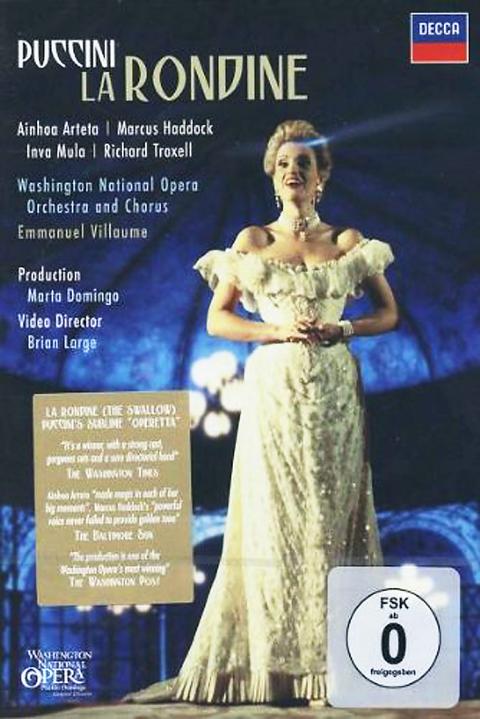
La Rondine is the one late work among the three, Edgar is very early, and Manon Lescaut was composed just before Puccini’s classic period. There’s no doubt that, of these three DVD versions, La Rondine makes for the most satisfactory experience.
The production comes from the Washington National Opera and is directed by Marta Domingo, Placido’s wife. Her version incorporates material discarded (and never orchestrated) by Puccini, plus an ending he authorized in 1920, perhaps after sensing that the usual conclusion wasn’t working as well as he’d hoped.
The story concerns a courtesan, Magda, who is being kept by the rich Rambaldo but falls in love with the poor Ruggero. (This, as we will see, is a strangely similar scenario to that of Manon Lescaut). She eventually leaves Rambaldo to live by the ocean with Ruggero. Rambaldo shows up, however, and Ruggero leaves Magda in disgust — he thinks she’s accepted money from him — and she walks into the water (in this version) in a rather hastily executed suicide.
Whatever the virtues or otherwise of this reconceptualization, the production is absolutely magnificent. The staging is fabulous — colorful, lavish wherever the plot permits, and exceptionally well-suited to this operetta-like score. The celebrated video director Brian Large ensures that these qualities are transferred in full onto DVD.
All the soloists rise to the occasion. Most impressive is Marcus Haddock as Ruggero, but Ainhoa Arteta as Magda is also outstanding, as are Richard Troxell (the Pinkerton on the fine DVD of Madama Butterfly directed by Frederick Mitterand), Inva Mula and William Parcher as Prunier, Lisette and Rambaldo respectively.
La Rondine doesn’t reach the heights of Puccini’s finest operas but, in this version at least, it certainly has plenty going for it.

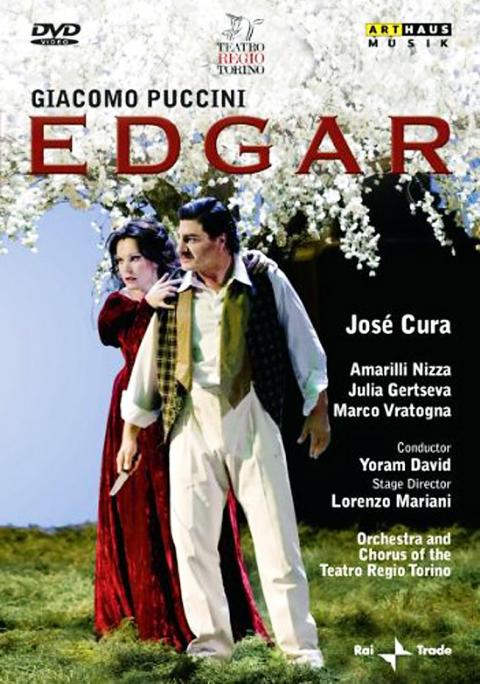
The same, unfortunately, can’t be said of Edgar, Puccini’s youthful failure. Jose Cura is certainly a big name, and might have proved the salvation of the Teatro Regio Torino production issued by ArtHaus. But, sad to say, nothing can save Edgar.
The story features a young man torn between a conventionally virtuous woman, Fidelia, and a sensual gypsy, Tigrana. The plot is extremely drawn-out, with Edgar setting fire to a house, joining the army, and feigning death in battle, while all the time offering tantalizing foretastes of Mascagni’s far shorter, far more melodic, and infinitely more dramatic Cavalleria Rusticana (Rustic Chivalry), one of opera’s greatest short masterpieces.
Once again high claims are made for the particular version of the opera used. It’s the world premiere of Puccini’s four-act version, we’re told. But one of the many problems with Edgar is that it’s already too long. The last thing it needs is another act.
But if you must experience Edgar with all its imperfections on its head this DVD can at least be said to have a star in Cura, and a very fine singer, Julia Gertseva, in the role of Tigrana.
Manon Lescaut is the most often performed of these B-list works — the Taipei Symphony Orchestra staged it in Taipei’s Metropolitan Hall last year, for instance. The DVD featuring a Chemnitz Opera House production, however, leaves something to be desired.
The production is set in the 1920s, which proves effective enough. Less eye-catching is the placing of the final act on a modern Parisian superhighway instead of in a US desert, a decision that involves the two lovers being made to avoid getting on board a transatlantic liner at the end of the previous act. But what’s wrong with a desert? Manon is supposed to die of thirst after her lover, Des Grieux, fails to find any water — credible in a desert, even an American one, but hardly very likely in the middle of Paris.
The soloists — Astrid Weber as Manon, Zurab Zurabishvili as Des Grieux — are perfectly effective, and indeed would be fine in a more credible production. As it is, conductor Frank Beerman’s assertion in a bonus track that this is the most complex of all Puccini’s operas, and admirably avoids “grand kitsch,” feels somehow irrelevant to the general impression conveyed when watching it.

This is the year that the demographic crisis will begin to impact people’s lives. This will create pressures on treatment and hiring of foreigners. Regardless of whatever technological breakthroughs happen, the real value will come from digesting and productively applying existing technologies in new and creative ways. INTRODUCING BASIC SERVICES BREAKDOWNS At some point soon, we will begin to witness a breakdown in basic services. Initially, it will be limited and sporadic, but the frequency and newsworthiness of the incidents will only continue to accelerate dramatically in the coming years. Here in central Taiwan, many basic services are severely understaffed, and

It is a soulful folk song, filled with feeling and history: A love-stricken young man tells God about his hopes and dreams of happiness. Generations of Uighurs, the Turkic ethnic minority in China’s Xinjiang region, have played it at parties and weddings. But today, if they download it, play it or share it online, they risk ending up in prison. Besh pede, a popular Uighur folk ballad, is among dozens of Uighur-language songs that have been deemed “problematic” by Xinjiang authorities, according to a recording of a meeting held by police and other local officials in the historic city of Kashgar in

Jan. 5 to Jan. 11 Of the more than 3,000km of sugar railway that once criss-crossed central and southern Taiwan, just 16.1km remain in operation today. By the time Dafydd Fell began photographing the network in earnest in 1994, it was already well past its heyday. The system had been significantly cut back, leaving behind abandoned stations, rusting rolling stock and crumbling facilities. This reduction continued during the five years of his documentation, adding urgency to his task. As passenger services had already ceased by then, Fell had to wait for the sugarcane harvest season each year, which typically ran from

The People’s Republic of China (PRC) was out in force in the Taiwan Strait this week, threatening Taiwan with live-fire exercises, aircraft incursions and tedious claims to ownership. The reaction to the PRC’s blockade and decapitation strike exercises offer numerous lessons, if only we are willing to be taught. Reading the commentary on PRC behavior is like reading Bible interpretation across a range of Christian denominations: the text is recast to mean what the interpreter wants it to mean. Many PRC believers contended that the drills, obviously scheduled in advance, were aimed at the recent arms offer to Taiwan by the


 RSS
RSS