


Letters to Juliet represents an interesting paradox: it is a movie that is very nearly perfect without being especially good. Directed by Gary Winick from a script by Jose Rivera and Tim Sullivan, the film fulfills every one of its ambitions with the same kind of brisk efficiency that its heroine brings to her job of magazine fact-checking. But its goals are so modest, so tiny, so timid that fulfillment is exactly what it does not provide. No hard feelings are risked, no feathers of audience sensitivity are ruffled, and as a result no memorable lines are uttered, no startling scenes unfold, and no character emerges toward whom you feel anything more than tepid good will.
The people in tragedies, according to Aristotle, are better than the rest of us, while the people in comedies are worse. In a certain kind of modern comic romance, though, the two primary stipulations are that the main characters be better-looking and duller than the audience, which produces a self-canceling wash of emotions. No cathartic tears or therapeutic laughter, but instead a mild, smiley stupefaction. Look at how pretty Italy is! And how pretty Amanda Seyfried is! She’s drinking a glass of wine. I’ll bet that tastes good. Isn’t that fellow handsome? Doesn’t that old lady look sad? A wedding, how nice!
Actually, the old lady — her name is Claire, and she’s played by the effortlessly marvelous Vanessa Redgrave — looks amused, baffled, occasionally stricken and, in general, blithely indulgent toward the slick, artificial story unfolding around her. Claire, who alights in Verona in search of a long-lost love, does not have much to do or say, but Redgrave, cooing and sighing and exchanging knowing looks with Seyfried, imparts grace, authenticity and a sense of emotional gravity to a movie desperate for all of those things and unsure just how to manufacture them.
Seyfried’s character, Sophie — who checks facts at a version of The New Yorker edited by Oliver Platt from an office with a view of the Brooklyn Bridge — arrives in Verona on a prenuptial kind-of-honeymoon with her fiance, Victor (Gael Garcia Bernal).
Sophie and Victor are passionate young people, but just not about each other. She wants to write, he’s about to open a restaurant, and their blissful Italian sojourn turns into a model of the stressed-out, competitive metropolitan marriage that would surely follow. (Not that there’s any real danger of that.) They chat and text each other, but mostly go their separate ways — “win-win,” as Victor puts it — he to hunt down culinary delicacies, she to chase after a story that turns out to be Claire’s.
First, though, Sophie happens upon a group of Italian women known as Juliet’s secretaries, who gather the letters that lovelorn ladies from around the world have tucked between the stones of a wall under the most famous balcony in Verona, opening their hearts to love’s great martyr. Each petitioner receives a reply, and Sophie decides to answer a melancholy note that has been languishing there for half a century. Its author was Claire, a British exchange student who was supposed to meet a local beau named Lorenzo, but then succumbed to cold feet and went back to England.
Now, lured by the response that Sophie has written, Claire is back in Verona, along with a handsome blond grandson named Charlie (Christopher Egan, basically Ryan Phillippe with some of Hugh Grant’s mannerisms), whose instant detestation of Sophie is the first sign of impending love. Claire is determined to find her Lorenzo, and she, Charlie and Sophie set out on a meandering and picturesque road trip, encountering a series of codgers named Lorenzo, each of which would be happy to be the right one.
For much of its running time, Letters to Juliet is content to provide touristic evidence that Italy exists: hillsides bathed in golden light; steep and stony little towns; tile roofs and gently sloping vineyards. The human scenery suggests that time stopped sometime after Shakespeare but long before Berlusconi, and that Italy’s authentic cultural role is as a colorful background for Anglophone romance.
That conceit worked reasonably well for Henry James and E.M. Forster, whose august shadows occasionally fall over this sunny and superficial trifle. Seyfried shows some of the charm and verve of those authors’ expatriate heroines, and it is hard not to root for Sophie’s happiness, even as the film carefully spares her the risk of serious heartache.
Letters to Juliet is the fourth movie Seyfried has appeared in this year, and it, along with the romantic weepie Dear John, is likely to consolidate her position as a certified movie star. And while she has yet to perform a feat of bravura big-screen acting (her best work is still on the HBO series Big Love), her combination of stubbornness, vulnerability and practical good sense makes her appealing to just about any imaginable audience. She is to the verge of tears what Kristen Stewart is to the bitten lip: a virtuoso of barely restrained and tantalizingly ambiguous emotion.
Which makes her, like Redgrave, a little more interesting than the movie she’s in. It’s not that Letters to Juliet is bad. If you want a bad romantic comedy, I can give you a long list. But being able to like a movie of this kind is a form of disappointment, since what you want — what you are promised — is love.


The US war on Iran has illuminated the deep interdependence of Asia on flows of oil and related items as raw materials that become the basis of modern human civilization. Australians and New Zealanders had a wake up call. The crisis also emphasizes how the Philippines is a swatch of islands linked by jet fuel. These revelations have deep implications for an invasion of Taiwan. Much of the commentary on the Taiwan scenario has looked at the disruptions to world trade, which will be in the trillions. However, the Iran war offers additional specific lessons for a Taiwan scenario. An insightful
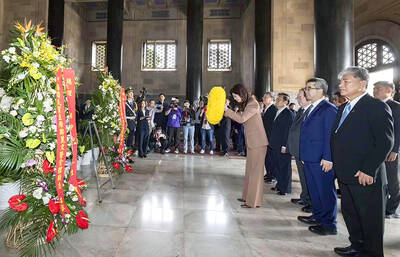
The problem with Marx’s famous remark that history repeats itself, first as tragedy, the second time as farce, is that the first time is usually farce as well. This week Chinese Nationalist Party (KMT) Chair Cheng Li-wun (鄭麗文) made a pilgrimage to the People’s Republic of China (PRC) “to confer, converse and otherwise hob-nob” with Chinese Communist Party (CCP) officials. The visit was an instant international media hit, with major media reporting almost entirely shorn of context. “Taiwan’s main opposition leader landed in China Tuesday for a rare visit aimed at cross-strait ‘peace’”, crowed Agence-France Presse (AFP) from Shanghai. Rare!

Polling data often confirms what we expect, but sometimes it throws up surprises. When examined over time, some patterns appear that speak to something bigger going on. In this column, whenever possible, Formosa’s polls are used. Despite the sometimes cringeworthy antics of Formosa’s Chairman, Wu Tzu-Chia (吳子嘉), the data produced includes detailed breakdowns crucial for analysis. It has also been conducted monthly 11-12 times a year for many years with many of the same questions, allowing for analysis over time. When big shifts do occur between one month and the next it is usually in response to some event in

April 6 to April 13 Few expected a Japanese manga adaptation featuring four tall, long-haired heartthrobs and a plucky heroine to transform Taiwan’s television industry. But Meteor Garden (流星花園) took the nation by storm after premiering on April 12, 2001, single-handedly creating the “idol drama” (偶像劇) craze that captivated young viewers across Asia. The show was so successful that Japan produced its own remake in 2005, followed by South Korea, China and Thailand. Other channels quickly followed suit, with more than 50 such shows appearing over the following two years. Departing from the melodramatic


 RSS
RSS