


A wooden sign at a remote beach in Central California is carved with the words "dangerous surf." That is why, on the first weekend in December each year, surf kayakers descend on Jalama Beach. In their tiny boats, they are hoping to ride big waves kicked up by winter storms.
Say "surfing" and "California" and most people picture a tanned young man in board shorts standing on a surfboard. Kayak surfers don helmets and neoprene tops, and stuff themselves into what look like short river kayaks, but with a flat, surfboard-like bottom and fins.
Using a double-ended paddle for power, surf kayakers launch from the beach and watch the breaking waves, timing their entry so they can punch through a smaller wave.
Wedged in tightly for maximum control, the kayak surfers cannot jump off when they wipe out or easily duck-dive under a big wave like a board surfer. They have to ride out a mistake upside down, with their heads in the water like keels in the surging whitewater, until they can Eskimo roll back upright.
"You have to stay calm and accept the beating," said Rusty Sage, a member of the US West Coast kayak surfing team that won the world championship in Costa Rica last year. Sage is also a former national champion freestyle river kayaker. Because whitewater for kayakers is in limited supply in Southern California, many river kayakers cross-train in the surf.
When things go right in the surf, it is a rush like no other. A few quick paddle strokes match your speed to the hurrying wave, you plunge down the steep face and make a bottom turn that sends you shooting along the curl.
"The feeling when you catch a big wave can't be duplicated in life," Sage, 25, of Reno, Nevada, said in a telephone interview. "You come off with a scream of pure excitement."
While the screams were more muted this year at Jalama — the waves were not as monstrous as in previous years and fewer kayakers showed up, about 30 — the mornings produced 24m glassy waves that delighted the kayak surfers, who shared some waves with a pair of dolphins.
"Dolphins like to have fun," said Erik Miller, 44, a US West team member from Idaho. "Dolphins are my favorite people to surf with."
Along with the dolphins, some of the best surf kayakers in the country often show up at Jalama.
Randy Phillips, 52, a local and a kayak designer who some consider to be the godfather of kayak surfing, has been organizing the event he calls the Jalama Expression Session for 11 years. He said it was modeled after get-togethers that board surfers had in the 1960s to show off their moves without the pressure of competition.
"There are no fees, no judges, it's just a gathering," Phillips said.
Jalama also attracts what he called "the brain trust" of kayak design. Because surf kayaking is such a niche sport, there are only a handful of surfboat manufacturers, and most come to Jalama to show off their latest designs.
Modern surf kayaks are hand-built using light and strong carbon-Kevlar composite materials. Phillips' designs are handmade in England. The kayaks have pockets in their flat surfboard-like bottoms that allow kayakers to add and adjust the position of plastic fins. The fins help the boats track in the water and maintain speed on a wave.
While surf kayaks have borrowed terminology and design elements from surfboards, that does not mean board surfers always see sit-in-a-boat surfers as kin. Some call kayak surfers "butt-surfers" and yell "stand up" when they see them on a wave. At California's more crowded surf breaks, animosity toward kayak surfers is not uncommon.
"The majority of board surfers don't like to be around their own kind, so how could you expect them to accept another form of surfing?" Phillips said.
But the vibe at Jalama, a remote, curving, sun-soaked beach, is laid-back and friendly. Amtrak's Coast Starlight train rumbles by over a steel trestle and palm trees provide a bit of shade. Jalama is the only public beach on 61km of coastline.
"There is a place for everybody," said Don Kline, a surfer from Valencia, California.
Phillips said his philosophy was, "Give a wave, make a friend." With powerful paddle strokes, surf kayakers can catch waves that board surfers cannot and can surf in more adverse conditions. So Phillips advocates letting board surfers catch a wave first, and letting them have the easier-to-catch waves.
"It's all about sharing the stoke and sharing the waves," he said.
It is also about observing the unwritten but rigid etiquette of surfing, or as some call them, "the rules of engagement." For example, the surfer closest to the peak of the wave owns the wave, and others need to get out of the way. Snaking — trying to get in front of a surfer near the peak of a wave — is a no-no.
On a Saturday night at the Jalama Expression Session, Phillips set out barbequed tri-tip sirloin and chicken, chili beans, salad and garlic bread. A cooler filled with margaritas stirred with a broken paddle is another tradition. After the sun set, the kayakers watched video of the day's exploits and carnage projected on a portable screen, yelling and laughing.
At dawn the next morning, the kayakers paddle out through the pounding surf, and sit patiently beyond the breakers, waiting for that one perfect wave.

Taiwan’s English education system is being pulled apart by three opposing forces. Bilingual Nation 2030 pulls students toward English and global communication. Artificial Intelligence (AI) readiness pulls them toward digital judgment, verification and AI-mediated work. But Taiwan’s old exam culture pulls them back toward memorization, grammar drills, timed reading and correct answers. If the education system keeps using old exams to define success, it risks producing graduates who are neither genuinely bilingual nor genuinely AI-ready, but trained for tasks machines can already perform. The first force is Bilingual Nation 2030. Launched in 2018, the policy aimed to “help Taiwan’s workforce connect

It seems every few days one bumps into one of those “real man” comments in which Taiwan is urged to “face reality” or similar, and “make a deal,” with the speaker implying that soon it will be too late. “Deal” advocates always present themselves as having a superior grip on reality, and the manly ability to make the “hard choice.” Their testosterone-laden language often echoes that of Taiwan sellout advocates. Note that such commentary always specifies a process (“make a deal, work with, make progress”), never the end state of what occupation by a violent authoritarian colonialist state will entail. In
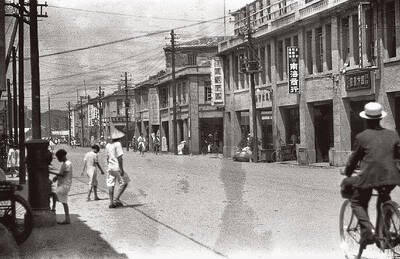
June 1 to June 7 "If all Taiwanese were as afraid of dying as you, then what would happen?” Physician Shih Chiang-nan (施江南) reportedly said this to his wife Chen Chiao-tung (陳焦桐) after she urged him to stop intervening on behalf of Taiwanese soldiers stranded overseas after serving in the Japanese Army during World War II. Shih had clashed with high-ranking officials over the issue, engaged in several heated arguments with Taiwan governor-general Chen Yi (陳儀) and allegedly shouted at general Ko Yuan-fen (柯遠芬), chief of staff of the Taiwan Garrison Command, over

“Taiwan’s Opposition Leader Comes to US With a Message Straight Out of Beijing” read a May 31 headline in the Wall Street Journal. Top US administration officials and members of Congress almost certainly read the WSJ, and if there was a bullet point takeaway that people in Washington should absorb ahead of Chinese Nationalist Party (KMT) Chair Cheng Li-wun’s (鄭麗文) arrival in DC on June 9, that headline is it. The last few columns have discussed this very topic, and the timing is not coincidental. While those top officials likely do not read the Taipei Times, judging by the number


 RSS
RSS