


Agroup of 20-somethings work intensively in their Tianmu (天母) flat preparing the first play to be put out by the theater company Lee Qingzhao the Private (李清照私人劇團). The self-funded theater commune has residents proficient in dancing, script writing, directing and costume design, and the members have all set out to impress with unrestrained vitality and creativity.
Founded half a year ago by two young poets Yuguo (魚果) and Liu Liang-yen (劉亮延), the company takes its name from the female poet of the Sung Dynasty. Its first play takes as its point of departure the serpent figure of Bai Suzhen (白素貞) from the Tale of the White Snake(白蛇傳). The style it has chosen is that of kabuki.
A traditional Japanese form of theater originating in the Edo period, kabuki has its roots in the popular culture of the townspeople. The choice of the form echoes the spirit of the young group, which portrays the lives of ordinary folk drawn from classical Chinese literature.
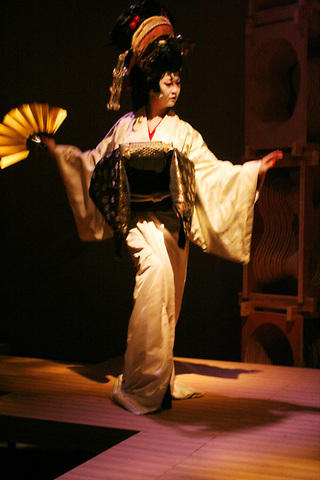
PHOTO COURTESY OF THEATER COMPANY OF LEE QING ZHAO THE PRIVATE
“We are named after Lee Qingzhao because she is the representative figure in classical Chinese literature who roams freely between folk art and the refined. As readers, we find Zhao's language full of surprises. She takes us to different realms and offers alternative ways of sensing and feeling. We hope that our plays are encounters that surprise the audience,” Liu said.
Using the disguise of kabuki dance, Liu's Bai Suzhen is a stunning mix-and-match dance piece. It is performed by young yet experienced Jasmine Wang (王世緯) accompanied by live piano and percussion sounds and erotic chanting by Yuguo. Wang spent three months learning kabuki dance and is also a professionally trained Butoh dancer. In this performance, she had to overcome the challenge of dancing in many layers of costumes weighing more than 10kg.
The off-stage chanting is worth an independent introduction of its own. Mixing traditional Japanese dance music and the Frensh impressionism of Debussy, gifted young poet Yuguo puts his creative input into Liu's modern poetry and transforms it into a sultry psalm of the serpent, using the sounds of various Taiwanese dialects. When asked how he defines his music, Yuguo said, “let's just say it's a form of personal expression.”
Like Liu's most recent acclaimed play about Cao Chi-chiao (曹七巧), a melancholic rereading of Eileen Chang's (張愛玲) The Golden Cangue (金鎖記) in the form of Peking opera, Bai Suzhen is a monologue from a twisted female character whose craziness is magnified through layers of repetitions.
Making references to the Chinese classic and a kabuki theater piece called Dojiji, both of which share similar imagery of snakes, women, shrines and hatred, the play is not a faithful adaptation of the classic but is intended to raise the question of “who is reading it.”
“Our use of the text doesn't make this an adaptation. Take The Golden Cangue, for example. To present such a sensual novel, you can't simply retell the story. You need to bring out what you think is the essence of the text. The return is to the reader who has something to say,” Yuguo said.
What Liu and Yuguo try to say about the literary revision is that it is in the nature of a constant becoming: a snake trying to become a women and vice versa — a figure caught in between two contexts and the authenticity of identity.
The play also mirrors the formation of the company. “[The character] Bai Suzhen cannot be defined in words. She is always on the road but does not know where to go. We are like her. We are not theater professionals but still want to put on a play because there is a possibility of becoming,” Liu said.

By global standards, the traffic congestion that afflicts Taiwan’s urban areas isn’t horrific. But nor is it something the country can be proud of. According to TomTom, a Dutch developer of location and navigation technologies, last year Taiwan was the sixth most congested country in Asia. Of the 492 towns and cities included in its rankings last year, Taipei was the 74th most congested. Taoyuan ranked 105th, while Hsinchu County (121st), Taichung (142nd), Tainan (173rd), New Taipei City (227th), Kaohsiung (241st) and Keelung (302nd) also featured on the list. Four Japanese cities have slower traffic than Taipei. (Seoul, which has some
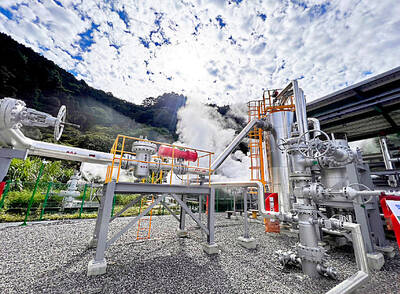
Taiwan’s semiconductor industry consumes electricity at rates that would strain most national grids. Taiwan Semiconductor Manufacturing Co (TSMC) alone accounted for more than 9 percent, or 2,590 megawatts (MW), of the nation’s power demand last year. The factories that produce chips for the world’s phones and servers run around the clock. They cannot tolerate blackouts. Yet Taiwan imports 97 percent of its energy, with liquefied natural gas reserves measured in days. Underground, Taiwan has options. Studies from National Taiwan University estimate recoverable geothermal resources at more than 33,000 MW. Current installed capacity stands below 10 MW. OBSTACLES Despite Taiwan’s significant geothermal potential, the

In our discussions of tourism in Taiwan we often criticize the government’s addiction to promoting food and shopping, while ignoring Taiwan’s underdeveloped trekking and adventure travel opportunities. This discussion, however, is decidedly land-focused. When was the last time a port entered into it? Last week I encountered journalist and travel writer Cameron Dueck, who had sailed to Taiwan in 2023-24, and was full of tales. Like everyone who visits, he and his partner Fiona Ching loved our island nation and had nothing but wonderful experiences on land. But he had little positive to say about the way Taiwan has organized its
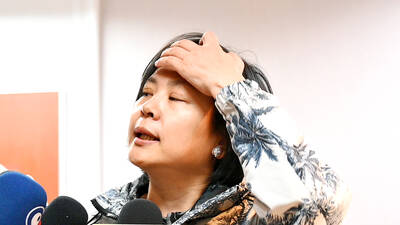
The entire Li Zhenxiu (李貞秀) saga has been an ugly, complicated mess. Born in China’s Hunan Province, she moved to work in Shenzhen, where she met her future Taiwanese husband. Most accounts have her arriving in Taiwan and marrying somewhere between 1993 and 1999. She built a successful career in Taiwan in the tech industry before founding her own company. She also served in high-ranking positions on various environmentally-focused tech associations. She says she was inspired by the founding of the Taiwan People’s Party (TPP) in 2019 by Ko Wen-je (柯文哲), and began volunteering for the party soon after. Ko


 RSS
RSS