


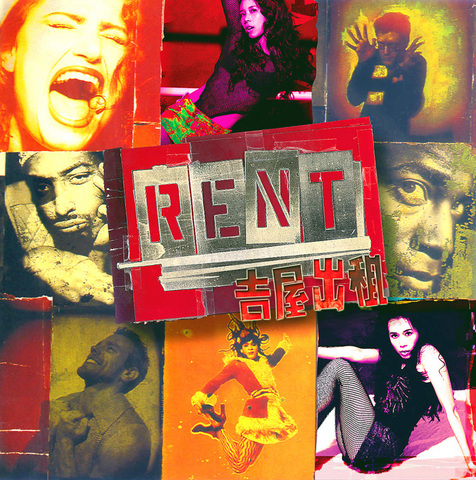
The 10 year-old musical Rent has gained a new lease on life and is now touring Asia. It will tack up a sign and take to the stage of the International Convention Center on Feb. 7 through Feb. 12.
Based on Giacomo Puccini's 1896 opera, La Boheme, Rent tells of one year in the life a group of friends living a Bohemian life in New York's East Village in 1990, struggling to succeed as artists, haunted by the specter of HIV, ravaged and rewarded by their relationships, and of course trying hard to pay the rent.
"Five hundred twenty-five thousand six hundred minutes," are Rent's opening lines. "How do you measure, measure a year? In daylights, in sunsets, in midnights in cups of coffee. In inches, in miles in laughter in strife. In five hundred twenty-five thousand six hundred minutes. How do you measure a year in the life?"

PHOTOS COURTESY OF BROKER BROTHERS
For the show's co-creator, Jonathan Larson, the answer was to "measure it in love ... seasons of love."
In 1989, he teamed up with playwright Billy Aronson and wrote the music and lyrics for the show. Originally set in New York's Upper West Side, Aronson moved the action to New York's downtown area, where Larson himself lived. From there, the story began to more closely reflect Larson's own life, where he and friends kept an apartment in a derelict building with only an illegal wood-burning stove -- and each other's company -- to keep warm.
Like the show's lead character, the filmmaker Mark, Larson had an on-again, off-again relationship with a dancer who ultimately left him for a woman. His own roommate became the inspiration for Mark's roommate, the HIV-positive musician and former junkie Roger. Larson's childhood friend became the inspiration for Angel, Rent's HIV-positive drag queen street musician.
Other characters that round out the script tell of the turmoil in the lives of a generation of artists confronted with HIV: Angel's boyfriend is a computer whiz who is also living with HIV. Roger's girlfriend, Mimi, is also an HIV-positive drug addict S&M dancer. And Taye is the group's former friend who married for money and became their landlord and the anti-thesis of everything they held dear.
For the Asian touring company, many of these roles will be played by members of the original Broadway cast, putting to rest the notion that Taiwan gets only third-rate production
companies.
The show's Broadway alumni Jeremy Kushnier, John Eric Parker, Trey Ellet, Danielle Lee Greaves, Andy Senor and Caren Lyn Manuel are all reprising their original roles.
But for local audiences, the biggest draw may well be Karen Mok (莫文蔚) playing the drug addicted S&M dancer Mimi. Reviews of the show's dates in Singapore, Hong Kong, Beijing and Shanghai have focused largely on Mok's performance, calling it everything from solid to outstanding, and getting better with each show date.
Mok had only two weeks' preperation time and four rehearsals with the cast before the Singapore premiere.
Like many of the characters in the heart-wrenching story, Larson's own life came to a tragic end. After struggling with the show through years of workshops and rewrites, Larson died of an aortic aneurysm the night before Rent's off-Broadway premiere. He was 35.
Following rave reviews, the show moved to the Nedelander Theater on Broadway. It opened 10 years ago this coming April and went on to earn four Tony awards, including Best Musical, Best Book of a Musical and Best Score of a Musical, as well as the New York Drama Critics' Circle Award for Best Musical. It also earned Larson a posthumous Pulitzer Prize for Drama.
For your information :
WHAT: Rent, starring the show's Broadway cast and Karen Mok
WHERE: The International Convention Center, in Taipei (
WHEN: From Feb. 7 to Feb. 12
TICKETS: Available now through the ERA Ticketing system, tickets cost between NT$1,000 and NT$6,000.
Call (02) 2341 9898 for details.

Ajay Verma, a consultant gastroenterologist at Kettering general hospital in Northamptonshire, says our gut is a “complex machine.” “It is constantly providing us with the nutrition we need, initially to grow and develop, and then for us to survive, thrive and repair from injury and illness.” How can we keep it functioning well? Put simply: “Make sure what you put into it is balanced, and that you clear out its waste products adequately,” Verma says. “In a general gastroenterology clinic, the most common conditions we see are irritable bowel syndrome (IBS), gastroesophageal reflux disease, inflammatory bowel disease and constipation,” says Nisha

And so, in the wake of US President Donald Trump’s trip to the People’s Republic of China (PRC), all the experts on the Strait of Hormuz suddenly became experts on US-China-Taiwan relations. The Internet has certainly expanded human knowledge. Lots of these sudden experts made noise this week about Trump’s words after the meeting with PRC dictator Xi Jin-ping (習近平). Trump is going to sell out Taiwan! Longtime Taiwan commentator J. Michael Cole summed the situation up neatly in the Guardian: “We need to keep in mind that he has a tendency to say many things — sometimes contradicting himself within

Last week US President Donald Trump was asked by a reporter whether he would speak on the phone to the President of Taiwan. “l’ll speak to him. I speak to everybody. We have that situation very well in hand,” Trump said. This marked the second time in a couple of weeks he had said he would talk to the President of Taiwan. In 2016 he famously took a call from then-president Tsai Ing-wen (蔡英文), when he was president-elect. Despite warnings that the apocalypse was nigh because of a phone call, the world quickly forgot about the conversation between two democratically-elected presidents.

May 25 to May 31 Few believed that apples could be cultivated on a commercial scale in Taiwan’s high mountains. When horticulturalist Cheng Chao-hsiung (程兆熊) first proposed the idea in 1955, both American and Taiwanese colleagues dismissed it as implausible, arguing that temperate fruit could not be reliably grown on a subtropical island, especially on rugged terrain. However, it was this terrain in the Central Mountain Range where many Chinese Civil War veterans were resettled in the late 1950s. With limited job prospects and no family in Taiwan, they were placed on cooperative farms aimed toward self-sufficiency. Some say the conditions


 RSS
RSS