


MGM in the mid-1940s was a reporter's paradise. The mammoth sound stages were abuzz with at least eight features at once, with such names as Gable, Astaire, Stewart, Garland, Rooney, Kelly, Garson, Barrymore and Ball. All were available for interviews, or at least a brief chat between scenes.
It was on sets such as these that I began hearing a different sort of chat, as well -- an odd-sounding language spoken only by film crews that originated in the silent era and continues today.
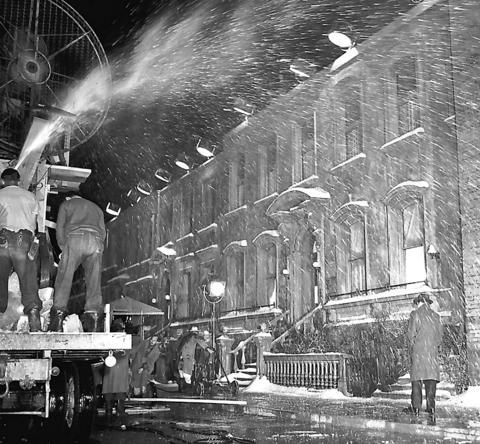
MGM's Stage 30 contained the most impressive set: the pool of MGM's amphibious star, Esther Williams. Typically, she and a couple dozen other bathing beauties would be splashing about. When the director approved a particular setup, an assistant would announce over a loudspeaker: ``Hit the kliegs.''
PHOTOS: AP
On catwalks high above the stage, a dozen or more huge spots called klieg lights -- named after their 1920s inventors, the Kliegl brothers -- began to flash on, creating the illusion of sunlight on the cobalt water.
As the shooting day continued, grips, gaffers and best boys would scurry around making references to ``singles,'' ``blondes,'' ``babies'' and ``obies'' without as much as a smirk.
I had no idea what any of it meant. Thank goodness at least the stars spoke English.
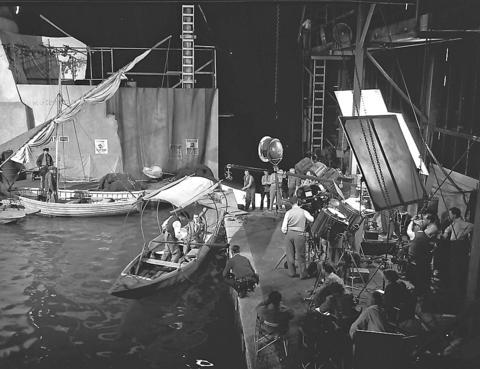
But as I later discovered, the stars themselves inspired some of this strange set slang.
Emmy-winning director of photography George Spiro Dibie explains an ``obie,'' for instance, is a light placed atop the camera to shine in the actor's eyes and create a pleasant highlight. It was named for Merle Oberon, who favored the device.
When a cameraman wants a 50mm lens, he calls for a ``Jack Lord,'' the actor who played the detective hero of TV's Hawaii Five-O. Get the connection -- Five-O, 50mm?
A ``John Ford,'' Dibie says, is a shot favored by the legendary director in which an actor is seen from a distance, then walks toward the camera and into his own close-up.
If a ``DP'' -- that's director of photography -- calls for ``a cowboy shot,'' he may not necessarily be working on a Western, noted Dibie.
``When cowboys duel on a Western street, where do they go for their guns? Their holsters. So you have to photograph down almost to their knees. That's why we call it a cowboy shot,'' he says.
Even for a Hollywood veteran like Dibie, it took awhile to get it all down. He recalls working on the set of 1970s On a Clear Day, You Can See Forever and being told that a close-up of Barbra Streisand needed to be a ``3-shot.''
``For me, a 3-shot would be three actors in the scene,'' says Dibie. ``I was wrong. A 3-shot meant eyes and bosom.''
No version of this lingo has ever made much sense to me, despite a lifetime on movie sets.
A new paperback by New York-based camera operator Dave Knox offers some answers: A gaffer is the chief lighting technician; the best boy is the second electrician, working under the gaffer, and a grip is the jack of all trades, building sets, moving cameras and cables, and whatever else needs doing.

Ajay Verma, a consultant gastroenterologist at Kettering general hospital in Northamptonshire, says our gut is a “complex machine.” “It is constantly providing us with the nutrition we need, initially to grow and develop, and then for us to survive, thrive and repair from injury and illness.” How can we keep it functioning well? Put simply: “Make sure what you put into it is balanced, and that you clear out its waste products adequately,” Verma says. “In a general gastroenterology clinic, the most common conditions we see are irritable bowel syndrome (IBS), gastroesophageal reflux disease, inflammatory bowel disease and constipation,” says Nisha

And so, in the wake of US President Donald Trump’s trip to the People’s Republic of China (PRC), all the experts on the Strait of Hormuz suddenly became experts on US-China-Taiwan relations. The Internet has certainly expanded human knowledge. Lots of these sudden experts made noise this week about Trump’s words after the meeting with PRC dictator Xi Jin-ping (習近平). Trump is going to sell out Taiwan! Longtime Taiwan commentator J. Michael Cole summed the situation up neatly in the Guardian: “We need to keep in mind that he has a tendency to say many things — sometimes contradicting himself within
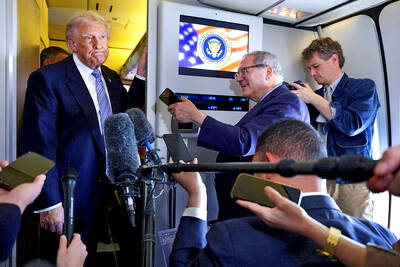
Last week US President Donald Trump was asked by a reporter whether he would speak on the phone to the President of Taiwan. “l’ll speak to him. I speak to everybody. We have that situation very well in hand,” Trump said. This marked the second time in a couple of weeks he had said he would talk to the President of Taiwan. In 2016 he famously took a call from then-president Tsai Ing-wen (蔡英文), when he was president-elect. Despite warnings that the apocalypse was nigh because of a phone call, the world quickly forgot about the conversation between two democratically-elected presidents.
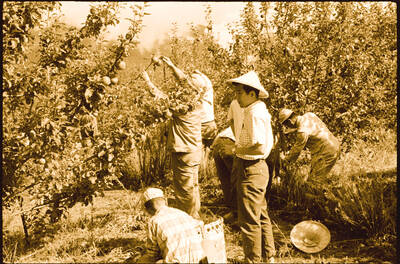
May 25 to May 31 Few believed that apples could be cultivated on a commercial scale in Taiwan’s high mountains. When horticulturalist Cheng Chao-hsiung (程兆熊) first proposed the idea in 1955, both American and Taiwanese colleagues dismissed it as implausible, arguing that temperate fruit could not be reliably grown on a subtropical island, especially on rugged terrain. However, it was this terrain in the Central Mountain Range where many Chinese Civil War veterans were resettled in the late 1950s. With limited job prospects and no family in Taiwan, they were placed on cooperative farms aimed toward self-sufficiency. Some say the conditions


 RSS
RSS