


The final of the Chrysler and ICRT Jazz Band competition tomorrow at Dayeh Takashimaya is cashing in on the growing popularity of the musical form in Taiwan.
"Taiwan is getting crazy about jazz music and more people have their eyes on jazz music. ... We hope this competition can become their impetus to carry on," said a promoter for the event.
"Through promoting Taiwan jazz music and importing domestic bands we hope to make jazz music become more free and open in Taiwan."

PHOTOS COURTESY OF CHRYSLER AND ICRT
Since June 20 the Chrysler and ICRT Jazz Band Competition has been holding preliminary events. They were judged by Bill Thissen, the anchor of ICRTs Jazz Flavors; Liu Xiu-ying (
The final groups chosen for the final are: Jazzaholix (
Jazzaholix, which was established in 2003 by guitar player Liu Chin-hua (

Jazzy Bon are Taiwanese and Japanese players who have finished their studies at US music academies and are known for their technical proficiency and playing latin jazz.
Onyx Jazz Quartet's players are also from Taiwan and Japan and are considered to be more mainstream.
The drummer, Dafu, the saxophone player Jimmy Lee and the guitar player, Kinya Ikeda all graduated at US musical academies and are all good composers.
In the finals tomorrow every band will play two songs, about eight to 10 minutes each. It starts at 4pm, in the square at Dayeh Takashimaya in Tianmu, 1F, 55, Zhongcheng Road, Sec 2, Taipei (台北市士林區忠誠路二段55號1樓).


The US war on Iran has illuminated the deep interdependence of Asia on flows of oil and related items as raw materials that become the basis of modern human civilization. Australians and New Zealanders had a wake up call. The crisis also emphasizes how the Philippines is a swatch of islands linked by jet fuel. These revelations have deep implications for an invasion of Taiwan. Much of the commentary on the Taiwan scenario has looked at the disruptions to world trade, which will be in the trillions. However, the Iran war offers additional specific lessons for a Taiwan scenario. An insightful
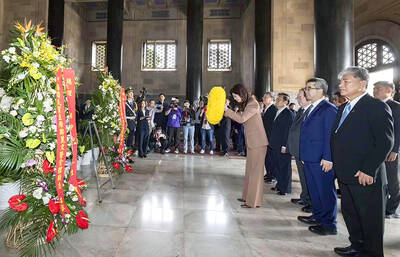
The problem with Marx’s famous remark that history repeats itself, first as tragedy, the second time as farce, is that the first time is usually farce as well. This week Chinese Nationalist Party (KMT) Chair Cheng Li-wun (鄭麗文) made a pilgrimage to the People’s Republic of China (PRC) “to confer, converse and otherwise hob-nob” with Chinese Communist Party (CCP) officials. The visit was an instant international media hit, with major media reporting almost entirely shorn of context. “Taiwan’s main opposition leader landed in China Tuesday for a rare visit aimed at cross-strait ‘peace’”, crowed Agence-France Presse (AFP) from Shanghai. Rare!

Polling data often confirms what we expect, but sometimes it throws up surprises. When examined over time, some patterns appear that speak to something bigger going on. In this column, whenever possible, Formosa’s polls are used. Despite the sometimes cringeworthy antics of Formosa’s Chairman, Wu Tzu-Chia (吳子嘉), the data produced includes detailed breakdowns crucial for analysis. It has also been conducted monthly 11-12 times a year for many years with many of the same questions, allowing for analysis over time. When big shifts do occur between one month and the next it is usually in response to some event in

April 6 to April 13 Few expected a Japanese manga adaptation featuring four tall, long-haired heartthrobs and a plucky heroine to transform Taiwan’s television industry. But Meteor Garden (流星花園) took the nation by storm after premiering on April 12, 2001, single-handedly creating the “idol drama” (偶像劇) craze that captivated young viewers across Asia. The show was so successful that Japan produced its own remake in 2005, followed by South Korea, China and Thailand. Other channels quickly followed suit, with more than 50 such shows appearing over the following two years. Departing from the melodramatic


 RSS
RSS