


Actress Halle Berry has been awarded this year's Golden Raspberry for worst actress for her role in the movie Catwoman.
The 2002 Oscar winner turned up in person to accept the dubious honor, but she was not joined on the podium by US President George W Bush, who won the prize for worst actor for his role in Fahrenheit 9/11.
"Omigosh, oh my God," Berry joked in accepting the award. "I never in my life thought that I would be here, winning a Razzie. It's not like I ever aspired to be here, but thank you."

PHOTO: EPA
"When I was a kid, my mother told me that if you could not be a good loser, then there's no way you could be a good winner," she said. However, she added, "I hope to God I never see these people again."
Other winners included US Defense Secretary Donald Rumsfeld and Britney Spears who won worst supporting-actor and actress prizes for their roles in Fahrenheit 9/11.
Razzies were also awarded for the worst films of the group's first 25 years: drama, Battlefield Earth; comedy, Gigli; musical, From Justin to Kelly.
The awards came as Hollywood was making the final preparations for Sunday night's Academy Awards.

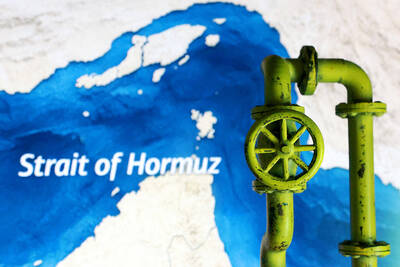
The US war on Iran has illuminated the deep interdependence of Asia on flows of oil and related items as raw materials that become the basis of modern human civilization. Australians and New Zealanders had a wake up call. The crisis also emphasizes how the Philippines is a swatch of islands linked by jet fuel. These revelations have deep implications for an invasion of Taiwan. Much of the commentary on the Taiwan scenario has looked at the disruptions to world trade, which will be in the trillions. However, the Iran war offers additional specific lessons for a Taiwan scenario. An insightful

The problem with Marx’s famous remark that history repeats itself, first as tragedy, the second time as farce, is that the first time is usually farce as well. This week Chinese Nationalist Party (KMT) Chair Cheng Li-wun (鄭麗文) made a pilgrimage to the People’s Republic of China (PRC) “to confer, converse and otherwise hob-nob” with Chinese Communist Party (CCP) officials. The visit was an instant international media hit, with major media reporting almost entirely shorn of context. “Taiwan’s main opposition leader landed in China Tuesday for a rare visit aimed at cross-strait ‘peace’”, crowed Agence-France Presse (AFP) from Shanghai. Rare!

Polling data often confirms what we expect, but sometimes it throws up surprises. When examined over time, some patterns appear that speak to something bigger going on. In this column, whenever possible, Formosa’s polls are used. Despite the sometimes cringeworthy antics of Formosa’s Chairman, Wu Tzu-Chia (吳子嘉), the data produced includes detailed breakdowns crucial for analysis. It has also been conducted monthly 11-12 times a year for many years with many of the same questions, allowing for analysis over time. When big shifts do occur between one month and the next it is usually in response to some event in

April 6 to April 13 Few expected a Japanese manga adaptation featuring four tall, long-haired heartthrobs and a plucky heroine to transform Taiwan’s television industry. But Meteor Garden (流星花園) took the nation by storm after premiering on April 12, 2001, single-handedly creating the “idol drama” (偶像劇) craze that captivated young viewers across Asia. The show was so successful that Japan produced its own remake in 2005, followed by South Korea, China and Thailand. Other channels quickly followed suit, with more than 50 such shows appearing over the following two years. Departing from the melodramatic


 RSS
RSS