


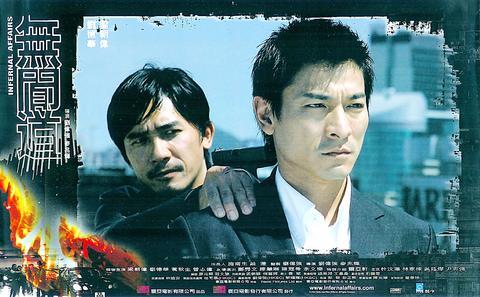
Infernal Affairs (
Directed by Andrew Lau (
Leading parallel lives, Ming and Yan are feeling increasingly trapped in their false surroundings. Ming would like to sever all ties with his illegal past and become a real cop. To do so would mean the elimination of Sam, the triad leader who sent him to the police academy to be a spy. For Yan, he is sick and tired of chopping people up in the name of justice and is striving to regain his real identity. Only one person can help him: Superintendent Wong, the man who recruited him as an undercover cop. Ming and Yan's paths finally cross each other one fateful evening. During a police attempt to topple Sam's drug deal, both sides realize there's a mole amongst themselves. A series of cat-and-mouse chases ensue, as each side competes to uncover their mole first. To make things even more chaotic, Ming is finally promoted to probationary inspector and is transferred to Internal Affairs. His first assignment is to uncover Sam's mole in the police department...
PTU
Directed by Jonnie To (
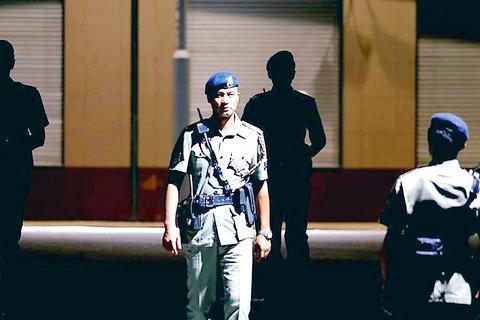
On a long and suspenseful evening, a group of young punks are causing trouble. The son of a gang leader is stabbed dead and a police officer loses his gun in a fight. Meanwhile, two PTU (Police Tactical Unit) teams are patrolling the harbor area and a gang leader is poised to avenge his dead son. All these elements are wrapped up in a final showdown -- a bullet-flying, blood-spraying fight.
The background to Johnnie To's first movie after The Mission (2000) follows a string of events that begins in a restaurant, when Lo, a jaded-looking police sergeant has a run-in with Ponytail, the son of notorious gangster boss Bald Head. Lo goes out to fight the punk friends of Ponytail, while Ponytail is mysteriously assassinated inside the eatery. Lo loses his gun during the scuffle.
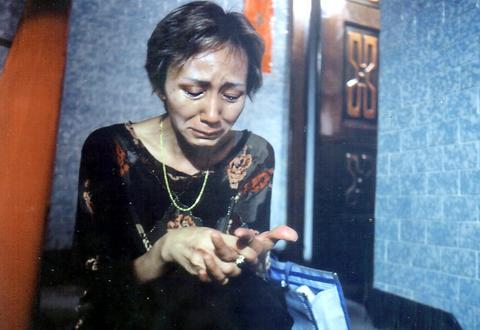
To find the gun and not be reported to his superior, Lo has to find information on the dead Ponytail's cellphone. He steals the phone but this makes him a suspect in the investigation of Ponytail's death. A meeting of the various parties is set for 4am in the harbor area.
Goodbye, Dragon Inn (
Directed by Tsai Ming-liang (
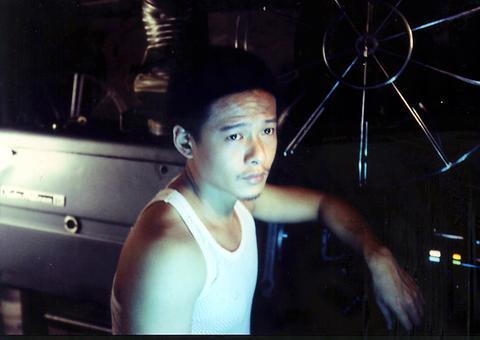
This film is Tsai Ming-liang's elegy lamenting the close-down of a Taipei County cinema, which not coincidentally echoes the depressing state of Taiwan cinema.
In pouring rain, a young Japanese tourist enters a run-down cinema during its last day of operation. The signboard outside says "Now showing: Dragon Inn," which was a classic martial arts film of the 1960s.
Inside the theater are empty seats. The tourist is obviously not there to appreciate the classic movie, instead he is looking for sexual adventure, as this cinema has been used as a gay meeting spot. He has no luck with just the few unattractive and old men in the place. Strangely some of the old people resemble those martial actors in the movie.
The Missing (
Directed by Lee Kang-sheng (
This film is Lee Kang-sheng's impressive debut feature and shows obvious potential. Though heavily influenced by his mentor Tsai Ming-liang -- especially in terms of the camera angles and narrative -- Lee presents his own message.
An elderly woman loses her grandson in a local park. She desperately looks for him around the park, listens to broadcast services, goes to the police station and even borrows the loudspeaker from street vendors to find the kid. Back home, she calls on her dead husband for help, but to no avail.
On this same day, a teenage boy, unrelated to the old woman, loses his grandfather, who has alzheimer's disease. Although he is helpless, he skips school and spends all day in the computer game arcade. It is a hot summer day, SARS fears are in the air and the city is anxious.
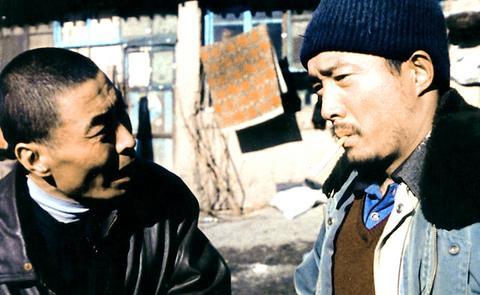
Blind Shaft (
Directed by Li Yang (
In one of the many poorly-equipped coal mines in Northern China, Song Jinming and Tang Chaoyang begin another day of hard work with Tang's brother Chaolu, who has just arrived. In the depths of a mineshaft, Song and Tang strike Chaolu with a pickaxe and kill him. They make the mine collapse and then escape from the "accident" unscathed. While pretending to lament the death, Tang and Song threaten to report the incident to the local government and police, in order to extort compensation monies from the mine's owner. Fearing exposure of the mine's illegal operations, the mine owner finally gives in to their demands.
After leaving and sending their loot home, the partners start scouting for another "relative." At the local train station, which is full of itinerant job-seekers, Tang finds another potential victim, Yuan Fengming -- a 16-year-old peasant boy from the countryside. Song believes that Yuan should not be killed as Yuan is just a kid, but Tang gets his way and the plan is carried forward. The relationship between the partners is gradually transformed by Yuan's innocence. Finally, the partners' scheme takes an unexpected turn.


The US war on Iran has illuminated the deep interdependence of Asia on flows of oil and related items as raw materials that become the basis of modern human civilization. Australians and New Zealanders had a wake up call. The crisis also emphasizes how the Philippines is a swatch of islands linked by jet fuel. These revelations have deep implications for an invasion of Taiwan. Much of the commentary on the Taiwan scenario has looked at the disruptions to world trade, which will be in the trillions. However, the Iran war offers additional specific lessons for a Taiwan scenario. An insightful

It’s only half the size of its more famous counterpart in Taipei, but the Botanical Garden of the National Museum of Nature Science (NMNS, 國立自然科學博物館植物園) is surely one of urban Taiwan’s most inviting green spaces. Covering 4.5 hectares immediately northeast of the government-run museum in Taichung’s North District (北區), the garden features more than 700 plant species, many of which are labeled in Chinese but not in English. Since its establishment in 1999, the site’s managers have done their best to replicate a number of native ecosystems, dividing the site into eight areas. The name of the Coral Atoll Zone might

Polling data often confirms what we expect, but sometimes it throws up surprises. When examined over time, some patterns appear that speak to something bigger going on. In this column, whenever possible, Formosa’s polls are used. Despite the sometimes cringeworthy antics of Formosa’s Chairman, Wu Tzu-Chia (吳子嘉), the data produced includes detailed breakdowns crucial for analysis. It has also been conducted monthly 11-12 times a year for many years with many of the same questions, allowing for analysis over time. When big shifts do occur between one month and the next it is usually in response to some event in

The problem with Marx’s famous remark that history repeats itself, first as tragedy, the second time as farce, is that the first time is usually farce as well. This week Chinese Nationalist Party (KMT) Chair Cheng Li-wun (鄭麗文) made a pilgrimage to the People’s Republic of China (PRC) “to confer, converse and otherwise hob-nob” with Chinese Communist Party (CCP) officials. The visit was an instant international media hit, with major media reporting almost entirely shorn of context. “Taiwan’s main opposition leader landed in China Tuesday for a rare visit aimed at cross-strait ‘peace’”, crowed Agence-France Presse (AFP) from Shanghai. Rare!


 RSS
RSS