


Are you a humble 20-something office worker burning with desire for the Louis Vuitton handbag Jennifer Lopez swings in her shapely hand on the cover of Vogue, but short of the NT$32,800 that it costs? Especially when you're still in debt for that purchase of another Vuitton bag you bought last month on a whim to emulate the trend-setting pop diva Faye Wang. Help is at hand as secondhand brand shops become ever more popular.
In downtown Taipei's Jeou-ru Building (
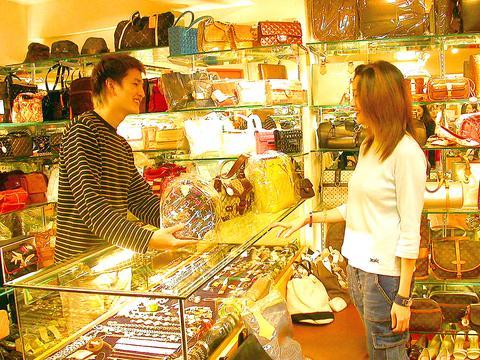
PHOTO: VICO LEE, TAIPEI TIMES
Gathering all the most wanted brand names from Chanel, Gucci, Burberry, FENDI, Prada, Hermes, Louis Vuitton and more into a space that is often less than three-pings, these shops easily lure the cash-strapped young followers of designer fashion. Even high-schoolers are attracted to the second hand glamor.
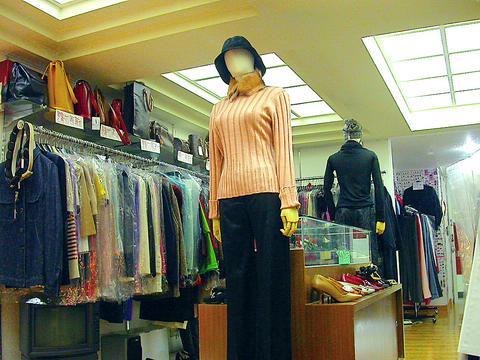
Genie, a clothing saleswoman in her early 20s, used to spend a lot on brands like Louis Vuitton and Chanel, the two most hyped brands in Taiwan, but switched to secondhand goods a year ago because it was more
economical.
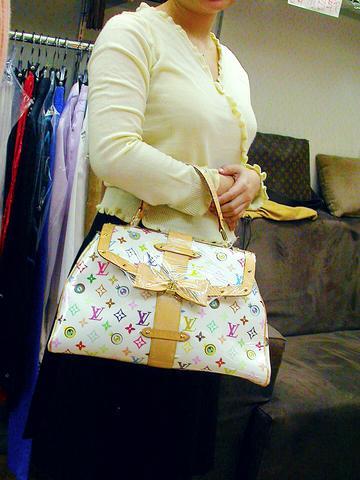
"I can save up to NT$10,000 on a leather bag. After two or three months, when I get tired of it, I can sell it back and make back most of the money to buy a new one. This way I spend only NT$2,000 to NT$3,000 on a new bag instead of NT$20,000 to NT$30,000."
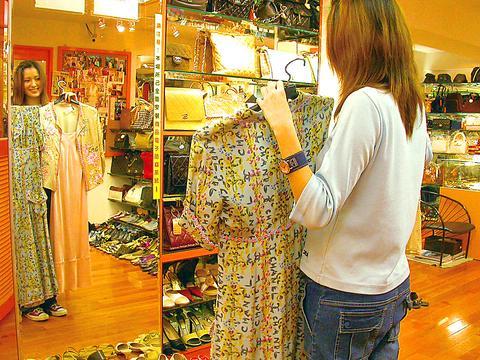
Only when she can't find something in secondhand shops does she buy it new. The current economic doldrums have had no effect on her.
"Brand goods are so attractive. Every woman wants to have them. The economic recession doesn't stop them from buying," she said.
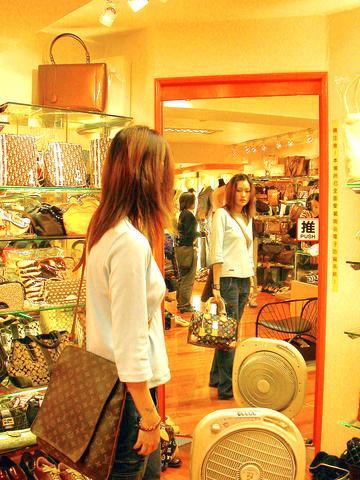
In the last few years, an increasing number of seasoned brand name followers, mostly women, have been setting up secondhand shops and there are now more than 40 in central Taipei. More than half were opened in the last two years and new shops are still being opened at the speed of three to five a month, according to Lu Shih-yuan (
Many in the business compare the trend to the custard tart frenzy a few years ago. At the time, custard tart shops spread across Taipei so fast that at the peak of the fad, one could hardly turn a corner without bumping into such a shop and a long queue outside. That was months before nearly all of them succumbed to newer fads and closed down.
Secondhand brand goods shops, however, may be here to stay. "In the next six months to a year at the very least, the trend will go on heating up. There is still some room for growth. Although the economy is looking up a little bit, it's still a long way from the real boom, when people will have so much money they insist on buying first-hand goods," Lu said.
Expecting continued growth, the magazine's publisher is launching a sister monthly early next year about secondhand goods from entertainers.
"Our magazine is not meant to reap a windfall from a passing fad but to operate permanently, because the secondhand brand goods industry will keep on thriving," Lu said.
Economic recession, with which the craze is said to be coterminous, only partly explains the phenomenon, shop owners said. Taiwanese tend to follow Japanese trends and this has led to a national movement to own brand goods, as most Japanese do. For those who cannot afford a Louis Vuitton handbag like J-pop diva Ayumi Hamasaki, secondhand shops bring their dreams within reach.
"Whatever the Japanese do, Taiwanese like to follow suit. The secondhand shop is also a Japanese concept born from the country's economic recession in the late 1980s," said Chen Si-ying (
The lure of brand names is so overwhelming for many Taiwanese that their spending has contributed to the 30 percent increase in consumer debt last year, which amounted to NT$510 billion as of August this year, according to the Central Bank.
"The recession has hit not the very rich but the middle class, so those who sell their things just want to get rid of useless things. Before the secondhand shop boom, they give things away to friends for free," Chen said.
Hsu, the proprietress of Echo who only wanted to give her surname, said she often collects carloads of goods from houses worth hundreds of millions of dollars, in much the same way ordinary folks have their old books and newspapers taken away for a negligible amount, more to get them out of the way than to make money.
Also, there are many secondhand shoppers who rarely step into a Chanel branch or a speciality store, but who don't mind buying secondhand since they can conveniently save up to 30 percent of the original price. Take the craze for Louis Vuitton "Deauville" bags (as advertised by Jennifer Lopez), where a 20 percent difference means some NT$6,600. For young office workers with a monthly salary of NT$30,000 to NT$40,000, that is a significant markdown and more capital for their next round of shopping.
"Some women feel less guilty about going shopping again if they know they can sell their luxuries later on," said Chen, at MISS, explaining the psychology behind the boom.
"Consumers have become smarter. Many now see brand goods as a financial arrangement because no matter what happens, a designer product has its set price. Even when they become third or fourth hand, it's still worth thousands or tens of thousands of dollars. Ordinary office workers care about that amount," said Chen Shih-fan (
Secondhand shops may seem at first glance to be a women's world, but men have done their part to boost the business. Su, a 20-something who works in the fashion business, spends NT$30,000 to NT$40,000 a month on brand names, mainly at specialty stores, but also at secondhand shops for the thrill of "treasure hunting."
On spotting an almost new Gucci cellphone strap at Second Hand, Su did not hesitate before paying NT$3,500 with his credit card. Such treasure hunters, explained Hsiao Chiao (小喬), proprietress of Second Hand, constitute the largest share of her customer base.
"Some buy secondhand not because they cannot afford first-hand but because we happen to have things they want which cost less," she said.
With the increasing number of shops, Mika -- proprietress of Mika Shop (
The competition has been tough but not detrimental as most shops manage to retain some 80 percent of their customers. As the Taipei market is gradually nearing saturation, shops are fanning out into less urbanized places like Chiayi, Nantou and Tainan to cater to the country gentry. Very few of them have gone out of business, as Lu, at Second Hand Brand Goods, observed. Hsiao Chiao does not worry about competition.
"In the long run, some shops may be driven out of competition, but in the near future, the market only grows bigger, because there will be more and new brands and everyone is starting to use designer brands," she said.
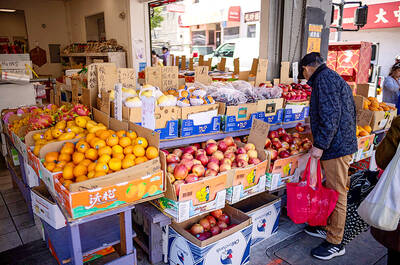
Ajay Verma, a consultant gastroenterologist at Kettering general hospital in Northamptonshire, says our gut is a “complex machine.” “It is constantly providing us with the nutrition we need, initially to grow and develop, and then for us to survive, thrive and repair from injury and illness.” How can we keep it functioning well? Put simply: “Make sure what you put into it is balanced, and that you clear out its waste products adequately,” Verma says. “In a general gastroenterology clinic, the most common conditions we see are irritable bowel syndrome (IBS), gastroesophageal reflux disease, inflammatory bowel disease and constipation,” says Nisha
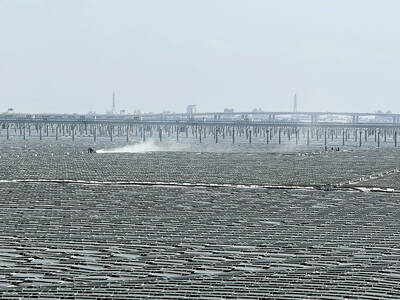
The arithmetic is straightforward and uncomfortable. By the end of 2025, Taiwan had committed itself to a 50-30-20 electricity mix — half natural gas, 30 per cent coal, 20 per cent renewables. The Ministry of Economic Affairs’s (MOEA) own monthly energy reports tell a different story. Natural gas reached 47.8 per cent of generation last year. Coal stood at 35.4 per cent, comfortably above its target ceiling. Renewables came in at 13.1 per cent, well short of the 20 per cent Taipei had pledged a decade earlier. Installed renewable capacity reached roughly half of the 12 gigawatts (GW) the government

Last week US President Donald Trump was asked by a reporter whether he would speak on the phone to the President of Taiwan. “l’ll speak to him. I speak to everybody. We have that situation very well in hand,” Trump said. This marked the second time in a couple of weeks he had said he would talk to the President of Taiwan. In 2016 he famously took a call from then-president Tsai Ing-wen (蔡英文), when he was president-elect. Despite warnings that the apocalypse was nigh because of a phone call, the world quickly forgot about the conversation between two democratically-elected presidents.
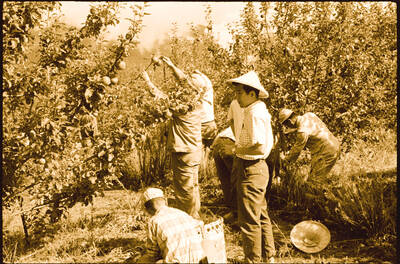
May 25 to May 31 Few believed that apples could be cultivated on a commercial scale in Taiwan’s high mountains. When horticulturalist Cheng Chao-hsiung (程兆熊) first proposed the idea in 1955, both American and Taiwanese colleagues dismissed it as implausible, arguing that temperate fruit could not be reliably grown on a subtropical island, especially on rugged terrain. However, it was this terrain in the Central Mountain Range where many Chinese Civil War veterans were resettled in the late 1950s. With limited job prospects and no family in Taiwan, they were placed on cooperative farms aimed toward self-sufficiency. Some say the conditions


 RSS
RSS