


Korea hits the classical jackpot this month with two fine recordings, one featuring a fledgling South Korean pianist, the other an American-born
violinist.
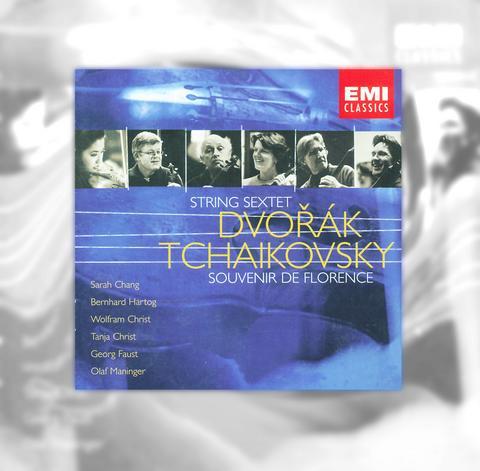
Dvorak and Tchaikovsky
String Sextets Chang, Hartog, W and T Christ, Faust, Maninger
EMI 5 57243 2
It was Brahms who brought the string sextet back to life for his era. But whereas his two essays in the genre were youthful works, both Dvorak and Tchaikovsky attempted a string sextet in the latter part of their careers. Both produced masterpieces as a result, and it is impossible to say which is the better.
Dvorak's chamber music is one of the glories of the 19th century. It has all the emotional richness of Brahms, and at least a touch of his characteristic complexity. In addition, it has a distinctive rural dimension, using a rustic Czech ambiance to evoke the pleasures of country life everywhere. At his best, as here, Dvorak also has an innocence that is totally captivating. Just how enormously popular he was in his day tends to be forgotten now, with only a few favorite works regularly played. Certainly this magnificent sextet, given all-star treatment (as here) when it was premiered, deserves to be better known.
Tchaikovsky's sextet, subtitled Souvenir of Florence, has little that relates to the city, unless the composer had some unrecorded love affair there. It certainly strikes direct to the heart. Unrelenting, strongly defined, yet at the same time confident and happy, it has the power all on its own to convince you that Tchaikovsky was a composer of the very first rank. This new CD is not recorded, as quintets and sextets so often are, by a string quartet with additional guest players. Instead, six virtuosos in their own right have got together to create near-perfect renderings. They are led by Sarah Chang on first violin. Born in Philadelphia to Korean parents, Chang has already forged a brilliant career for herself as a solo violinist. This outstanding recording is supremely fine, and cannot be recommended too highly.
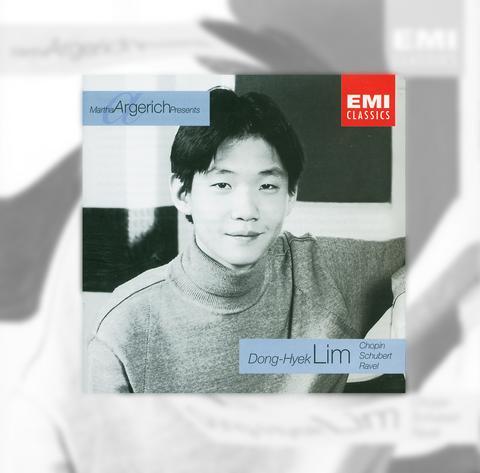
Lom Dong-Hyek
Piano works by Chopin, Schubert, Ravel EMI 5 67933 2
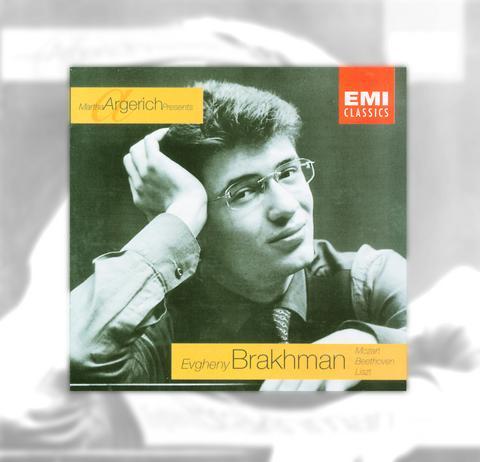
EVGHENY BRAKMAN Piano works by Mozart, Beethoven Liszt
EMI 5 67935 2
Someone has come up with the idea of Martha Argerich adding her famous name to debut CDs introducing emerging young pianists, her name on the cover acting as a guarantee of their artistry, and of course helping to sell the product at the same time. And indeed it is astonishing to compare the youthful face of South Korean teenager Lim Dong-hyek, 19, on this CD cover with his grand master manner as displayed in its contents. He ranges over the keyboard like a general deploying his forces. You look back at the cover photo and ask "Can this really be him?" There is no doubt at all that this is wonderful playing.
The only query might be whether the items recorded are the best that could have been chosen. There are four popular Chopin items, the first set of the Schubert Impromptus, and Ravel's La Valse as transcribed by the composer for piano solo. These are popular pieces, and maybe EMI calculates that when trying to launch a new classical artist it's ill-advised to attempt anything too out of the ordinary. But certainly no one who likes these particular pieces is going to be in the slightest way disappointed.
The young Russian Evgheny Brackman, 22, is given similar treatment, offering a Mozart sonata, another by Beethoven (Tempest), and Liszt's gargantuan Piano Sonata in B Minor. His playing is immaculate rather than sensational, in the manner that Yundi Li and Lang Lang are sensational. Whether these two new young pianists will eventually achieve fame on the international concert circuit is still in the lap of the gods.
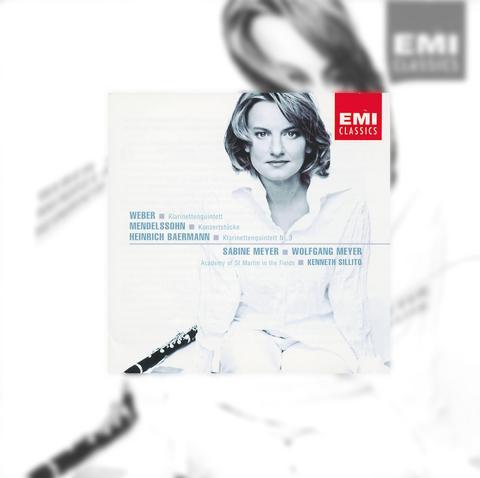
Sabine and Wolfgang Meyer
Clarinet works by Weber, Mendelssohn, Baermann
EMI 5 57359 2
Items in the classical style for the clarinet all have one thing in common -- the apparent impossibility of escaping the influence of Mozart's two masterpieces for the instrument. Brahms succeeded in his Clarinet Quintet simply by acquiescing, not trying to struggle against the echo from the past, but instead embracing it and, eventually, managing to go beyond it. None of the items on this CD, however, successfully evade Mozart's ghost.
Heinrich Baermann was a forgotten name until recently, yet he dominates this CD. He was a famous early 19th century clarinetist who stimulated Weber and Mendelssohn to write pieces for the instrument, and also wrote three quintets featuring it himself. The slow movement from the last of these became famous in the early 20th century when it was unearthed and attributed, quite wrongly, to the young Wagner. Listening to it here you quickly realize how absurd that attribution actually was. The instrumental backing for such items in the 19th century was very fluid. You could play them with a piano or a string quartet, which ever happened to be the more convenient.
Here Sabine and Wolfgang Meyer opt to play them with a small orchestra, that of London's Academy of St Martin in the Fields under Kenneth Sillito. Sabine Meyer plays the clarinet in the Weber and Mendelssohn items, with Wolfgang on the rather lugubrious basset-horn in the latter, and then Wolfgang takes to the clarinet for the Baerman piece itself.
It has to be said that the music as written is not of the top class. But if you're attracted to either the instrument or the soloists, or happen to be in a particularly good mood anyway, you might find this rather light-weight recital makes a pleasant enough background sound.


The US war on Iran has illuminated the deep interdependence of Asia on flows of oil and related items as raw materials that become the basis of modern human civilization. Australians and New Zealanders had a wake up call. The crisis also emphasizes how the Philippines is a swatch of islands linked by jet fuel. These revelations have deep implications for an invasion of Taiwan. Much of the commentary on the Taiwan scenario has looked at the disruptions to world trade, which will be in the trillions. However, the Iran war offers additional specific lessons for a Taiwan scenario. An insightful
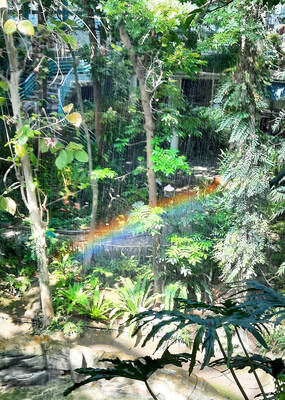
It’s only half the size of its more famous counterpart in Taipei, but the Botanical Garden of the National Museum of Nature Science (NMNS, 國立自然科學博物館植物園) is surely one of urban Taiwan’s most inviting green spaces. Covering 4.5 hectares immediately northeast of the government-run museum in Taichung’s North District (北區), the garden features more than 700 plant species, many of which are labeled in Chinese but not in English. Since its establishment in 1999, the site’s managers have done their best to replicate a number of native ecosystems, dividing the site into eight areas. The name of the Coral Atoll Zone might

Polling data often confirms what we expect, but sometimes it throws up surprises. When examined over time, some patterns appear that speak to something bigger going on. In this column, whenever possible, Formosa’s polls are used. Despite the sometimes cringeworthy antics of Formosa’s Chairman, Wu Tzu-Chia (吳子嘉), the data produced includes detailed breakdowns crucial for analysis. It has also been conducted monthly 11-12 times a year for many years with many of the same questions, allowing for analysis over time. When big shifts do occur between one month and the next it is usually in response to some event in
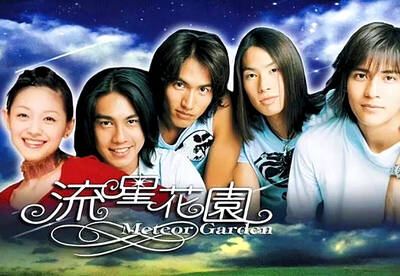
April 6 to April 13 Few expected a Japanese manga adaptation featuring four tall, long-haired heartthrobs and a plucky heroine to transform Taiwan’s television industry. But Meteor Garden (流星花園) took the nation by storm after premiering on April 12, 2001, single-handedly creating the “idol drama” (偶像劇) craze that captivated young viewers across Asia. The show was so successful that Japan produced its own remake in 2005, followed by South Korea, China and Thailand. Other channels quickly followed suit, with more than 50 such shows appearing over the following two years. Departing from the melodramatic


 RSS
RSS