


Time can wash away many things. But for Taiwan's coal miners, time has never taken away the memories of their now dismantled industry; their proud contribution to the nation's economy, the constant hazard of their profession and the black lung disease that is now killing many.
But time many soon wash away this, too.
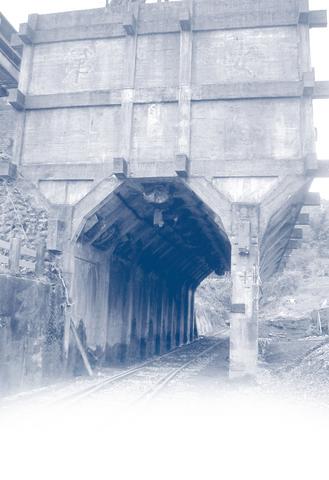
Take a trip to Taipei's Pingshi village, where New Pingshi Coal Mining Corp (
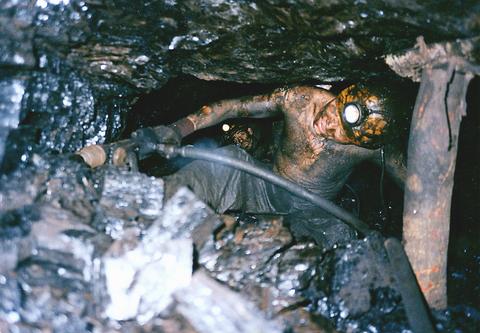
In fact, New Pingshi remains well-kept by comparison. In Ruifang (
Wang Kuo-wei (
In the 1960s and 1970s, Taiwan had more than 400 coal mines and more than 60,000 miners working in the pits every day producing some five million tonnes annually. Half the coal was used in power plants and the other half for export. "Our history can be traced back to 1875, when British ships came to Keelung port requesting coal for fuel," said Wang, citing a book called Keelung Coal History, published by the Keelung City Government.
Taiwan's coal miners were especially hard workers. The mine veins run deep, around 400m underground. The narrow pits were dug between fragile sandstone. Miners worked lying down, constantly alert of collapse, or any spark that might trigger an explosion. "The temperature there is 40C and humidity is 90 percent; many of us worked naked," Wang said.
The thickness of Taiwan's mining seams is less than a meter on average, making it hard to use large machines to excavate the mines. It depended heavily on labor, which raised the cost. In 1984, there were three major explosions that killed a total of 180 miners. That, combined with the coal's high cost (around three times higher than imported coal), caused Taiwan's coal industry to wither in the late 1980s. In 2000, when Lifong Coal Mine Corp stopped production, the 100-year-old industry came to a close in Taiwan.
"We are now running against time," said Shueh Li-ni (
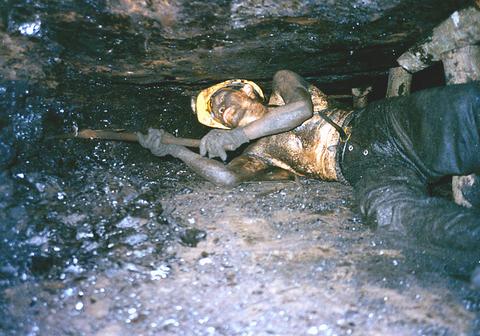
PHOTO COURTESY OF WANG KUO-WEI
"The old miners are gradually falling, and the history and culture might soon be forgotten. Thanks to Mr Lin, we now have a small place to display these historical pieces," Shueh said.
Lin Tsai-sheng (
"It's very humble, but we hope to make a start. We need more donations," Shueh said. The Keelung museum is one of the few attempts to preserve Taiwan's coal mining culture. In 1998, Taipei County Government announced plans to build a large coal mine museum and memorial in Houtong (侯桐), the old site of Ruisan Coal Mine Corp. But the project is still only on paper, according to the county government's construction bureau. The government also has a plan to set up a memorial park at another mine in Shihti. That project, also announced in 1998, remains on ice.
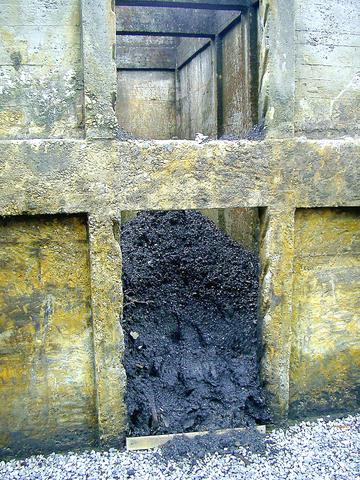
PHOTO: YU SEN-LUN, TAIPEI TIMES
"We set up this small museum in haste, but at least it's something to fulfill Lin's wish before it's too late.
"I want to see the history and knowledge of coal mines passing down to future generations. Besides, I can't bring these things to my grave," Lin told the Taipei Times by phone. Suffering from skin cancer, Lin said with a voice of gravel that he was unable to give a longer interview.
Another race against time is the black lung disease with which many coal miners struggle. Most miners worked in the mines more than 10 years, and none of them are immune to the incurable disease. Filmmaker Wu Nien-jen's (吳念真) Dohsan -- A Borrowed Life (多桑, 1994) vividly depicts his father's suffering from the disease, unbearable difficulty with breathing, constant coughing and other complications. The father eventually jumped off the hospital roof to end his pain.
"We feel very strongly about the film and don't really want to see it again," said Wang Kuo-wei who has been diagnosed with light symptoms of black lung disease. But Wang's co-worker, surnamed Chen, is a lot worse. He has now been diagnosed with severe symptoms of the disease, but when he was first diagnosed 15 years ago, he was already retired.
Before labor insurance regulations were amended in 1999 to accommodate those suffering from occupational diseases after having left employment, Chen had not received a penny for his sickness. In April of this year, the Council of Labor Affairs passed the Occupational Disease Protection Law, which gives a monthly allowance of NT$1,000 to NT$6,000 to those suffering from occupation-related diseases. But the law was not made retroactive and only those diagnosed with black lung diseases after April this year are eligible. "It's still too late for me," said Chen. Now working as a street cleaner to support himself, Chen has been quiet about his rights for many years.
In Dohsan, the father always looked stern and stubbornly never admitted to his pain. This same spirit is true of many old Taiwanese miners, according to Wang. "One reason you would take on such hazardous work is that you would rather grit your teeth and take the risk than ask for money from people," Wang said. This is the reason miners have remained quiet in the labor movement. Retired miners only staged a few protests demanding greater labor payments in the past five years. "They don't like to ask people to give them money," Wang said. "But they might well be the most disadvantaged."
*Keelung Mine Industry History Museum (基隆礦業史料館) 35, Lane 77 Chengring St., Keelung (基隆市正榮街77巷35號) Tel: (02) 2463-1966
Set up by the Keelung Culture Preservation Association, admission is free. The museum displays various minerals, mining equipment, photos and books. Guides are available. * Taiwan Coal Mine History and Culture Exhibition Hall (台灣煤礦歷史文化陳列館)
5 Tingliao Tsu, Pingshi village, Pingshi township, Taipei County (台北縣平溪鄉平溪村頂寮子5號). Take the Pingshi line train to Shihfen station
Tel: (02) 2495-8680
A 30-hectare factory set up at the original coal mine by Kong Yung-tsang, former chairman of the New Pingshi Coal Mine Corp.
Admission: NT$160 includes riding on the mine trams, visiting a simulated mine tunnel and the museum.
On display are mine washers, a motor room, mine pit, mine tram, miners' shower and dormitory and various mining equipment, videos and photos.
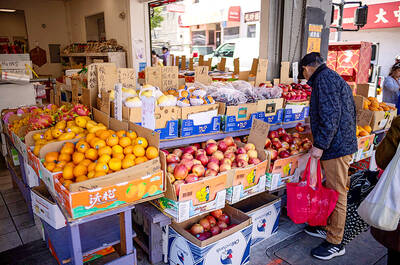
Ajay Verma, a consultant gastroenterologist at Kettering general hospital in Northamptonshire, says our gut is a “complex machine.” “It is constantly providing us with the nutrition we need, initially to grow and develop, and then for us to survive, thrive and repair from injury and illness.” How can we keep it functioning well? Put simply: “Make sure what you put into it is balanced, and that you clear out its waste products adequately,” Verma says. “In a general gastroenterology clinic, the most common conditions we see are irritable bowel syndrome (IBS), gastroesophageal reflux disease, inflammatory bowel disease and constipation,” says Nisha
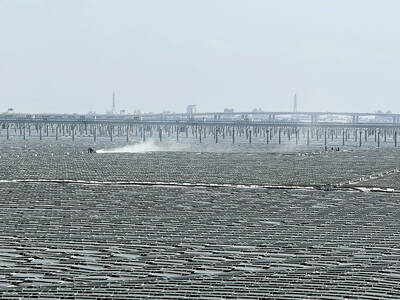
The arithmetic is straightforward and uncomfortable. By the end of 2025, Taiwan had committed itself to a 50-30-20 electricity mix — half natural gas, 30 per cent coal, 20 per cent renewables. The Ministry of Economic Affairs’s (MOEA) own monthly energy reports tell a different story. Natural gas reached 47.8 per cent of generation last year. Coal stood at 35.4 per cent, comfortably above its target ceiling. Renewables came in at 13.1 per cent, well short of the 20 per cent Taipei had pledged a decade earlier. Installed renewable capacity reached roughly half of the 12 gigawatts (GW) the government

Last week US President Donald Trump was asked by a reporter whether he would speak on the phone to the President of Taiwan. “l’ll speak to him. I speak to everybody. We have that situation very well in hand,” Trump said. This marked the second time in a couple of weeks he had said he would talk to the President of Taiwan. In 2016 he famously took a call from then-president Tsai Ing-wen (蔡英文), when he was president-elect. Despite warnings that the apocalypse was nigh because of a phone call, the world quickly forgot about the conversation between two democratically-elected presidents.
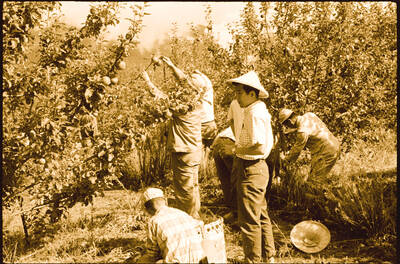
May 25 to May 31 Few believed that apples could be cultivated on a commercial scale in Taiwan’s high mountains. When horticulturalist Cheng Chao-hsiung (程兆熊) first proposed the idea in 1955, both American and Taiwanese colleagues dismissed it as implausible, arguing that temperate fruit could not be reliably grown on a subtropical island, especially on rugged terrain. However, it was this terrain in the Central Mountain Range where many Chinese Civil War veterans were resettled in the late 1950s. With limited job prospects and no family in Taiwan, they were placed on cooperative farms aimed toward self-sufficiency. Some say the conditions


 RSS
RSS