


Over the coming week, the world renowned little voices of the Vienna Boys Choir will be charming audiences across Taiwan, when the popular European choral ensemble makes a welcome return to concert halls in Taichung, Hsinchu and Taipei.
Twenty members of the 100-strong choir have made the trip to Taiwan this year, which it is hoped will prove as popular with local audiences as the group's previous eight visits. Aged between 10 and 14, the 100 youngsters of the Vienna Boys Choir are divided into four touring groups -- each of which gives roughly 300 performances annually.
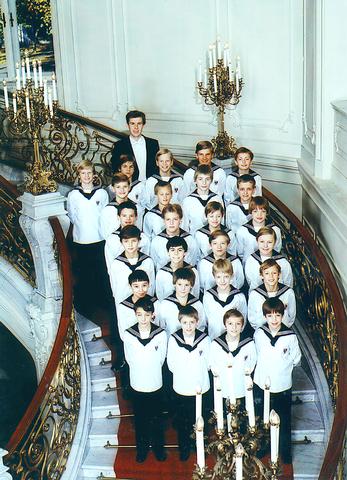
PHOTO COURTESY OF THE FREDERIC CHOPIN FOUNDATION TAIPEI
Now revered the world over for the cherub-like innocence and angelic singing voices of its members, the roots of the Vienna Boys Choir were far less blissful.
It all began in the late 1400s with Emperor Maximilian I of Austria -- a chap who, along with conquering much of Central Europe by the sword and ensuring his foes were slaughtered in rather sadistic ways, also had a passion for music.
By the late 1400s Maximilian had not only found himself with a quite few extra acres of land on which to practice rituals common to 15th-century European blue-bloods such as the wanton slaughter of peasantry, but had also amassed a multitude of musicians. Many of whom were children.
The now renowned choir first took shape shortly after Maximilian moved his court from Innsbruck to Vienna in 1498. The Teutonic ruler gave specific instructions that six young boys were to be included in the ensemble that was to perform at his new royal dwellings in Vienna.
For over 400 hundred years the choir performed for the sole pleasure of the royal Austrian court. It was only after the collapse of the Habsburg Empire after World War I that the boy's choir began to perform in public concert halls.
Josef Schnitt, the dean of the imperial chapel and a shrewd businessman set about transforming the once private choir into an international phenomenon in the early 1920s. Making its international debut in Berlin in 1926, the choir has been warbling its way around the world for much of the past 80 years.
The group has long since shed the imperial yoke, that in days of yore meant the chorister's repertoire consisted of tunes solely befitting of the ruling classes, and the group now have a very wide ranging and liberal play lists.
Not that the choir has dropped traditional cloister music and its world-renowned Gregorian Chants from its repertoire. It still performs such music every Sunday at Vienna's Imperial Chapel as it has done since 1498, but in order to capture the hearts and minds of global audiences the choir has branched out.
In keeping with the times, the group's repertoire now includes polkas, waltzes, vaudeville, world music, some unique crossover projects which see the choir collaborating with artists and choreographers and even performing its own choral re-workings of popular chart music and Top Ten hits.
For its Taiwan performances, the Vienna Boys Choir will be performing a smorgasbord of material which includes works by Heinrich Schutz, Mozart and Schubert as well a selection of international folk songs, polkas and waltzes.

By global standards, the traffic congestion that afflicts Taiwan’s urban areas isn’t horrific. But nor is it something the country can be proud of. According to TomTom, a Dutch developer of location and navigation technologies, last year Taiwan was the sixth most congested country in Asia. Of the 492 towns and cities included in its rankings last year, Taipei was the 74th most congested. Taoyuan ranked 105th, while Hsinchu County (121st), Taichung (142nd), Tainan (173rd), New Taipei City (227th), Kaohsiung (241st) and Keelung (302nd) also featured on the list. Four Japanese cities have slower traffic than Taipei. (Seoul, which has some

Taiwan’s semiconductor industry consumes electricity at rates that would strain most national grids. Taiwan Semiconductor Manufacturing Co (TSMC) alone accounted for more than 9 percent, or 2,590 megawatts (MW), of the nation’s power demand last year. The factories that produce chips for the world’s phones and servers run around the clock. They cannot tolerate blackouts. Yet Taiwan imports 97 percent of its energy, with liquefied natural gas reserves measured in days. Underground, Taiwan has options. Studies from National Taiwan University estimate recoverable geothermal resources at more than 33,000 MW. Current installed capacity stands below 10 MW. OBSTACLES Despite Taiwan’s significant geothermal potential, the

In our discussions of tourism in Taiwan we often criticize the government’s addiction to promoting food and shopping, while ignoring Taiwan’s underdeveloped trekking and adventure travel opportunities. This discussion, however, is decidedly land-focused. When was the last time a port entered into it? Last week I encountered journalist and travel writer Cameron Dueck, who had sailed to Taiwan in 2023-24, and was full of tales. Like everyone who visits, he and his partner Fiona Ching loved our island nation and had nothing but wonderful experiences on land. But he had little positive to say about the way Taiwan has organized its
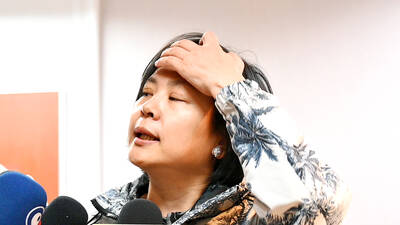
The entire Li Zhenxiu (李貞秀) saga has been an ugly, complicated mess. Born in China’s Hunan Province, she moved to work in Shenzhen, where she met her future Taiwanese husband. Most accounts have her arriving in Taiwan and marrying somewhere between 1993 and 1999. She built a successful career in Taiwan in the tech industry before founding her own company. She also served in high-ranking positions on various environmentally-focused tech associations. She says she was inspired by the founding of the Taiwan People’s Party (TPP) in 2019 by Ko Wen-je (柯文哲), and began volunteering for the party soon after. Ko


 RSS
RSS