


Starting this year, the Taipei Fine Arts Museum will only accept five applicants for exhibitions at the museum, which is a dramatic reduction from the previous 25. The goal in this move is quality enhancement, more careful screening of the applicants and a larger budget for each exhibition.
Chen Luoke (
His paintings reflect his passion for travel, with a mixture of vague outlines of the human body and strokes that suggest the structures of a city.
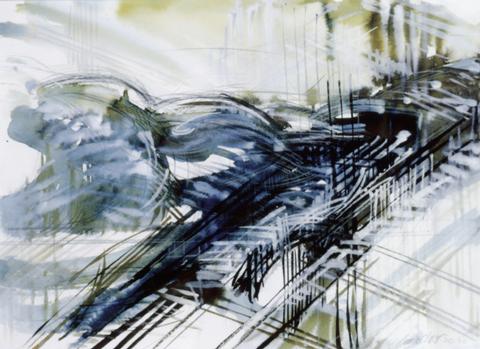
PHOTO COURTESY OF TFAM
Chen's human figures are not the ones usually seen in paintings, they have no vivid features and appear decapitated. Despite the deceiving title of Figure Landscape, the 31 paintings on view are entirely abstract. The sinuous curves outlining the figures are sliced by Chen's characteristic short strokes, so that viewers need time to visualize the person depicted.
Chen, who was born in Taipei and has been living in Wuppertal since 1985, said he preferred not to draw heads because they are too easily recognizable. "Figurative painting is no fun," Chen said at the opening of his show on Thursday. He prefers viewers to "read between the lines," and to visually solve the image puzzle of the concealed silhouette of the body he tries to draw.
On view at the show are two series that reflect his recollections of the cities of Montreal and his adopted city of Wuppertal.
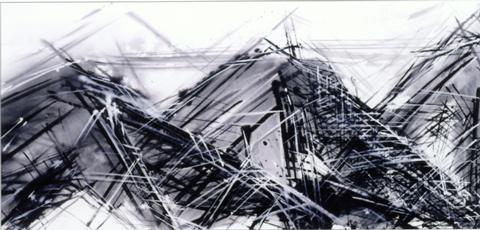
PHOTO COURTESY OF TFAM
The Montreal series is based on slanted lines that Chen said were inspired by the unique design of fire escapes that impressed him during his visits there. Upon closer observation, one can recognize a prostrate body with a bare abdomen or a luscious thigh in each painting.
Contrary to the brightly-toned Montreal series, the Wuppertal series has a sharp and colder look. Chen said he remembers Montreal as a lively city with a spring-like atmosphere, whereas Wuppertal is a rainy industrial city. The colors of his new home inspired Chen to choose greyish tones in his Wuppertal series. The images are also centered around a unique structure in the city, the Schwebebahn, or cable car, which has an intriguing triangular structure. Chen blends this structure with images of a leg bent at the knee.
The exhibition also features three large unframed paintings on rice paper, each concealing more than one body. Try to find them in the blur. Several of Chen's paintings are also on exhibit at the Howard Plaza Hotel until Aug. 15.
Art Notes:
What: Figure Landscape: Solo Exhibition by Luoke Chen (人體風景:陳羅克個展)
Where: Gallery 3C, Taipei Fine Arts Museum (台北市立美術館3C展場), 181 Chungshan N. Rd., Sec. 3, Taipei (台北市中山北路三段181號)
When: Until Oct.7
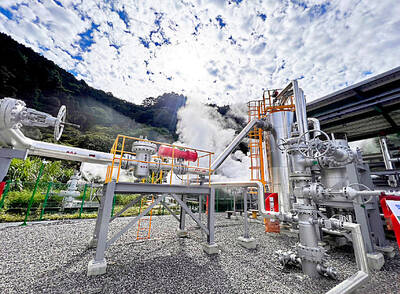
Taiwan’s semiconductor industry consumes electricity at rates that would strain most national grids. Taiwan Semiconductor Manufacturing Co (TSMC) alone accounted for more than 9 percent, or 2,590 megawatts (MW), of the nation’s power demand last year. The factories that produce chips for the world’s phones and servers run around the clock. They cannot tolerate blackouts. Yet Taiwan imports 97 percent of its energy, with liquefied natural gas reserves measured in days. Underground, Taiwan has options. Studies from National Taiwan University estimate recoverable geothermal resources at more than 33,000 MW. Current installed capacity stands below 10 MW. OBSTACLES Despite Taiwan’s significant geothermal potential, the

In our discussions of tourism in Taiwan we often criticize the government’s addiction to promoting food and shopping, while ignoring Taiwan’s underdeveloped trekking and adventure travel opportunities. This discussion, however, is decidedly land-focused. When was the last time a port entered into it? Last week I encountered journalist and travel writer Cameron Dueck, who had sailed to Taiwan in 2023-24, and was full of tales. Like everyone who visits, he and his partner Fiona Ching loved our island nation and had nothing but wonderful experiences on land. But he had little positive to say about the way Taiwan has organized its
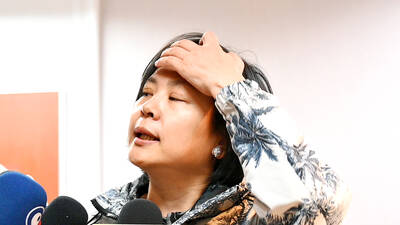
The entire Li Zhenxiu (李貞秀) saga has been an ugly, complicated mess. Born in China’s Hunan Province, she moved to work in Shenzhen, where she met her future Taiwanese husband. Most accounts have her arriving in Taiwan and marrying somewhere between 1993 and 1999. She built a successful career in Taiwan in the tech industry before founding her own company. She also served in high-ranking positions on various environmentally-focused tech associations. She says she was inspired by the founding of the Taiwan People’s Party (TPP) in 2019 by Ko Wen-je (柯文哲), and began volunteering for the party soon after. Ko
Chinese Nationalist Party (KMT) Chair Cheng Li-wun (鄭麗文) returned from her trip to meet People’s Republic of China (PRC) dictator Xi Jinping (習近平) bearing “a gift” for the people of Taiwan: 10 measures the PRC proposed to “facilitate the peaceful development of cross-strait relations.” “China on Sunday unveiled 10 new incentive measures for Taiwan,” wrote Reuters, wrongly. The PRC’s longstanding habit with Taiwan relations is to repackage already extant or once-existing policies and declare that they are “new.” The list forwarded by Cheng reflects that practice. NEW MEASURES? Note the first item: establishing regular communication mechanisms between the Chinese Communist Party


 RSS
RSS