


Charles Wooten has made some mistakes. First he overstayed his visa. Then on Nov. 19 last year he was caught by Taipei police driving a stolen motorcycle. He says he didn't know the bike was stolen and that he bought it from "a guy at a nightclub," whom he could not subsequently track down. Earlier this month, the Taipei District Court (台北地方法院) found him guilty of larceny and possession of stolen goods, fining him NT$5000. On account of these infractions, he has been detained for the last 161 days at a special detention center for foreign nationals. Only recently has he enjoyed the prospect of release, which will come when he is taken to CKS International Airport and deported.
In 1991, one foreign man who calls himself Jimmy was subjected to "hell on earth" for motorcycle theft. He served 45 days in Taoyuan Prison in a communal cell full of what he referred to as gangsters, murderers and the mentally imbalanced. He witnessed beatings and saw the aftermath of jail rape. On his first day in, he was threatened within an inch of his life by a "Big Brother" (大哥) from the notorious Bamboo Union gang. He said he only survived as "a wallflower."
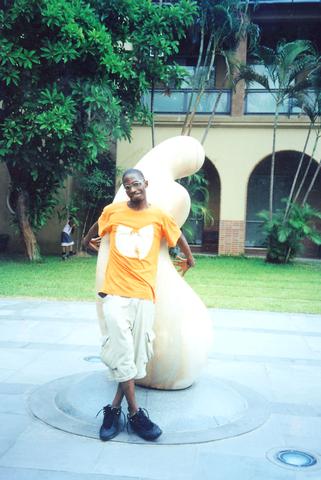
PHOTO: JOY DAI
Ivan, another foreigner, was arraigned, indicted and found guilty for theft of a motorcycle license plate last year. His verdict came in spite of the fact that the plate had been reported stolen two years before he ever came to Taiwan. As the circumstances of his case were extenuated, he was given a commuted sentence of 50 days and two years of criminal probation. He is still in Taiwan.
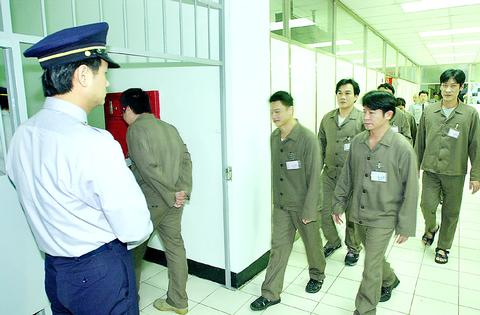
PHOTO: GEORGE TSORNG, TAIPEI TIMES
Over the last decade, motorcycle-related crimes have been a major trauma for a number of North Americans and Europeans living in Taiwan. The problem stems from the huge number of improperly registered motorcycles, said Chang Chuan (
Foreign offenders from all over the island who do not post bail end up at the Foreigners' Detention Center (
The detention center is a white, concrete and tile building surrounded by low fences and razor wire. It is located amid a large complex of police training facilities in Sanhsia (三峽), Taipei County. The average stay there is 77 days for lesser offenses such as overstaying a visa, but for those under investigation on criminal charges, like Wooten, the average stay is 250 days. Some inmates have been there for more than two years. However, none of that time counts toward prison terms that may eventually be handed down by Taiwan's courts.
The center has recently come under criticism for the protracted processing of its inmates, prompting a first-hand investigation of the matter on April 10 by Taiwan's Vice President, Annette Lu (
There are a number of factors contributing to foreigners' involvement in motorcycle crimes, including the legal impossibility for foreigners without Alien Resident Certificates (ARCs) of owning a motorcycle, the perception by many foreign residents of an unregulated environment and general ignorance of the law.
Like Wooten, Jimmy and Ivan, most lawbreakers feel that they have not committed a crime at all, or at least that they have committed one unwittingly. However, foreign residents holding student visas and tourist visas, including five year multiple reentry permits, cannot legally apply for a Taiwan driver's license, nor can they register motorcycles under their own names. Yet many still wish to buy motorcycles or scooters as a convenient form of transportation.
For the embassies, consulates and foreign trade offices in Taiwan, and especially for Taiwan's courts, none of these conditions removes offenders from the purview of the law. Most foreign representative offices in Taiwan take attitudes similar to what is expressed in the "Guide for Canadians Imprisoned Abroad," which reads: "If you break the laws of another country, you are subject to the judicial system of that country. Being a foreigner or not knowing the local laws is not an excuse."
Even so, many find it hard not to blame an environment of quasi-legality and haphazard enforcement.
"You almost feel like not obeying the law," said Jimmy, describing prevalent attitudes in the early 1990s. "It's just not applied anywhere. You see where they have rules and regulations and people violate them willy nilly ? You get the feeling there's no force behind [the law]." This perceived laxness was enough, he said, to adopt the mindset that brought him to steal a motorcycle. At the time, his motorcycle had recently been stolen and he was acquainted with several foreign friends who had taken abandoned motorcycles and "rehabilitated" them.
"Nobody was worrying about it," he said.
Though he now realizes that his act was wrong, he said that having no legal means of purchasing a motorcycle helped him rationalize his crime. Using similar reasoning, Ivan feels that the difficulties of getting the proper papers induce many foreigners to purchase questionably legal bikes. He bought his motorcycle from "a British guy" for NT$5000 four or five days after he arrived in Taiwan.
"What [the guy] told me," said Ivan, "was that a lot of foreigners don't have registration or have registration in somebody else's name ? and when you get pulled over by the cops it doesn't matter much -- which I found to be true, right? Because I got pulled over by the cops eight or nine times [at routine roadside checks] before I was arrested."
Wooten tells a similar story, saying he was lured by the motorcycle's cheap price of NT$2500 down and the promise of future payment. According to Correct Law's Chang, buyers should know better. "If the price is too cheap, you know it's stolen -- that's what the court thinks," he said.
For his ignorance, Ivan was apprehended when a policeman ran a random check on his license plate while he was stopped at a traffic light. He was then taken to a precinct station and was then questioned at a second Taipei police station where he was held overnight. The following morning he was arraigned by a prosecuting attorney and released on bail.
He describes the experience as unnerving and less-than-straightforward. "They were never really square with [me and the friend who was on the back of my bike]," he said. "I'm in the police station and the police are telling me this is xiao shiqing (
And in spite of it all, he said, "The cops at the stations were really nice, you know. Some of them even asked me if I would teach them English."
When the police finally told Ivan he was under arrest, they continued to tell him that it wasn't a big deal, that he didn't need a lawyer and that it wouldn't go to trial. "But it did," he said.
Jimmy's experience was similar. "They totally extract a confession and they don't have to torture you, they just give you the nice guy treatment. And that, after what you've been through, after your psychological terror of being arrested and being put in this situation, you're pretty softened up already. So you're willing to spill your guts when they're telling you this nice guy story, like at worst you'll see a week and then you'll get kicked out of the country or something."
While both Ivan and Jimmy were able to post bail and retain relative freedom during their trials (Jimmy's passport was held, Ivan's was not), Wooten is being held at the Sanhsia detention center until his situation can be finalized. Complicating his case is his visa overstay of ten months.
"According to immigration law, any overstay must be held at the detention center," said John C.F. Chang (
Trials are conducted entirely in Mandarin and can be very drawn out. Ivan's took about five months, Jimmy's about eight months including an appeal, and Wooten's five months. All three defendants hired lawyers at their own expense, with legal fees running from NT$40,000 to NT$70,000.
Neither Ivan nor Jimmy felt that the courtroom proceedings were especially relevant to their cases or that their lawyers were able to mount meaningful defense cases. Ivan said his trial was "just ridiculous," while Jimmy felt that he had come before a "hanging judge."
Wooten refused to comment on his trial, as he is still in detention.
The judge and prosecutor "would talk about all kinds of crazy things, like whether my cousins in the US drove motorcycles," said Ivan. "My lawyer was grasping for things to say to fill time."
In the end, all three defendants were found guilty of motorcycle theft and Wooten was also found guilty of possession of stolen goods. In his trial, Wooten was unable to prove that he had purchased the motorcycle from a third party, and his ruling stated that he stole the vehicle after finding the keys left in the ignition -- an assertion he plainly denies.
According to Chang of Correct Law, possession of stolen goods and larceny are different crimes under Taiwan's law, but both carry the same penalty of five years imprisonment or less. Moreover, he said that court sentencing of foreign residents is usually consistent with that of Taiwanese, and sometimes even more lenient.
"Long jail sentences are for professional motorcycle thieves," he said. "In the case of foreigners, the penalty is usually very light because they are first-time offenders and the motorcycles they are found to have stolen have little value. In most cases, foreign offenders are not even deported."
Chen, also of Correct Law, added, "In those cases where foreigners receive jail time, except for serious crimes such as drug crimes, they are generally deported instead of being forced to serve out their sentences."
Yet 10 years ago in Jimmy's case, the outcome was worse than he could have imagined: deportation, a ban on returning to Taiwan for 10 years, and all preceded by hard time in a Taiwan prison. While serving his sentence, he said he spent 45 days sitting on the ground of his cell, because "the guards didn't want us milling around."
"I saw a couple guys get the [expletive] beat out of them," he said. One was a Malaysian worker who was attacked after using the toilet, because "it smelled really bad and he didn't flush promptly."
"So when he came out, Big Brother said `Oh. Oh, you stunk up the whole cell you evil smelling foreign bastard. And [the Malaysian] gave him some lip, like `oh oho it didn't smell that bad.' Immediately there were like three guys on him just kicking the [expletive] out of him ... I was paralyzed. I was [expletive] bricks I was so scared."
Chang said currently, such prison sentences are extremely rare for foreign residents convicted of motorcycle theft. Taiwan's criminal code allows those sentenced to jail terms of six months or less to pay fines instead of serving time. However, the court can choose to waive that privilege at its discretion, as it did in Jimmy's case.
Jimmy believes that his stiff sentence had to do with police's suspicion of other crimes, possibly offenses that were drug-related. He said police ransacked his apartment and had him under surveillance for some time before his arrest, but has no conclusive evidence to prove that he was under investigation for anything besides motorcycle theft, "because the prosecutors would not share information relating to their investigations with my attorney," he said.
Neither Wooten nor Ivan had such complications. Ivan received only a commuted sentence, probation and the right to stay in Taiwan; and Wooten's stay at Sanhsia has been a comfortable one in comparison to Jimmy's nightmare. Though Wooten was put in solitary confinement for three days for spreading word of a long-running detention center ghost story, he, like all detainees, has been allowed telephone privileges, reading material and other gifts from friends, weekly visits from his girlfriend, and standard recreational activities, like basketball. The rub is the depravation of his liberty. "I just want to get out of here," he said.
Next week, he will likely get his wish. After five months and 10 days of incarceration, his final courtroom judgment, which calls for no jail time and a fine of only NT$5000, has received the endorsement of the attorney that prosecuted his case. Once his girlfriend can arrange airline tickets to the US, he will be homeward bound.
A few legal facts
*A total of 762 foreign nationals were convicted of crimes last year, with the most offenders coming from Thailand (181), the Philippines (134), Myanmar (86), Hong Kong (60), South Korea (38), the United States (32), Japan (22), India (8) and the United Kingdom (6).
*Larceny accounted for 242 out of 762 convictions of foreigners last year and was the dominant category for foreign crime in each of the last five years. Possession of stolen goods accounted for 22, or 2.8 percent of convictions last year.
*Taiwan law does not differentiate between felonies and misdemeanors. Larceny includes all theft regardless of the value of goods stolen. Court penalties, however, take into account the degree and circumstances of the crime. Light penalties generally do not result in deportation.
*Defendants have the right to attorney and the right to remain silent during initial police interrogation and questioning by the prosecuting attorney. At these early stages, however, defendants are not always informed of these rights. In some cases, defendants have been advised against hiring a lawyer and been questioned without being told that they were charged with a crime.
*There are currently 197 foreign nationals (almost all of them male) in Taiwan jails and prisons, including 10 North Americans an Europeans. The foreigners' detention center in Sanhsia currently houses 113 inmates (57 female, 56 male), including the 10 North Americans and Europeans.
*Embassies, consular offices and foreign trade offices expect citizens of their respective countries to abide by Taiwan law and submit to the verdicts of its courts. Most offer their citizens limited support, such as lists of lawyers, general advice, prison visits and assistance in contacting relatives.

Ajay Verma, a consultant gastroenterologist at Kettering general hospital in Northamptonshire, says our gut is a “complex machine.” “It is constantly providing us with the nutrition we need, initially to grow and develop, and then for us to survive, thrive and repair from injury and illness.” How can we keep it functioning well? Put simply: “Make sure what you put into it is balanced, and that you clear out its waste products adequately,” Verma says. “In a general gastroenterology clinic, the most common conditions we see are irritable bowel syndrome (IBS), gastroesophageal reflux disease, inflammatory bowel disease and constipation,” says Nisha

And so, in the wake of US President Donald Trump’s trip to the People’s Republic of China (PRC), all the experts on the Strait of Hormuz suddenly became experts on US-China-Taiwan relations. The Internet has certainly expanded human knowledge. Lots of these sudden experts made noise this week about Trump’s words after the meeting with PRC dictator Xi Jin-ping (習近平). Trump is going to sell out Taiwan! Longtime Taiwan commentator J. Michael Cole summed the situation up neatly in the Guardian: “We need to keep in mind that he has a tendency to say many things — sometimes contradicting himself within

Last week US President Donald Trump was asked by a reporter whether he would speak on the phone to the President of Taiwan. “l’ll speak to him. I speak to everybody. We have that situation very well in hand,” Trump said. This marked the second time in a couple of weeks he had said he would talk to the President of Taiwan. In 2016 he famously took a call from then-president Tsai Ing-wen (蔡英文), when he was president-elect. Despite warnings that the apocalypse was nigh because of a phone call, the world quickly forgot about the conversation between two democratically-elected presidents.

May 25 to May 31 Few believed that apples could be cultivated on a commercial scale in Taiwan’s high mountains. When horticulturalist Cheng Chao-hsiung (程兆熊) first proposed the idea in 1955, both American and Taiwanese colleagues dismissed it as implausible, arguing that temperate fruit could not be reliably grown on a subtropical island, especially on rugged terrain. However, it was this terrain in the Central Mountain Range where many Chinese Civil War veterans were resettled in the late 1950s. With limited job prospects and no family in Taiwan, they were placed on cooperative farms aimed toward self-sufficiency. Some say the conditions


 RSS
RSS