


Formerly remote, peaceful, and entirely rural, Laos is said to have become, in the 1960s and early 1970s, the most heavily bombed country on the planet.
Today, unexploded ordnance still constitute a terrible source of death and mutilation in many parts of the country. If the new Bush administration is looking for a cause that will win it unanimous international applause, it might be to clear this impoverished land of the US' dreadful legacy, perhaps under the slogan "We put 'em there, we should take 'em away."
In his classic travel book A Dragon Apparent, Norman Lewis wrote that 50 years ago, Vientiane or Luang Prabang were the dream postings of French colonial administrators. The land-locked, hilly country, with its diminutive towns and devout Buddhists, was a sleepy, indulgent Shangri-la where nothing important, or worrying, ever seemed to happen.
The battle against the French, fought by nationalists fired by communist ideology, changed all that. And when the Americans took over from the French in the battle against communism in Indochina, Laos was tragically drawn into the conflict. As William Shawcross chillingly documented in his book Sideshow, Cambodia and Laos were bombed, secretly at first, in an attempt to rupture the supply lines of Vietnam's communist Viet Cong.
Laos remains an out-of-the-way destination. Its communist government appears to be of two minds about the desirability of tourism, and generally only groups are admitted. Yet the religious center of Luang Prabang is one of the jewels of the region, and some of the hill tribes have, as Stephen Mansfield asserts in this excellent little book titled Lao Hill Tribes, still never set eyes on a tourist.
A true count of the country's many minority groups is apparently close to impossible. With regard to language alone, the country is thought to contain roughly 600 different dialects. Certain tribes nevertheless dominate.
One of the biggest is the Hmong. A people of Chinese origin and still numerous in China's Yunnan Province, the Hmong used to be known as the Lao warrior class. Their fidelity led them to ally strongly with the former royal dynasty, and as a result they suffered badly when the former guerrillas, the Pathet Lao, came to power in 1975. Some 80,000 Hmong now live in the US, part of the 750,000 Lao -- about one sixth of the population -- displaced by the conflicts of a generation ago.
Several of the tribes appear to have originated in China, and to have been driven south by more powerful groups. The Mien, for example, still venerate a Chinese dog deity. And the Hmong themselves have myths that tell of their origin in a distant land of long winter nights, and permanent ice and snow, suggesting to anthropologists a Mongolian provenance.
For the rest, the hill people of Laos appear as colorful as most threatened minorities worldwide. They still trade using silver, and old coins are a prominent feature of many hill tribe costumes.
In some tribes the women practice serial monogamy -- any number of husbands, but never two at once and it's the wife who makes the move when she feels like a change. Children born to Mien single mothers enhance their value when they marry, perhaps on the grounds that they bring potential workers into the new family, and with no strings attached.
Then there are the Kaw, whose women can wear a form of miniskirt without there being any hint of immodesty. Most tribes are virtually vegetarian, sacrificing any animals they have to spirits. Some are wary of nocturnal journeys along river banks in case water spirits trick them into taking a dive in the mistaken belief that they're actually fish.
In the minds of many lowland Lao, the hill dwellers possess an awesome magical power. Even the former kings felt they needed these people's blessings on a regular basis, and tribal shamans are more popular (and more readily available) than doctors.
Not surprisingly the hill tribes are extensive cultivators of the opium poppy. It's an attractive crop to them because it needs to be grown at high elevations, so the more prosperous lowlanders for once can't compete. The trade is clearly tolerated, and rumor has it that you stand a better chance of getting an individual visa to visit the country after the poppy harvesting season (December to February) is over.
In the most shocking sentence in the book, Mansfield writes that "The government of Laos has declared its intention to resettle all the hill tribes onto the lowland plains within the next few years."
If put into effect, this would constitute one of the most draconian and tragic acts of social displacement in modern Asia. Indonesia's long-standing policy of moving people to remote locations is even now displaying its disastrous consequences in southern Borneo, where thousands of Maduran immigrants are having to be evacuated from Kalimantan because of the hostility of indigenous Dayaks.
The Lao hill tribes, however, are unlikely to take such threats lying down. They provided, after all, the most stubborn resistance in all Laos to the French, just as Taiwan's highland Aborigines did to the Japanese. Even so, the government plan is a real danger, and made all the more serious by the suspicion that it's the ambitions of foreign logging companies that lie behind the policy. Such people have the resources to intimidate populations in ways that Laos's impoverished government probably could not muster on its own.
This book is one of a series brought out by Oxford University Press titled "Images of Asia." Compact though they are, each is written by an expert in the field. They are colorfully illustrated and attractively produced. Among other areas covered are heritage sites, ancient cities and their historical contexts and Asia's birds. The striking illustration on the cover of this book also adorns the back cover of their catalog.For your information
Lao Hill Tribes
By Stephen Mansfield
116 pages
Oxford University Press

This is the year that the demographic crisis will begin to impact people’s lives. This will create pressures on treatment and hiring of foreigners. Regardless of whatever technological breakthroughs happen, the real value will come from digesting and productively applying existing technologies in new and creative ways. INTRODUCING BASIC SERVICES BREAKDOWNS At some point soon, we will begin to witness a breakdown in basic services. Initially, it will be limited and sporadic, but the frequency and newsworthiness of the incidents will only continue to accelerate dramatically in the coming years. Here in central Taiwan, many basic services are severely understaffed, and
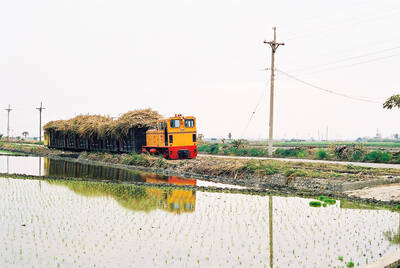
Jan. 5 to Jan. 11 Of the more than 3,000km of sugar railway that once criss-crossed central and southern Taiwan, just 16.1km remain in operation today. By the time Dafydd Fell began photographing the network in earnest in 1994, it was already well past its heyday. The system had been significantly cut back, leaving behind abandoned stations, rusting rolling stock and crumbling facilities. This reduction continued during the five years of his documentation, adding urgency to his task. As passenger services had already ceased by then, Fell had to wait for the sugarcane harvest season each year, which typically ran from
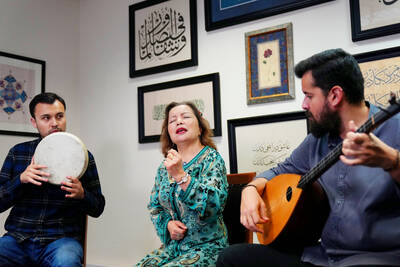
It is a soulful folk song, filled with feeling and history: A love-stricken young man tells God about his hopes and dreams of happiness. Generations of Uighurs, the Turkic ethnic minority in China’s Xinjiang region, have played it at parties and weddings. But today, if they download it, play it or share it online, they risk ending up in prison. Besh pede, a popular Uighur folk ballad, is among dozens of Uighur-language songs that have been deemed “problematic” by Xinjiang authorities, according to a recording of a meeting held by police and other local officials in the historic city of Kashgar in

The People’s Republic of China (PRC) was out in force in the Taiwan Strait this week, threatening Taiwan with live-fire exercises, aircraft incursions and tedious claims to ownership. The reaction to the PRC’s blockade and decapitation strike exercises offer numerous lessons, if only we are willing to be taught. Reading the commentary on PRC behavior is like reading Bible interpretation across a range of Christian denominations: the text is recast to mean what the interpreter wants it to mean. Many PRC believers contended that the drills, obviously scheduled in advance, were aimed at the recent arms offer to Taiwan by the


 RSS
RSS