


In the past, without the modern conveniences of double-glazing, air-conditioners and convection heaters, people had to rely on the blessings of nature for their comfort or even survival. For example, the principles of fengshui often dictate that the door of a building should face north, avoiding the glare of the rising sun and the direct heat of summer.
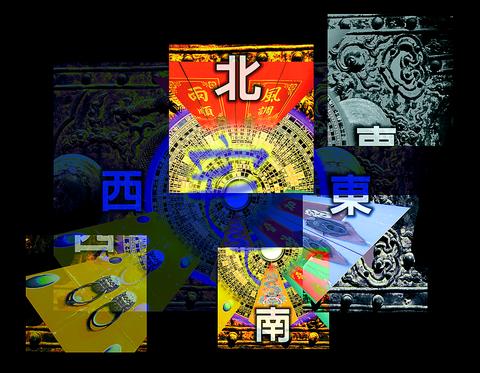
While this and many other principles of fengshui may have made perfectly good sense when building a mud brick house on the alluvial plains of the Yangtze River, they don't always seem to make sense in the modern world.
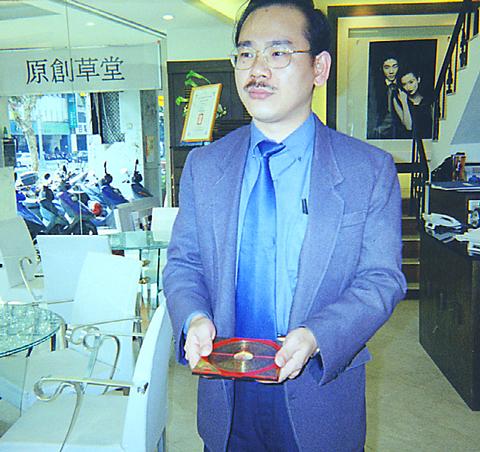
PHOTO: LISA CHIU
"Things have changed and many of the traditional fengshui applications are not practical and sometimes conflict with modern architecture," Lin Hung-ming (林弘敏), an interior designer said. He also said that interior designers often prefer to build more or larger windows to make buildings brighter and happier, but many fengshui masters object to such ideas as conflicting with fengshui taboos. "And most of them have not been trained in interior design," said Lin.
Expert Advice
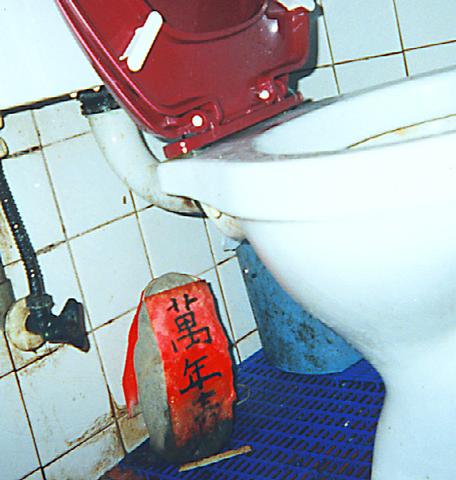
PHOTO: LISA CHIU
During the Ming dynasty (1368-1644), fengshui became popular among fortunetellers, who liked to draw connections between the place a person lived and that person's luck. The practice of fengshui drew heavily on the lore of divination and developed a complex system of rules and taboos that may seem quaint to the skeptical but still influence people today.
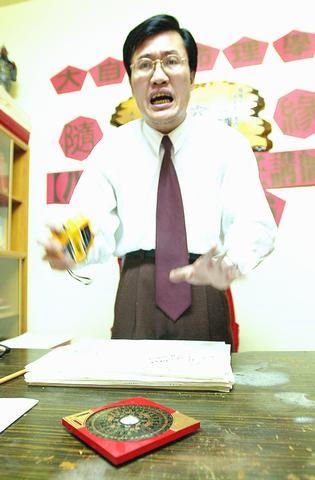
PHOTO: GEORGE TSORNG, TAIPEI TIMES
For example, the front door of a house must not be in a direct line with the back door, for it is believed that good fortune will not remain in your house. The toilet, no matter how clean it is, should never face the front entrance. A bed should never be placed under a load-bearing wall, and you should never sleep with your feet pointing towards the bedroom door.
This may seem simple enough, but the subtleties of the art are known only to the practitioners, and their skills do not come cheap. To have a house inspected by a professional in the field costs about NT$30,000 to NT$50,000, and this does not include alterations that the fengshui master might recommend.
When Lin Chuo-kung (
Tseng Chung-sen (
"Although the fengshui masters do not necessarily make radical suggestions to the owner, it can be quite challenging doing interior design for a client when he is a strong believer of fengshui," interior designer Lin said. He added that it was surprising how many of his clients who believe strongly in fengshui are well-educated, successful business executives. He himself started studying fengshui six years ago.
Although not all fengshui methods are applicable to modern buildings because of the limitations of space in big cities, many land developers and designers will still consult a fengshui master. Although few will admit to believing everything about fengshui, they feel it is better to be safe than sorry.
Kao Hung-yuan (
Li You-peng (李宥朋), a civil engineer with the International Steel Company (理成工業), pointed out that many elements of fengshui have a practical or scientific explanation. "As an example, he pointed to the taboo against placing a mirror at the foot of a bed. Long ago when artificial light was poor, "you might wake up in the middle of the night and mistake your reflection for a ghost and scare yourself to death."
Placement is key
"I believe in fengshui but I am also a sensible person," said Lin of Sara House. "It's all about making more money and providing a better life for my family," he said. Although he is not superstitious, Lin said that he'd rather not gamble with his NT$10 million investment in his restaurant. "I see the money I put into fengshui as part of the investment," he says.
For many others, fengshui also means the difference between success and failure, health and death. Weng Yuan-pu (
At a small gathering at Weng's restaurant, Yang upbraids Weng for letting a guest sit in the seat behind the aquarium.
"I have specifically told you not to let anyone sit in that seat because that is where your money spot is," Yang says. Weng apologizes and asks the occupant to find another place to sit.
"I am happy that I met Master Yang," he said. Weng is now in the process of shopping for a larger place to expand his restaurant, "but of course, I have to see if Yang will help me locate a lucky place that suits my fengshui."


The US war on Iran has illuminated the deep interdependence of Asia on flows of oil and related items as raw materials that become the basis of modern human civilization. Australians and New Zealanders had a wake up call. The crisis also emphasizes how the Philippines is a swatch of islands linked by jet fuel. These revelations have deep implications for an invasion of Taiwan. Much of the commentary on the Taiwan scenario has looked at the disruptions to world trade, which will be in the trillions. However, the Iran war offers additional specific lessons for a Taiwan scenario. An insightful
Polling data often confirms what we expect, but sometimes it throws up surprises. When examined over time, some patterns appear that speak to something bigger going on. In this column, whenever possible, Formosa’s polls are used. Despite the sometimes cringeworthy antics of Formosa’s Chairman, Wu Tzu-Chia (吳子嘉), the data produced includes detailed breakdowns crucial for analysis. It has also been conducted monthly 11-12 times a year for many years with many of the same questions, allowing for analysis over time. When big shifts do occur between one month and the next it is usually in response to some event in
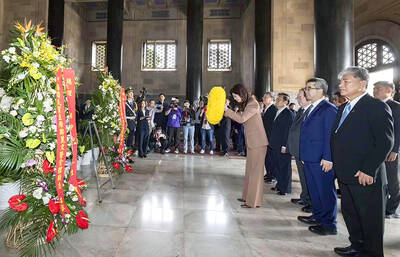
The problem with Marx’s famous remark that history repeats itself, first as tragedy, the second time as farce, is that the first time is usually farce as well. This week Chinese Nationalist Party (KMT) Chair Cheng Li-wun (鄭麗文) made a pilgrimage to the People’s Republic of China (PRC) “to confer, converse and otherwise hob-nob” with Chinese Communist Party (CCP) officials. The visit was an instant international media hit, with major media reporting almost entirely shorn of context. “Taiwan’s main opposition leader landed in China Tuesday for a rare visit aimed at cross-strait ‘peace’”, crowed Agence-France Presse (AFP) from Shanghai. Rare!
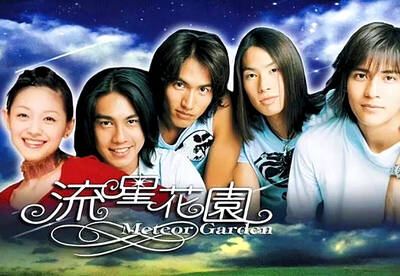
April 6 to April 13 Few expected a Japanese manga adaptation featuring four tall, long-haired heartthrobs and a plucky heroine to transform Taiwan’s television industry. But Meteor Garden (流星花園) took the nation by storm after premiering on April 12, 2001, single-handedly creating the “idol drama” (偶像劇) craze that captivated young viewers across Asia. The show was so successful that Japan produced its own remake in 2005, followed by South Korea, China and Thailand. Other channels quickly followed suit, with more than 50 such shows appearing over the following two years. Departing from the melodramatic


 RSS
RSS