


Sometimes it seems that director Vivian Chang (章蕙蘭) would like to forget who she is.
As the great-granddaughter of Chiang Kai-shek (
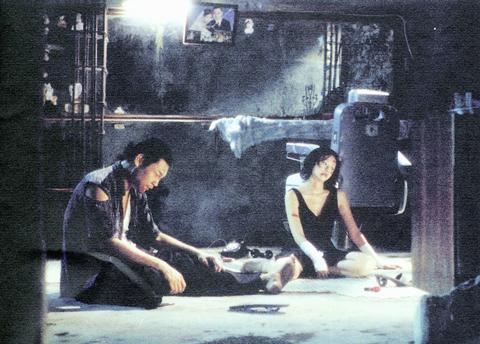
PHOTO: CMPC
The 29-year-old director's Hidden Whisper (

PHOTO: COURTESY OF CMPC
The high school teen, Hsiao-bai (
"The name Hidden Whisper means secretive episodes of life. The words these three girls said at the end of each part imply three kinds of sentiment to themselves," Chang said. The film was well received by critics at Cannes and it went on to receive kudos at the Edinburgh Film Festival and at the Pusan International Film Festival. Many critics said the work was a rare Taiwanese film because it wasn't overwhelmed by a burdensome social or political message.
The film instead seems to track a person's gleeful dalliance with escapism.
When the 5-year-old Hsiao-bai listens to her parents' violent fights in the darkness, she fantasizes that they are instead dancing an elegant tango. Hidden in the subtext is the characters' desire to be anyone other than who she is. "Growing up I sometimes wondered if I was someone else, what kind of life would I be living," Chang said. As a student, Chang was often rebellious, sometimes in an attempt to shirk the expectations inherent in the family mantle. "At high school, I skipped classes to go to movies, go dancing and play volleyball, basketball, anything but books," she said. "I even changed my school record cards to pretend I was a good student for my mom. It was at that time I realized an unruly part of my personality."
Although her parents hoped she would study law, Chang chose to learn filmmaking at Boston University, after first earning a sociology degree. At the film's local premiere, last Saturday, her father said, "When we heard she wanted to study film in the US, we did have some reservations and worries about the idea." But he is well used to it now, and brimming with pride as his daughter is referred to as "Director Chang."
Despite her youth, Chang is an experienced producer of short films, getting her first break by working on Sylvia Chang's (
Since the CMPC is a KMT party-owned business it's easy to conjure up such speculation. One might easily assume that a film industry bureaucrat would try to curry favor with the KMT by showing generosity toward the young artist. It happened once, which brought Chang's family background into the spotlight, ultimately stunting instead of benefiting her career. She was offered a chance by CMPC to film an award-winning script, but because of the scriptwriter's insistence on making his own film and a rumor about KMT pressure, Chang rejected the offer to elude a possible backlash.
Asking about her family has been a taboo and Chang is well-known for her poker-face when it comes to her father. "Anyone who knows Vivian would know that she hates this subject," a CMPC official said.
But like the character in Hidden Whisper, Chang is resolving her problems, partially by taking on a new identity. "I am still learning what it's like to be a director," she said. With such a strong first outing at Cannes, Chang surely has great things in store once she gets the hang of it.
INFO: For more information, contact Mingson Chou at tel: (02) 2381-2742 or check out additional information at www.oriented.org/index.shtml.
WHERE: The Majestic Theater is located at 7F, 116 Hanchung Street, Taipei (
MISC: Chang will be present for a 20-minute Q&A session at the end of the two English subtitled screenings.
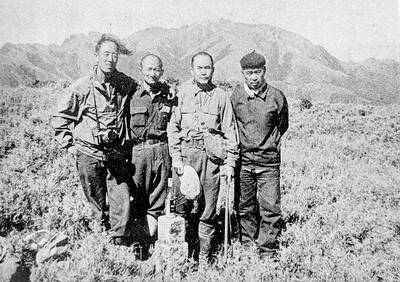
May 18 to May 24 Gathered on Yangtou Mountain (羊頭山) on Dec. 5, 1972, Taiwan’s hiking enthusiasts formally declared the formation of the “100 Peaks Club” (百岳俱樂部) and unveiled the final list of mountains. Famed mountaineer Lin Wen-an (林文安) led this effort for the Chinese Alpine Association (中華山岳協會). Working with other experienced climbers, he chose 100 peaks above 10,000 feet (3,048m) that featured triangulation points and varied in difficulty and character. The list sparked an alpine hiking craze, inspiring many to take up mountaineering and competing to “conquer” the summits. A common misconception is that the 100 Peaks represent Taiwan’s 100 tallest

Yesterday, the Democratic Progressive Party (DPP) nominated legislator Puma Shen (沈伯洋) as their Taipei mayoral candidate, the Chinese Nationalist Party (KMT) put their stamp of approval on Wei Ping-cheng (魏平政) as their candidate for Changhua County commissioner and former legislator Tsai Pi-ru (蔡壁如) of the Taiwan People’s Party (TPP) has begun the process to also run in Changhua, though she has not yet been formally nominated. All three news items are bizarre. The DPP has struggled with settling on a Taipei nominee. The only candidate who declared interest was Enoch Wu (吳怡農), but the party seemed determined to nominate anyone

In a sudden move last week, opposition lawmakers of the Chinese Nationalist Party (KMT) and Taiwan People’s Party (TPP) passed a NT$780 billion special defense budget as a preemptive measure to stop either Chinese leader Xi Jinping (習近平) or US President Donald Trump from blocking US arms sales to Taiwan at their summit in Beijing, said KMT heavyweight Jaw Shaw-kong (趙少康), speaking to the Taipei Foreign Correspondents Club on Wednesday night in Taipei. The 76-year-old Jaw, a political talk show host who ran as the KMT’s vice presidential candidate in 2024, says that he personally brokered the deal to resolve

“China wants to unify with Taiwan at the lowest possible cost, and it currently believes that unification will become easier and less costly as time passes,” wrote Amanda Hsiao (蕭嫣然) and Bonnie Glaser in Foreign Affairs (“Why China Waits”) this month, describing how the People’s Republic of China (PRC) is playing the long game in its quest to seize Taiwan. This has been a favorite claim of many writers over the years, easy to argue because it is so trite. Very obviously, if the PRC isn’t attacking Taiwan, it is waiting. But for what? Hsiao and Glaser’s main point is trivial,


 RSS
RSS