


An influential Silicon Valley presence for more than a decade, OpenAI CEO Sam Altman is emerging as the tech titan of the AI age, riding the wave of ChatGPT, the bot his company unleashed on the world.
Altman testified Tuesday to a US Senate Judiciary Committee panel and said artificial intelligence could be at a “printing press” moment, which would make him one of its main pioneers.
In 2015, Altman joined Tesla chief Elon Musk and others in starting OpenAI, a research company with a stated goal of building generative AI that benefits humanity.
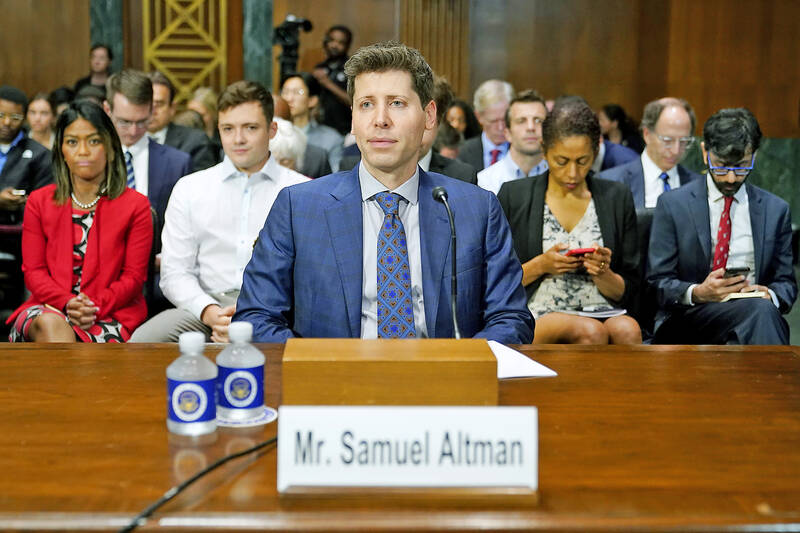
Photo: AP
“The technological progress we make in the next 100 years will be far larger than all we’ve made since we first controlled fire and invented the wheel,” Altman said in a 2021 blog post.
STARTUP GURU
Born in 1985 into a Jewish family, Altman grew up in a St. Louis suburb, where he got his first computer at the age of eight, according to a long profile in the New Yorker from 2016.

Photo: AP
Computers and the access to online community they enable helped him navigate being gay in a conservative part of the country, Altman said in an interview with Esquire.
Like so many tech figures before him, Altman dropped out of Stanford University to start a company, Loopt, which let smartphone users selectively share their whereabouts.
Loopt was acquired in 2012 in a deal valued at US$43.4 million — and Altman’s place in Silicon Valley was secured.
Altman took a year off during which he “read many dozens of textbooks; I learned about the fields that I had been interested in,” the San Francisco resident wrote in a post.
He told of learning about nuclear engineering, synthetic biology, investing and AI.
“The seeds were planted for things that worked in deep ways later,” he said.
T-SHIRTS AND SHORTS
In 2014, Altman became president of Y Combinator, an “accelerator” that provides startups with guidance and funding in exchange for stakes in the young companies.
Altman expanded Y Combinator’s strategy for investing beyond software startups to biotech, energy, and other fields.
“He thinks quickly and talks quickly; intense, but in a good way,” said Industrial Microbes founder Derek Greenfield, who met Altman while his biotech startup was getting backing from Y Combinator.
Greenfield recalled Altman always dressing casually, sometimes in a T-shirt and shorts.
“He was very down to earth,” Greenfield said.
Altman left Y Combinator, putting his energy into artificial intelligence despite feared risks.
“He’s a very deep thinker who is incredibly focused on getting things right,” Insider Intelligence senior director of marketing and commerce Jeremy Goldman said.
Altman backed a “United Slate” political project in 2018 aimed at improving housing and healthcare policy.
He also held a fundraising event for 2020 US presidential candidate Andrew Yang, who advocated for universal basic income.
Yang “had some ideas about universal basic income that (he said) everybody needed, in part because AI was going to take the people’s jobs,” Goldman said.
Altman has proposed that combining artificial intelligence, robotics and cost-free energy could essentially enable machines to do all the work and provide a “basic income” to adults across society.
“A great future isn’t complicated: we need technology to create more wealth, and policy to fairly distribute it,” Altman wrote in a blog post.
“Everything necessary will be cheap, and everyone will have enough money to be able to afford it.”
‘FAST CARS AND SURVIVAL’
In the New Yorker article, Altman said he was a “prepper,” someone who has preparations and supplies in place to survive an apocalyptic disaster.
He has spoken of owning high-performance sports cars and renting planes to fly around California.
Altman said in a blog post that the last day of each December he writes a list of things he wants to accomplish in the year ahead.
His personal investments include startups working on fusion energy and human life extension.
“I’m super optimistic,” he said in a podcast with TED curator Chris Anderson.
“It’s always easy to doom scroll and think about how bad things are,” Altman added, “but the good things are really good and getting much better.”

The US war on Iran has illuminated the deep interdependence of Asia on flows of oil and related items as raw materials that become the basis of modern human civilization. Australians and New Zealanders had a wake up call. The crisis also emphasizes how the Philippines is a swatch of islands linked by jet fuel. These revelations have deep implications for an invasion of Taiwan. Much of the commentary on the Taiwan scenario has looked at the disruptions to world trade, which will be in the trillions. However, the Iran war offers additional specific lessons for a Taiwan scenario. An insightful

The problem with Marx’s famous remark that history repeats itself, first as tragedy, the second time as farce, is that the first time is usually farce as well. This week Chinese Nationalist Party (KMT) Chair Cheng Li-wun (鄭麗文) made a pilgrimage to the People’s Republic of China (PRC) “to confer, converse and otherwise hob-nob” with Chinese Communist Party (CCP) officials. The visit was an instant international media hit, with major media reporting almost entirely shorn of context. “Taiwan’s main opposition leader landed in China Tuesday for a rare visit aimed at cross-strait ‘peace’”, crowed Agence-France Presse (AFP) from Shanghai. Rare!

What is the importance within the Chinese Nationalist Party (KMT) of the meeting between Xi Jinping (習近平), the leader Chinese Communist Party (CCP), and Cheng Li-wun (鄭麗文), the leader of the KMT? Local media is an excellent guide to determine how important — or unimportant — a news event is to the public. Taiwan has a vast online media ecosystem, and if a news item is gaining traction among readers, editors shift resources in near real time to boost coverage to meet the demand and drive up traffic. Cheng’s China trip is among the top headlines, but by no means

Sunflower movement superstar Lin Fei-fan (林飛帆) once quipped that the Democratic Progressive Party (DPP) could nominate a watermelon to run for Tainan mayor and win. Conversely, the DPP could run a living saint for mayor in Taipei and still lose. In 2022, the DPP ran with the closest thing to a living saint they could find: former Minister of Health and Welfare Chen Shih-chung (陳時中). During the pandemic, his polling was astronomically high, with the approval of his performance reaching as high as 91 percent in one TVBS poll. He was such a phenomenon that people printed out pop-up cartoon


 RSS
RSS