


Apple Inc began making its new iPhone 14 in India sooner than anticipated, after a surprisingly smooth production rollout that slashed the lag between Chinese and Indian output from months to mere weeks.
The US tech giant made the announcement yesterday, weeks after the marquee device’s Sept. 7 unveiling.
It had worked with Hon Hai Precision Industry Co (鴻海精密), known internationally as Foxconn Technology Group (富士康科技集團), with the original goal of assembling iPhones in Chennai about two months after global launch.

Photo: Bloomberg
The partners quickened the process after resolving supply chain issues, which helped production go smoother than expected, people familiar with the matter said on condition of anonymity.
Apple, which long made most of its iPhones in China, is seeking alternatives as Chinese President Xi Jinping’s (習近平) administration clashes with the US government and imposes COVID-19 lockdowns across the country that have disrupted economic activity.
Indian Prime Minister Narendra Modi’s administration is keen to make his country a viable competitor to China in technology and production capability, especially as Western investors and corporations begin to sour on Beijing’s track record.
“India is now an attractive location for manufacturing as it offers better labor cost structure while Apple is looking to reduce geopolitical risks,” Haitong International Securities Group (海通國際證券) analyst Jeff Pu (蒲得宇) said.
“To turn India into a major manufacturing site, Apple will help India accelerate its production timeline,” he said.
“We’re excited to be manufacturing iPhone 14 in India,” Apple said in a statement yesterday without discussing a production timeline.
A Hon Hai representative declined to comment.
Apple partners such as Hon Hai, which makes the majority of the world’s iPhones, typically begin assembling the device in India about six to nine months after Chinese factories. That is partly because more time is needed to secure and ship critical components to a supply chain less accustomed to the process.
Still, analysts such as Kuo Ming-chi (郭明錤) of TF International Securities Group Co (天風國際證券) have said they anticipate that Apple could eventually ship new iPhones from both countries at about the same time, a milestone in Apple’s efforts to diversify its supply chain and build redundancy.
Apple’s partners began making iPhones in India in 2017, the start of a years-long effort to build manufacturing capabilities in the country.
Besides offering backup to existing operations, the country of 1.4 billion is a promising consumer market, and the Modi administration has offered financial incentives under its “Make in India” program.
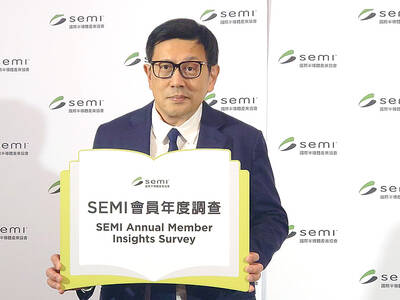
PRICE HIKES: The war in the Middle East would not significantly disrupt supply in the short term, but semiconductor companies are facing price surges for materials Taiwan’s semiconductor companies are not facing imminent supply disruptions of essential chemicals or raw materials due to the war in the Middle East, but surges in material costs loom large, industry association SEMI Taiwan said yesterday. The association’s comments came amid growing concerns that supplies of helium and other key raw materials used in semiconductor production could become a choke point after Qatar shut down its liquefied natural gas (LNG) production and helium output earlier this month due to the conflict. Qatar is the second-largest LNG supplier in the world and accounts for about 33 percent of global helium output. Helium is
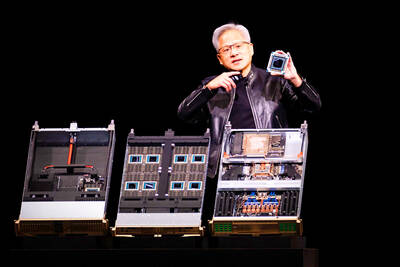
DOMESTIC COMPONENT: Huang identified several Taiwanese partners to be a key part of Nvidia’s Vera Rubin supply chain, including Asustek, Hon Hai and Wistron Nvidia Corp chief executive officer Jensen Huang (黃仁勳), addressing crowds at the company’s biggest annual event, unveiled a variety of new products while predicting that its flagship artificial intelligence (AI) processors would help generate US$1 trillion in sales through next year. During a two-and-a-half-hour keynote address, Huang announced plans to push deeper into central processing units (CPUs) — Intel Corp’s home turf — and introduced semiconductors made with technology acquired from start-up Groq Inc. The company even said it was developing chips for data centers in outer space. At the heart of Huang’s speech was the message that demand for computing power
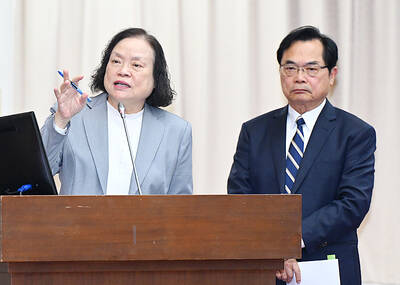
OPTIMISTIC: Inflation still has a chance of remaining below the central bank’s 2 percent alert level, as Taiwan’s economy is resilient with healthy exports, the NDC minister said Taiwan’s inflation could exceed 2 percent this year if oil prices continue to surge amid escalating tensions in the Middle East, prompting the government to reassess its economic outlook, the Directorate-General of Budget, Accounting and Statistics (DGBAS) said yesterday. DGBAS Minister Chen Shu-tzu (陳淑姿) told lawmakers at a meeting of the legislature’s Finance Committee that the agency’s earlier growth forecast of 1.68 percent in the consumer price index (CPI) and 7.71 percent for GDP this year did not account for the ongoing Middle East conflict and would need revision, if tensions persist. The previous forecast assumed an average international crude price of

ELECTRIC DREAMS: Smart cities would use ‘virtual power plants,’ which integrate idle electricity use from households, businesses and factories, Asustek said Asustek Computer Inc (華碩) yesterday showcased key components of its artificial intelligence (AI)-driven smart city initiatives at a trade show in Taipei, eyeing new business opportunities as cities develop sovereign AI infrastructure. Advances in generative, multimodal and physical AI are driving cities toward a new phase of “sovereign AI,” Asustek cochief executive officer Samson Hu (胡書賓) told reporters on the sidelines of the Smart City Summit and Expo at Taipei Nangang Exhibition Center’s Hall 2. The company showcased its “AI City” framework, which comprises three layers — computing infrastructure centered on AI servers, AI models and a platform layer for data processing


 RSS
RSS