


Taiwan’s inflation could exceed 2 percent this year if oil prices continue to surge amid escalating tensions in the Middle East, prompting the government to reassess its economic outlook, the Directorate-General of Budget, Accounting and Statistics (DGBAS) said yesterday.
DGBAS Minister Chen Shu-tzu (陳淑姿) told lawmakers at a meeting of the legislature’s Finance Committee that the agency’s earlier growth forecast of 1.68 percent in the consumer price index (CPI) and 7.71 percent for GDP this year did not account for the ongoing Middle East conflict and would need revision, if tensions persist.
The previous forecast assumed an average international crude price of US$58.6 per barrel, but prices have surged to top US$100 per barrel as geopolitical tensions intensified, Chen said.
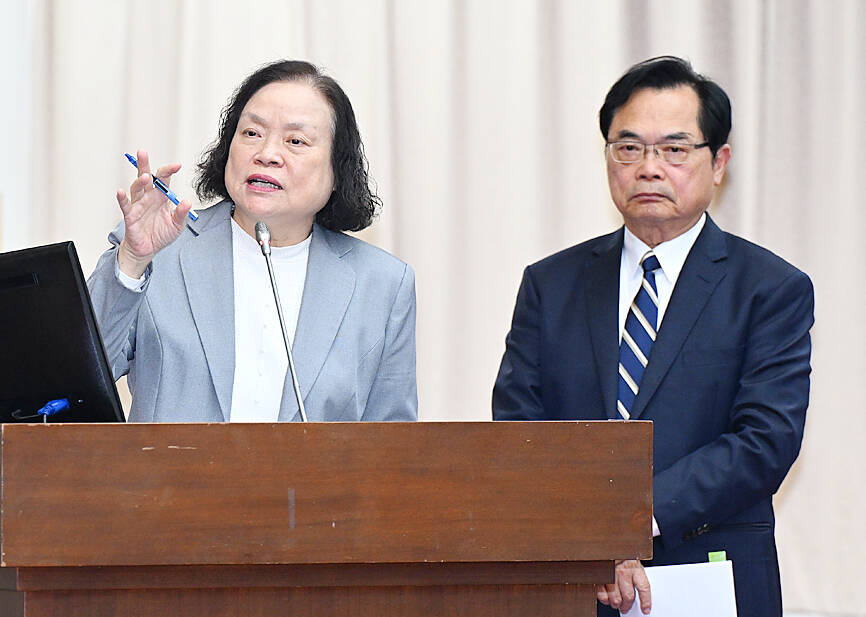
Photo: Liao Chen-hui, Taipei Times
Every 10 percent increase in oil prices would raise inflation by 0.24 percentage points and reduce economic growth by 0.12 percentage points, she said.
If crude oil climbs beyond US$100 per barrel, representing a 70 to 80 percent jump, the CPI could rise by about 1.7 percentage points, pushing inflation beyond 2 percent, while GDP growth could slow by 0.8 to 0.9 percentage points, she added.
The impact would remain limited if the Middle East conflict ends quickly, Chen said, adding that the government has already adopted price-stabilization measures to curb inflation.
If the conflict drags on, the Cabinet’s price stabilization task force could introduce additional measures.
The DGBAS is scheduled to update its economic forecast in May.
However, National Development Council (NDC) Minister Yeh Chun-hsien (葉俊顯) expressed greater optimism, saying that inflation still has a good chance of remaining below the central bank’s 2 percent alert level, while economic growth could exceed the government’s 7.71 percent forecast.
Taiwan’s economy remains resilient, supported by robust exports driven by rising capital spending from global cloud service providers, Yeh told a meeting of the legislature’s Economics Committee.
Rapid development and the adoption of artificial intelligence technologies could further bolster growth momentum, he said.
Amid rising geopolitical tensions, the government has secured sufficient liquefied natural gas supplies for this and next month, and prices for household natural gas would remain unchanged this month, he added.
Authorities would coordinate with state-run CPC Corp, Taiwan (中油) to stabilize the prices of essential goods, as well as implement a price-smoothing mechanism for gasoline and diesel, and other measures to cushion price increases, Yeh said.
The government has also further reduced commodity taxes on gasoline and diesel to 50 percent, ensured adequate fertilizer supplies, and continued fuel subsidies for the agriculture and fisheries sectors to help keep CPI growth below 2 percent this year, he said.

Cairo’s new monorail slices across the city skyline, running above the familiar chaos of blaring horns and aging buses’ exhaust fumes that mark rush hour below. The US$4.5 billion monorail, opened this month, is among Egypt’s most prominent new transport projects, part of a debt-funded infrastructure drive criticized for sapping state finances while bringing limited benefits to most of the country’s 109 million people. “It feels like you’re in a different country,” said Ramy Sayed, a restaurant manager, aboard a driverless Innovia 300 train. “No noise, no traffic, we’re not used to this.” The eastern line runs 56km from the bustling middle-class

Taiwanese firms have increased investment in the Philippines in recent years as Manila’s ties with Washington deepen and global supply chains continue to shift away from China, an expert at the Chung-Hua Institution for Economic Research (CIER, 中華經濟研究院) said yesterday. The Philippines had not been among Taiwanese investors’ top choices in Southeast Asia, CIER Taiwan ASEAN Studies Center director Kristy Hsu (徐遵慈) said at a seminar in Taipei. However, Taiwan’s investment in the country has grown significantly since the COVID-19 pandemic, reaching US $257 million last year, a high in recent years, she said. Although Taiwan’s total investment in the Philippines still lags
Intel Corp regards Taiwan Semiconductor Manufacturing Co (TSMC, 台積電) as a longstanding partner, as the US chipmaker would continue outsourcing production of advanced chips to TSMC, Intel chief executive officer Lip-Bu Tan (陳立武) said yesterday. “I don’t look at people as competitors. I look at the collaboration... Nvidia is also, you know, a good friend,” Tan told a news conference following his keynote speech at the Computex trade show in Taipei. “It’s a very trusted partnership for us... We are a big, top customer for them, and we’re going to continue doing that,” he said, referring to TSMC, the world’s largest foundry

Artificial intelligence (AI) agents would supplant smartphones as the center of people’s digital lives, fundamentally reshaping personal devices and driving a major computing upgrade cycle, Qualcomm Inc CEO Cristiano Amon said yesterday. In his keynote speech for this year’s Computex trade show in Taipei, Amon said that the rise of "agentic AI" — AI systems capable of reasoning, planning and carrying out tasks autonomously — would transform how people interact with technology across phones, PCs, vehicles and wearable devices. Describing the technology as the next major evolution in computing, Amon said that "2026 is the year of agents.” For decades, smartphones have sat


 RSS
RSS