


Intel Corp regards Taiwan Semiconductor Manufacturing Co (TSMC, 台積電) as a longstanding partner, as the US chipmaker would continue outsourcing production of advanced chips to TSMC, Intel chief executive officer Lip-Bu Tan (陳立武) said yesterday.
“I don’t look at people as competitors. I look at the collaboration... Nvidia is also, you know, a good friend,” Tan told a news conference following his keynote speech at the Computex trade show in Taipei.
“It’s a very trusted partnership for us... We are a big, top customer for them, and we’re going to continue doing that,” he said, referring to TSMC, the world’s largest foundry service provider.
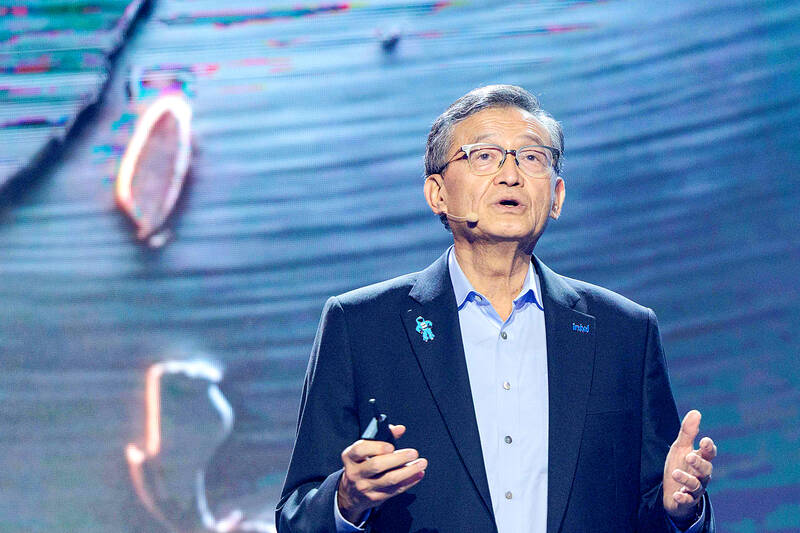
Photo: Cheng Yu-chen, AFP
Chen said he has formed trusted friendships with TSMC founder Morris Chang (張忠謀) and chairman C.C. Wei (魏哲家) for many years.
Intel is one of TSMC’s key customers utilizing 3-nanometer process nodes, along with Nvidia Corp, Apple Inc and Advanced Micro Devices Inc, he said.
Intel has long made chips inside its factories and also outsourced production to multiple foundry partners. However, the company makes most of its own data center chips to differentiate itself from others and create partnerships more easily, it said
“I think that’s the beauty of the business," Alex Katouzian, Intel’s executive vice president and general manager for client computing and physical AI group, said of the company's foundry strategy at the news conference. “Engineering teams have the flexibility to go one versus the other whenever it’s necessary. That gives us the most amount of flexibility.”
Tan, who took the CEO job in March last year, said Intel has made significant progress in enhancing its foundry business.
The company’s advanced 18A process node has entered full production, he said.
It has also made “tremendous progress” in next-generation 14A technology, so the company “can really scale volume,” he added.
Meanwhile, Intel reported robust demand for its central processing units (CPUs), thanks to fast growth in agentic artificial intelligence (AI), Tan said.
“In the last four weeks, I have had all CEOs calling me, [saying]: ‘I need more CPU,’” he said.
Commenting on Nvidia’s return to the PC chip market, Intel said it welcomes the competition.
Nvidia on Monday announced its new RTX Spark superchip for Windows PCs. The chip, codenamed N1X, includes a CPU developed in collaboration with MediaTek Inc (聯發科), Nvidia said.
“If you take a look at what they brought to market [on Monday], I think it’s a good thing,” Katouzian said. “It shows the importance of how critical the PC is.”
“We welcome the competition, but I think we’re going to do really well,” Katouzian said, citing Intel’s scale and the trust of its customer base.
“They want us to grow with them, there’s new opportunities on the AI side,” he said, calling the company’s roadmap “super strong.”
Additional reporting by AFP

Poland is betting on a flood of investments and technology transfers from Taiwanese companies to reengineer its US$1 trillion economy. Polish Prime Minister Donald Tusk said yesterday that Poland will no longer be “just an assembly hub” as it pursues further investments from the likes of Foxconn Technology Group (富士康). The firm, whose full name is Hon Hai Precision Industry Co (鴻海精密), last month agreed to build electric vehicles (EVs) in the European Union nation and now could be a partner in a semiconductor venture, he said. The government’s aim is to boost manufacturing and the country’s high-tech chops in an era

Google DeepMind vice president John Jumper, who won the 2024 Nobel Prize in chemistry for his work on artificial intelligence (AI), is leaving the company to join Anthropic PBC. Jumper has been a key member of Google’s AI coding development team and his departure strains the tech giant’s efforts to beat Anthropic, OpenAI and SpaceX in the race to build the most powerful AI models. Google has struggled to sell AI coding tools to businesses, according to former employees. Employees and executives at DeepMind have raised concerns in the past few months that the company does not have a clear solution for

RESTRICTION BREACH: ASML said that it denies ‘unfounded rumors regarding non-compliance with export controls concerning China,’ and enforces controls strictly US Secretary of Commerce Howard Lutnick in a series of recent meetings outlined concerns to Dutch chip-equipment giant ASML Holding NV’s senior leaders that one of its top-of-the-line machines might have made its way into China, in violation of US-led export restrictions. In the meetings, Lutnick expressed concern to ASML executives over the company’s extreme ultraviolet lithography (EUV) machines, people familiar with the talks said. EUV systems are used by firms such as Taiwan Semiconductor Manufacturing Co (台積電) to manufacture processors for the likes of Nvidia Corp and Apple Inc. ASML has never been allowed to ship them to China because of curbs
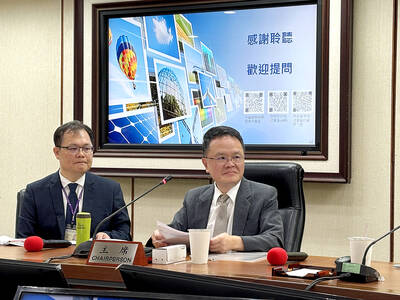
BAD FAITH LITIGATION? The two companies, owned by a California-based private equity firm, could be seeking licensing fees or a settlement payout with the suit Taiwan Intellectual Property Office (TIPO) Director-General Liao Cheng-wei (廖承威) said yesterday he suspected that two firms suing contract chipmaker Taiwan Semiconductor Manufacturing Co (TSMC, 台積電) for patent infringement are “patent trolls.” A patent troll refers to a company that buys patents not for manufacturing products, but to sue other companies for compensation, accusing them of using its patents. Patent trolls, formally called Non-Practicing Entities or Patent Assertion Entities, were responsible for more than 50 percent of lawsuits in the US last year, costing targeted businesses tens of billions of US dollars a year, according to the US-based LegalCharity Web site. Asked whether


 RSS
RSS