


Beijing is intensifying maritime pressure on Taiwan, but the nation will never yield, Ocean Affairs Council Deputy Minister Sung Chen-en (宋承恩) said.
The Coast Guard Administration (CGA) has adopted a “shadowing and monitoring” approach to avoid falling into a Chinese trap to escalate tensions and deepen the conflict, Sung said in an interview published yesterday in the Chinese-language Liberty Times (the Taipei Times’ sister newspaper).
China Coast Guard formations patrolling waters east of Taiwan, as well as official Chinese vessels entering areas around Itu Aba Island (Taiping Island, 太平島) and Pratas Islands (Dongsha Islands, 東沙群島) show Beijing’s attempts to significantly step up pressure at sea, Sung said.
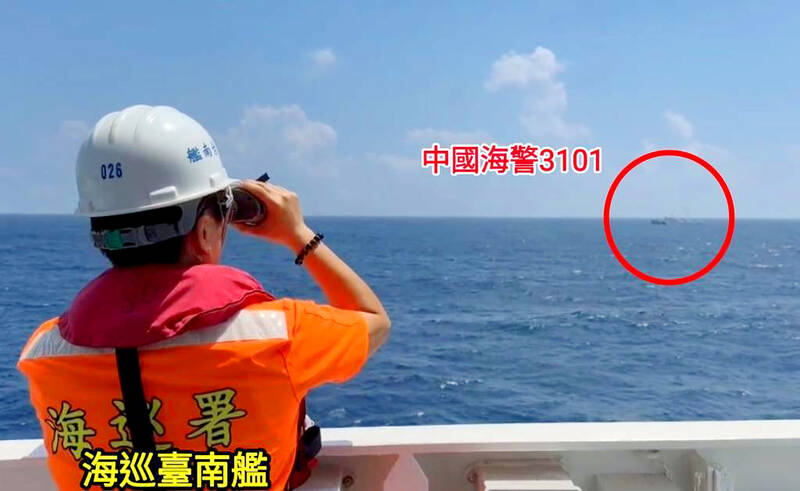
Photo courtesy of the CGA
He cited incidents on May 7 and 14 in which the Chinese research vessel Tongji (同濟號) circled Taiwan along the boundary of its restricted waters, repeatedly deploying monitoring equipment during the voyage.
This month, a joint operation involving a scientific vessel and a coast guard ship were also seen around the waters in Pratas for the first time, he said.
The vessels made sudden course changes after sailing in a straight line and entered Taiwan’s prohibited waters, Sung said, describing it as unprofessional and risky behavior.
China’s recent actions across multiple areas around Taiwan represent an escalation in provocations and show a greater disregard for Taiwan’s enforcement authority than in the past, he said.
In response to the mounting pressure, the CGA has adopted a “shadowing and monitoring” strategy, Sung said, adding that while the nature of maritime operations makes it impossible to prevent Chinese vessels from approaching, the goal is to ensure they do not enter Taiwan’s jurisdictional waters.
For every vessel deployed by China, Taiwan dispatches a corresponding number of patrol ships to track and monitor them on a rotating basis, he said.
The strategy is designed to deny Chinese vessels access to Taiwan-controlled waters while avoiding the use of force, thereby preventing Beijing from gaining a pretext to further escalate tensions, he said.
Legal rights are based on legitimate authority, he said.
Admiring a luxury home and walking around it every day for 10 years will not make it your own, he said as an analogy.
The People’s Republic of China has never exercised sovereignty over Taiwan and therefore has no jurisdiction over waters east of Taiwan, Sung said.
Chinese vessels might circle the area, but they ultimately leave nothing behind, and the CGA will continue monitoring them until they depart, he said.
“Tonnage is not everything; professionalism matters more,” he said, adding that the CGA has the resolve and capability to enforce the law peacefully and prevent unlawful incursions.
Ocean Affairs Council Minister Kuan Bi-ling (管碧玲), meanwhile, described China as “brazen” in a social media post yesterday.
Yesterday was the start of the Dragon Boat Festival holiday, but that did not stop China from continuing with its activities that infringe on Taiwan’s maritime jurisdiction, including “three noes” — no name, no registration, no flag — ships crossing the line and dumping mixed catch, she wrote.
The Chinese research vessel Xiang Yang Hong 22 was spotted entering restricted waters off Yilan County, and Chinese coast guard vessels have been operating in the Pratas area, she said.
Kuan attached a map showing the CGA vessel Tainan operating in waters around Pratas Island, tracking and pushing back against approaching Chinese coast guard ships.
The CGA continued to uphold “civilized values that transcend borders and distinctions between friend and foe,” while also carrying out its duty to defend sovereignty and protect fishing rights during the holiday, she said.

The Tourism Administration yesterday announced that it would reward repeat international visitors with incentives of up to NT$8,000 to boost inbound tourism. The incentives are available to all international tourists, it said, adding that repeat visitors would be rewarded with NT$5,000 and would receive an additional NT$3,000 if they bring travel companions. The nation received 2,990,657 inbound visitors during the first quarter, marking a 3.8 percent increase from the same period last year, agency data showed. Japanese nationals are among groups visiting Taiwan the most. About 1.48 million Japanese tourists arrived last year, a year-on-year increase of more than 12

66 FIGHTER JETS: The aircraft is likely undergoing preparations for its transfer to Taiwan — a significant step forward in the nation’s modernization program, a lawmaker said The first of Taiwan’s order of F-16V Block 70 aircraft has been sighted in Texas ahead of delivery, Democratic Progressive Party (DPP) Legislator Wang Ting-yu (王定宇) said. Taiwan’s first F-16V Block 70 two-seat aircraft, tail number 6831, was seen flying from Lockheed Martin’s production facility in Greenville, South Carolina, to Naval Air Station Joint Reserve Base Fort Worth in Texas, Wang wrote on Facebook yesterday. The plane is likely undergoing preparations for its transfer to Taiwan, marking a significant step forward in the Republic of China Air Force’s modernization program, Wang said, citing military analysts. The F-16V Block 70 is a new-build version

Taiwanese aviator Roger Lin (林睿哲) returned to Taiwan on Saturday after completing a nine-day round-the-world journey in a single-engine aircraft, becoming the first Taiwanese pilot to achieve the feat. Lin departed on June 5 from Los Angeles, California, and continued through Alaska, Japan, Taiwan, the Philippines, Indonesia, Malaysia, Thailand, Nepal, Jordan, Norway, Iceland and Canada before landing at the Taipei International Airport (Songshan) via Los Angeles and Japan. Lin shared numerous photos and videos of his journey on a Facebook page titled “Pilot Roger’s Around the World Flight,” including a video showing his aircraft flying over the Danjiang Bridge and
NOT JUST NUMBERS: What matters to intelligence work is crucial, reliable information, so even a few credible leads can be highly valuable to national security, a legislator said The National Security Bureau (NSB) yesterday said it has finished the establishment of an information-reporting channel for Chinese nationals, the aim of which is to broaden intelligence gathering on China’s political, military, economic and social developments. Chinese nationals can submit information on the Web page, https://report.nsb.gov.tw, the NSB said in a statement. The move aims to expand the bureau’s diverse intelligence sources and is pursuant to the National Intelligence Services Act (國家情報工作法), it said, adding that it referenced practices adopted by intelligence agencies in the US, the UK and Israel. An increasing number of people are approaching Taiwanese agencies to provide information, as


 RSS
RSS