


In a projection room, visitors at the Re: Battle City exhibition at Kaohsiung’s Neiwei Arts Center are invited to sit and watch a 20-minute animated movie.
Artist Chang Li-ren (張立人) created the movie with dolls he made by molding paper into crude, painted figurines. The dolls interact in a detailed and realistic Taiwanese cityscape. Outside the projection room, visitors can wander around a massive model of the city.
A sizeable crowd happily takes pictures of what looks like the best dollhouse in Taiwan: the same props that were used to tell the story of the country’s descent into techno-dictatorship in the movie.
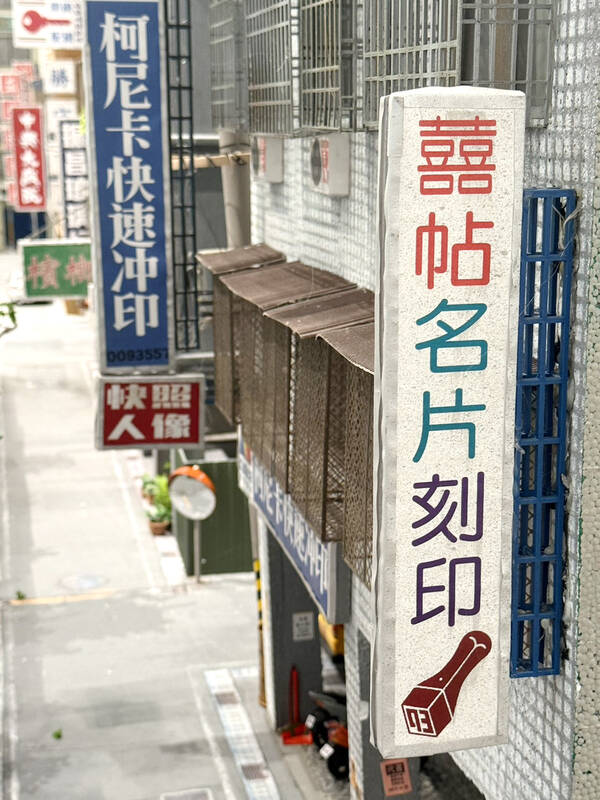
Photo: Julien Oeuillet
The contrast is strong, and that is the whole point.
Cheng Ya-Ping (鄭亞萍), a curator for Neiwei who worked with the exhibition’s curator, says that the animation reflects “some problems of Taiwanese society, such as misleading messages.”
DYSTOPIAN FICTION
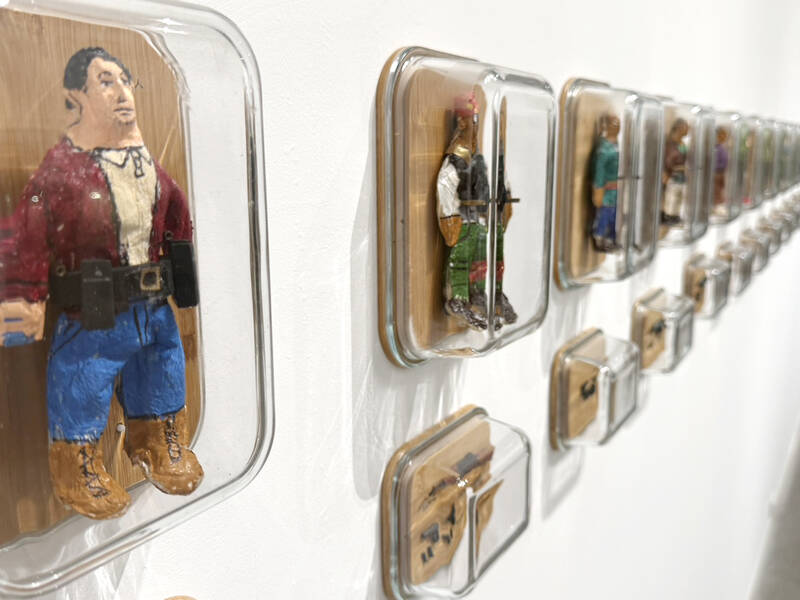
Photo: Julien Oeuillet
Chang says he was influenced by classics of dystopian science fiction like Blade Runner, Ghost in the Shell and Neon Genesis Evangelion.
“But more than anything,” he says, “it comes from my experience of growing up and living in Taiwan, the changing landscape of economic development, the atmosphere of society, the shadow of war, waves of migration and various social events.”
The countless paper figurines he created are also lined up on the wall.
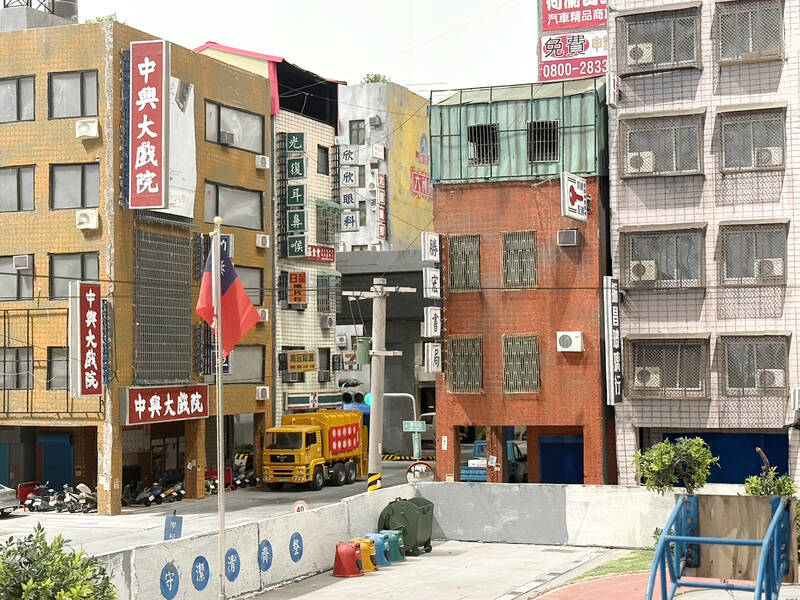
Photo: Julien Oeuillet
“The destiny of each character is shown by the items they carry,” Cheng says, referring to the objects exhibited alongside them.
The exhibition also shows several toys — some found in the garbage — that Chang collected and modified to serve as props in the movie.
There is a strong feeling of repurposing, of reappropriating commercial products and the rejects of capitalist society to denounce it.
The movie is all about a Taiwan suffocating under technological tyranny.
A CEO who could be any of today’s famous tech billionaires turns Taiwan into a horrifying regime that crushes everyone except the ultra-rich.
A far cry from the enthusiasm surrounding Taiwan’s booming stock exchange, Chang instead takes aim at the heralds of engineering revolutions and exposes the distress and despair of ordinary Taiwanese.
“What I’m really interested in is fate,” Chang says. “I feel that all of our destinies are intertwined. When we’re young, it’s difficult to sense it. But as we get older, fate becomes increasingly clear and tangible.”
QUINTESSENTIALLY TAIWANESE
Despite the high-tech equipment displayed by the villains, the city itself looks like a contemporary Taiwanese urban area, still bearing the traces of the past: rusty gates on windows, old-fashioned air-conditioning units, and corrugated iron panels improvising an extra floor.
“If you look at history on the scale of a nation,” Chang says, “or even humanity as a whole, you begin to see how the present has been woven together through countless chains of cause and effect. Looking back, the major turning points in history often seem obvious in hindsight.”
As the video is not online, it can only be seen at the exhibition, and its gut-wrenching but compelling and darkly comedic view of the future makes it the closest Taiwan has ever had to a movie like Terry Gilliam’s Brazil.
And this is the rare case of someone taking aim at Taiwan’s economic miracle rather than glorifying it.
Re: Battle City shows you something you rarely hear about overseas: the anxiety, fear, and spirit of rebellion that the global dominance of tech industries generates, even in Taiwan, despite the country being hailed as the epicenter of the technological revolution.

If a leisurely afternoon of high-end dining and watching the scenery roll by from the comfort of a plush armchair sounds like a good time to you, consider a trip on the Sea Breeze (海風號). This culinary, cultural and scenic experience is the perfect setting for a date, a celebratory outing with a small group of friends or a relaxing solo ride. The price tag is steep, especially if you consider the short distance the train actually covers over the 3.5-hour journey. But what you’re paying for on the Sea Breeze isn’t transportation; it’s the comfort, the service, the exclusivity, the
June 15 to June 21 According to legend, a giant from Orchid Island (Lanyu, 蘭嶼) named Si Mangangavang once built a large tatala canoe capable of carrying 16 people. He set sail southward to the Batanes in the Philippines, where he traded with the local Ivatan people. One of the goods they coveted was cowhide, which the Tao people of Orchid Island used to make armor. Through continued trade, the Tao and Ivatan forged close ties, and Si Mangangavang became good friends with a Batanes giant named Si Vakag. This story, collected in a 1998 book by ethnologist Yu Guang-hong (余光弘)
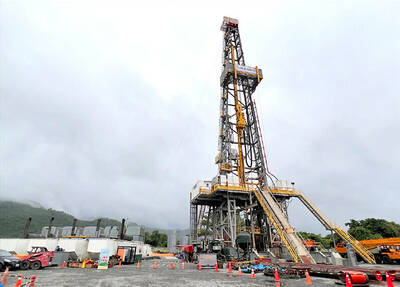
Taiwan’s renewable shortfall is a problem of execution, not resources. Japan’s long-cycle, joined-up energy planning is the model worth studying — but what Taiwan can borrow is the institutional machinery, not the politics. When Nvidia CEO Jensen Huang (黃仁勳) used his visit to Taipei last month to warn that the country needs far more electricity, he was naming a constraint its own planners already know well: Taiwan Power Co (Taipower, 台電) expects demand from the semiconductor and artificial intelligence (AI) sector alone to exceed 5 gigawatts (GW) by 2030. The harder question is not whether to build more capacity but which

One of the wildest things about the reception of Chinese Nationalist Party (KMT) Chair Cheng Li-wun (鄭麗文) in the international media is the way her words are presented without being contextualized, let alone challenged. The Financial Times, for example, interviewing her during her visit to New York, said that she blamed the halt to exchanges between Taiwan and the People’s Republic of China (PRC) for raising tensions. “There has been no dialogue, so you can see that the situation is almost on the brink of war,” the Financial Times quoted her as saying, without any hint that the PRC, not


 RSS
RSS