


Taiwan can lead the unification of the Chinese people, Nobel Peace Prize laureate and former Polish president Lech Walesa said in Taipei yesterday, adding that as the world order is changing, peaceful discussion would find good solutions, and that the use of force and coercion would always fail.
Walesa made the remarks during his keynote address at a luncheon of the Yushan Forum in Taipei, titled “Indo-Pacific Partnership Prospects: Taiwan’s Values, Technology and Resilience,” organized by the Taiwan-Asia Exchange Foundation with the Ministry of Foreign Affairs.
Walesa said that he had been at the forefront of a big peaceful revolution and “if I had been fighting at this time using force and coercion, nobody would have won against the Soviet Union, so we demonstrated that using peaceful means you can have much better effects than using force.”
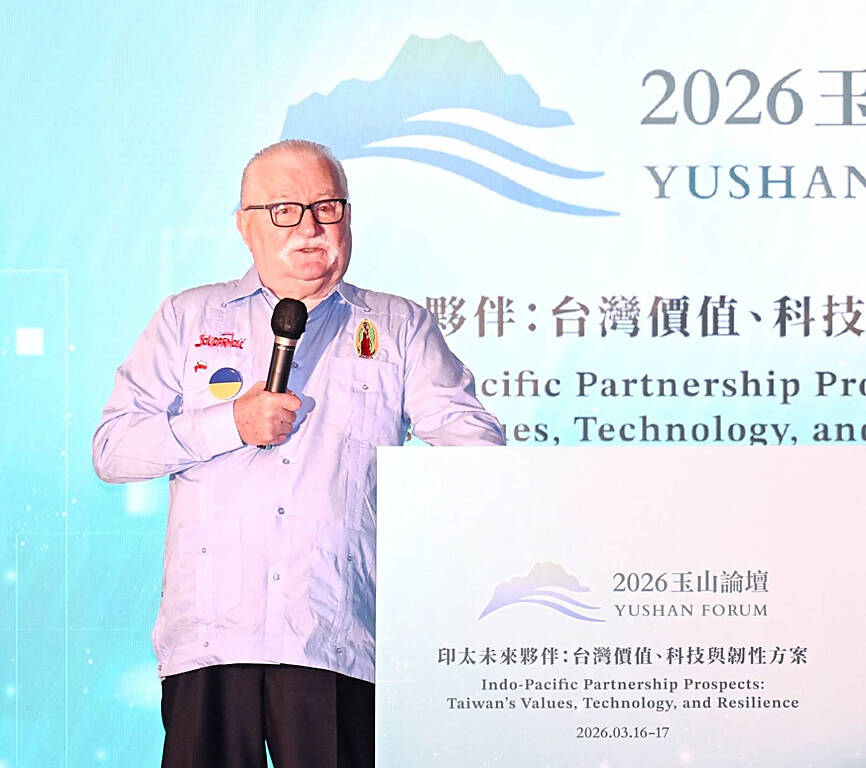
Photo: Fang Pin-chao, Taipei Times
At that time, “the communists really used up their possibilities and had to end, because it stopped the development of the world,” and the US-USSR polarity of the world also ended its possibilities, he said, so “we were asking ourselves not whether, but how to make changes.”
Reforming the world order was not possible at that time, and while many people believed only a war could change the situation, Walesa said he strongly believed peaceful argument was a possible solution, and Poland was able to “use peaceful means to destroy the world order.”
“Today we are at the special moment when we have to discuss the new world order,” as China, Russia and the US are struggling to lead the world, he said, adding that he believes that under these new circumstances, Chinese nations have to unite, but Taiwan should lead the unification of the Chinese people.
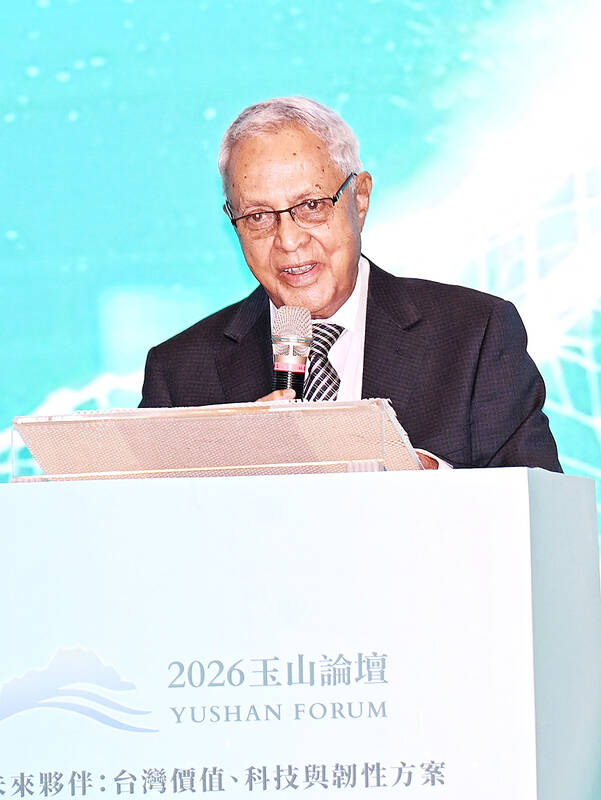
Photo: Fang Pin-chao, Taipei Times
“Taiwan has proved to the whole world that it has great solutions when it comes to the economy and politics,” he said. “Taiwanese solutions should be the model.”
Walesa said he deeply believes the world can find good solutions to big problems and solve them in a peaceful manner, and solutions that use force and coercion would always fail, just as the communist solution had failed.
Walesa in 1980 led strikes at the Lenin Shipyard in Poland and founded the trade union Solidarity, the first independent trade union in the Soviet bloc, challenging the communist regime and paving the way for democracy and reform in Poland.
He won the 1983 Nobel Peace Prize for his non-violent struggle for free trade unions and human rights in Poland, and he was elected as the first president of Poland in 1990.
Meanwhile, in his opening remarks, former Fijian prime minister Mahendra Chaudhry said that Fiji, as a sovereign and independent nation, should engage fully with nations that genuinely provide assistance, and that those countries should, in return, receive the recognition they deserve.
Chaudhry said that although Taiwan is only about twice the size of Fiji, it has overcome significant challenges to become one of the Indo-Pacific region’s most respected, advanced and successful democracies.
He said that at a time when global conflicts are disrupting supply chains, driving up inflation and pushing developing nations deeper into poverty, Taiwan’s New Southbound Policy offers important strategic opportunities for small island nations and serves as a stabilizing force in the Indo-Pacific region.
Chaudhry particularly thanked Taiwan for its strong expertise and long-standing contributions in healthcare, education, renewable energy and agriculture, and said these areas are key to helping Fiji address its food security challenges.
He called for Taiwan’s technical expertise to help modernize Fiji’s agriculture and boost production, noting that there is also significant potential for investment cooperation between the two sides in tourism and the services sector.

A signaling system malfunction disrupted high-speed rail (HSR) services beginning at 8am today, with trains temporarily reduced to three northbound and three southbound trains per hour as authorities conduct inspections. The malfunction occurred on a section of track in Miaoli County during pre-operation checks early this morning, forcing northbound and southbound trains to use a single track, the HSR operator said. The regular schedule has been replaced with three hourly trains offering only nonreserved seating in each direction, stopping at every station, it said, adding that business class cars would still have reserved seating. Departures from terminal stations are scheduled at the top

DRONE CENTRAL: Taiwan aims to become Asia’s democratic hub for drones, with most exports focused on high-quality military-grade models, an official said Taiwan’s drone industry is expected to expand significantly by 2030, producing 100,000 units per month and exporting half of them, the Ministry of Economic Affairs said yesterday. Current drone production capacity is about 15,000 units per month, but the industry can quickly scale up as demand increases, Industrial Development Administration Director-General Chiou Chyou-huey (邱求慧) told a news conference in Taipei. Taiwan’s drone output grew 2.5-fold last year to NT$12.9 billion (US$408.3 million) under a government program to develop the uncrewed vehicle sector, he said. The Executive Yuan in October last year approved plans to invest NT$44.2 billion into domestic production of uncrewed aerial

VERBOSE VESSELS: A CGA cutter and a China Coast Guard exchanged verbal barbs for more than a day in Taiwanese-controlled waters before the Chinese vessel left The Taiwanese and Chinese coast guards had a standoff near the strategically located Pratas Islands (Dongsha Islands, 東沙群島) in the north of the South China Sea, the Coast Guard Administration (CGA) said yesterday. The two sides engaged in intense radio exchanges over sovereignty claims during the 33-hour standoff. China Coast Guard vessel 3501 eventually left the restricted waters, 26.6 nautical miles (49.2km) west of the Pratas Islands, at 5pm yesterday, the CGA said. Lying approximately between southern Taiwan and Hong Kong, the Taiwan-controlled Pratas are seen by some security experts as vulnerable to Chinese attack due to their distance — more than
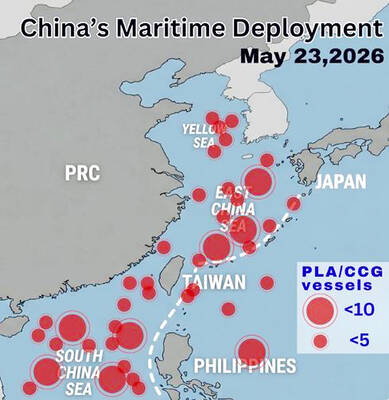
WARNING: China should stop engaging in actions that undermine regional peace and stability, as it would only build resentment among people across the Strait, the CGA said China has deployed more than 100 navy, coast guard and other vessels in waters from the Yellow Sea to the South China Sea and the western Pacific since US President Donald Trump and Chinese President Xi Jinping (習近平) met in Beijing, National Security Council Secretary-General Joseph Wu (吳釗燮) said yesterday. “In this part of the world, #China is the one & only PROBLEM wrecking the #StatusQuo & threatening regional peace & stability,” Wu wrote on X. In a separate post, he said Beijing was coercing Taiwan’s maritime domain, calling it illegal and provocative, after the Coast Guard Administration (CGA) expelled a


 RSS
RSS