


Nvidia Corp chief executive officer Jensen Huang (黃仁勳), addressing crowds at the company’s biggest annual event, unveiled a variety of new products while predicting that its flagship artificial intelligence (AI) processors would help generate US$1 trillion in sales through next year.
During a two-and-a-half-hour keynote address, Huang announced plans to push deeper into central processing units (CPUs) — Intel Corp’s home turf — and introduced semiconductors made with technology acquired from start-up Groq Inc. The company even said it was developing chips for data centers in outer space.
At the heart of Huang’s speech was the message that demand for computing power continues to soar, and Nvidia is uniquely equipped to meet the challenge.
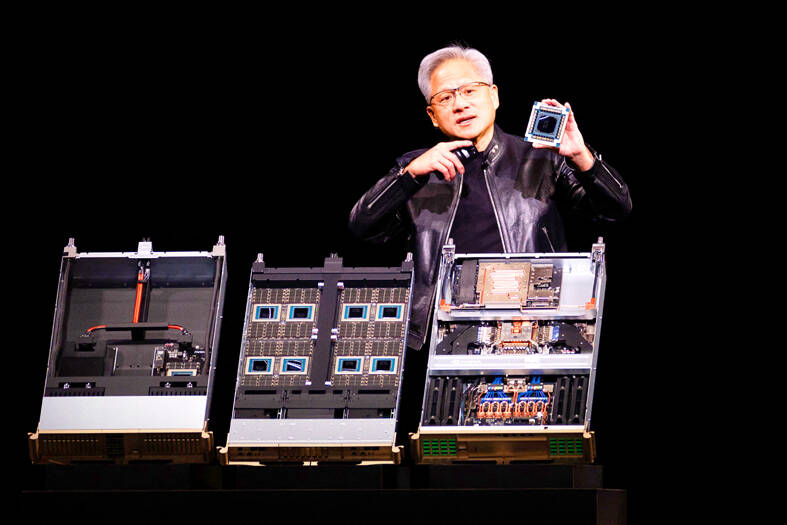
Photo: AFP
“I believe that computing demand has increased by 1 million times in the last two years,” Huang said on Monday at Nvidia’s annual GPU Technology Conference (GTC) in San Jose, California. “It is the feeling that we all have. It is the feeling every start-up has.”
Huang is contending with increasingly skeptical investors, who want more evidence that Nvidia’s booming sales growth will last. The trillion-dollar sales forecast, fueled by orders from the company’s Blackwell and Rubin chips, offered evidence that demand remains solid.
The company had previously forecast that data center gear would bring US$500 billion in sales through the end of this year. The latest forecast extends the outlook another year, doubling the cumulative amount.
New products and partnerships were a highlight of GTC.
The new Groq chip is designed to boost the responsiveness of AI systems and would be manufactured by Samsung Electronics Co, with Groq-based systems coming in the second half, Huang said.
Nvidia also showed off a computer made up of general-purpose CPUs. Such machines could be used in combination with other Nvidia-based computers or work independently.
That opportunity is “for sure” a multibillion-dollar business, Huang said.
The chipmaker also provides AI models and other software on an open-source basis, meaning that customers can tinker with the technology as they see fit. It also offers versions tailored for specific uses, aiming to help industries that it sees as ripe for disruption by AI.
Huang pointed to the rapid emergence of OpenClaw, an open-source agentic platform, and announced Nvidia’s enterprise-focused NemoClaw system, developed with enhanced security and privacy capabilities for corporate use.
Looking further ahead, Huang introduced the company’s Feynman architecture as the next step in its road map, featuring new processing and networking technologies, including co-packaged optics.
Nvidia uses GTC to announce partnerships with companies in a range of industries, aiming to show the increasing benefits of AI. It discussed new or expanded pacts with companies such as International Business Machines Corp, Hewlett Packard Enterprise Co and Adobe Inc. It also strengthened ties with Uber Technologies Inc, saying it was planning a fleet of Nvidia software-driven autonomous vehicles by 2028.
Huang expected Taiwan to be a key part of the supply chain delivering Nvidia’s Vera Rubin architecture.
Three slides in his presentation showed that of the more than 60 global partners for Nvidia’s Vera Rubin platform, many were Taiwanese companies, such as Asustek Computer Inc (華碩), Hon Hai Precision Industry Co (鴻海), Quanta Cloud Technology Inc (雲達), Wistron Corp (緯創) and Wiwynn Corp (緯穎).
Additional reporting by CNA
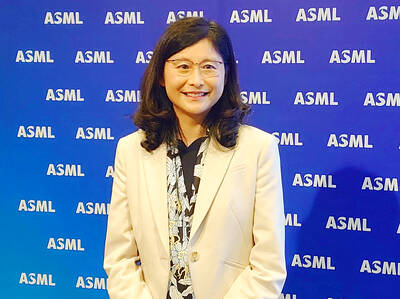
Netherlands-based semiconductor equipment supplier ASML Holding NV yesterday said that it is planning to hire an additional 1,000 people in Taiwan this year in response to growing demand from clients. ASML had previously planned to recruit 600 people this year, but that the plan has been adjusted upward, ASML vice president and ASML Taiwan general manager Grace Wang (汪佳慧) told reporters. ASML has a workforce of more than 4,500 in Taiwan, accounting for about 10 percent of its global total, Wang said. This year’s recruitment campaign would focus on adding people in the customer support, manufacturing and supply chain domains to assist ASML
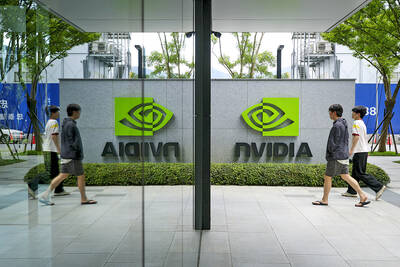
UNDER MICROSCOPE: Taiwan detained three people who allegedly conspired to buy servers in Taiwan and export them using fraudulent documentation, prosecutors said Nvidia Corp chief executive officer Jensen Huang (黃仁勳) on Saturday urged Super Micro Computer Inc to tighten up on compliance after Taiwan detained three people this week for allegedly making fraudulent declarations about artificial intelligence (AI) servers made by its US partner. The development marked the nation’s first crackdown on semiconductor smuggling, which grew after the US slapped restrictions on exports of high-end chips such as Nvidia AI accelerators to China. Nvidia is “rigorous” in explaining regulations to all of its partners, Huang told reporters after arriving in Taipei. “Ultimately Super Micro has to run their own company,” he said in response to

Nvidia Corp yesterday announced that CEO Jensen Huang (黃仁勳) would attend an employee meeting in Taipei tomorrow to celebrate the launch of the company’s Taiwan headquarters project. Huang would attend a gathering at the site of Nvidia’s planned headquarters in Beitou Shilin Technology Park (北投士林科技園區), the company said in a statement. After arriving in Taiwan on Saturday last week, Huang told reporters that he plans to meet with Quanta Computer Inc (廣達) chairman Barry Lam (林百里) and Taiwan Semiconductor Manufacturing Co (TSMC, 台積電) chairman C.C. Wei (魏哲家), and would attend the groundbreaking ceremony for Nvidia’s Taiwan headquarters tomorrow. Nvidia has not yet applied

Huawei Technologies Co (華為) said it has come up with a new pathway to shorten its gap with industry leader Taiwan Semiconductor Manufacturing Co (TSMC, 台積電), potentially achieving a breakthrough in making advanced semiconductors without cutting-edge equipment. Right now there is about a five-year gap between what TSMC is capable of and what Huawei, together with its manufacturing partner Semiconductor Manufacturing International Corp (中芯), can produce. Huawei is to start making 1.4-nanometer chips by 2031 with its own “LogicFolding” technology, Huawei semiconductor chief He Tingbo (何庭波) said in a rare public appearance during a chip conference yesterday, while TSMC has


 RSS
RSS