


Seated before a machine that checks cigar quality, Orquidea Gonzalez said she is proud to carry on the craft’s tradition and contribute to an export industry that has grown during the COVID-19 pandemic.
“I love making cigars. This is where I’ve spent my life, and it’s an art. Not everyone knows how to make cigars, like not everyone knows how to paint a picture,” the 55-year-old factory worker said.
Her job is to measure in a metal tube the draw of each cigar to ensure that the smoker gets the perfect puff.
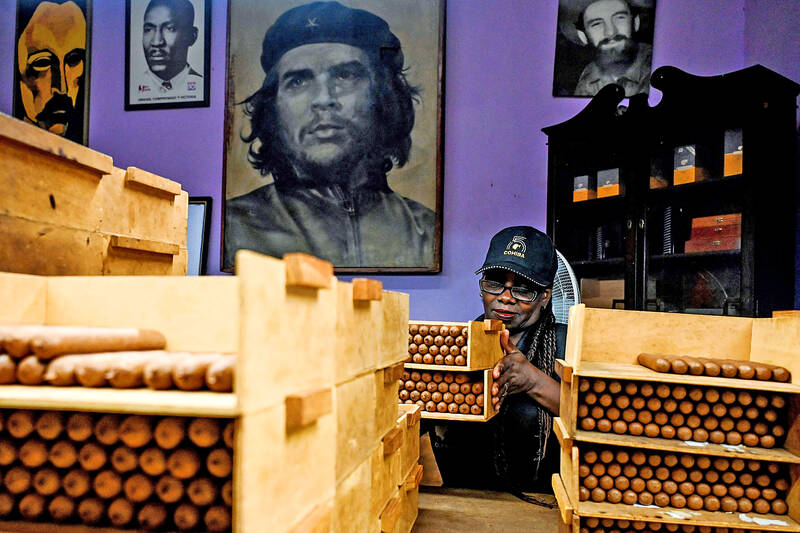
Photo: AFP
Warning: Smoking can damage your health
“If it’s less than 40, the [suction] level is excessive; if it’s more than 80, it’s too low,” she said, her eyes glued to the machine’s needle.
The El Laguito factory opened in 1966 in western Havana to make the cigars favored by the hero of the 1959 communist revolution and longtime Cuban president Fidel Castro.
The factory is the birthplace of Cohiba cigars, the country’s most prestigious brand. The name recalls the way the native Taino people referred to the rolled tobacco leaves they smoked.
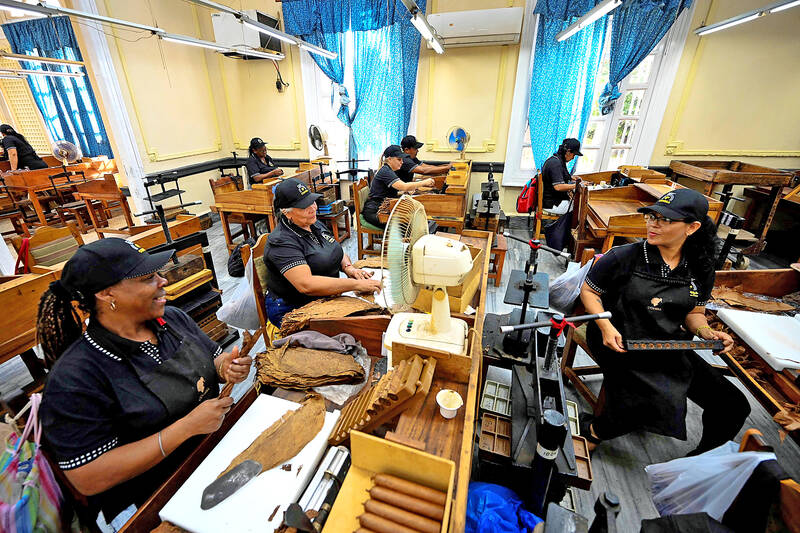
Photo: AFP
Warning: Smoking can damage your health
Rolling one’s own leaves is a tradition that endures among farmers in the western province of Pinar del Rio, where most Cuban tobacco farms are located.
Castro’s favorite cigar, the Cohiba Lancero, which he smoked until he quit in 1985 at the age of 59, is still produced in the factory.
“Despite all the difficulties we face,” the goal is to manufacture “nearly 2 million” cigars this year, or about 9,000 per day, factory head Oscar Rodriguez said.
Despite the COVID-19 pandemic, Cuban cigar exports grew by 15 percent last year, totaling US$568 million, according to Habanos SA, which includes all national brands.
That constitutes a significant boon for the Cuban economy, which is in the grips of its worst crisis in 30 years, with daily shortages and power cuts.
The factory “did not stop for a single day” during the pandemic, eventually making cigars “the country’s second-largest export,” Rodriguez said.
Spain, China, Germany, France and Switzerland are among the top buyers.
Expertly handling curved blades and a sticky substance, dozens of workers put the finishing touches on the ends of newly rolled cigars.
About 60 percent of the workers are women — following a tradition at the factory founded by Castro’s comrade-in-arms Celia Sanchez — that aims to give opportunities to single mothers or women in difficulty.
Another founder, Norma Fernandez, who died during the pandemic, rolled the cigars for the leader of the revolution.
“It was a privilege to be able to say: ‘I made the president’s cigars,’” said Gonzalez, hard at work at the factory, which is housed in an elegant 1950s villa.
Caridad Mesa, 55, started working at El Laguito as a cleaning lady. Thirty years later, she is in charge of spotting the smallest defects in the cigars.
It is necessary to control “the quality, the weight, the length ... the thickness,” she said, scrutinizing boxes brimming with cigars under a large portrait of Communist revolutionary icon Ernesto “Che” Guevara.
Cohiba cigars, which include a wide range of styles, can cost US$30 to US$200 each, in Cuba and abroad.
“Cuban tobacco is distinguished from all other kinds by the flavor of the land of Pinar del Rio,” Gonzalez said.
It is there “where the best tobacco crops are grown,” she added.
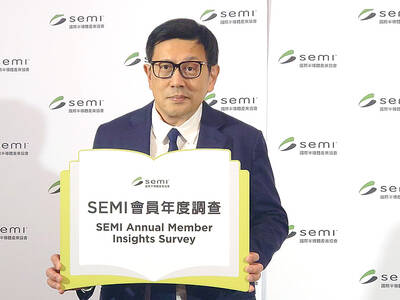
PRICE HIKES: The war in the Middle East would not significantly disrupt supply in the short term, but semiconductor companies are facing price surges for materials Taiwan’s semiconductor companies are not facing imminent supply disruptions of essential chemicals or raw materials due to the war in the Middle East, but surges in material costs loom large, industry association SEMI Taiwan said yesterday. The association’s comments came amid growing concerns that supplies of helium and other key raw materials used in semiconductor production could become a choke point after Qatar shut down its liquefied natural gas (LNG) production and helium output earlier this month due to the conflict. Qatar is the second-largest LNG supplier in the world and accounts for about 33 percent of global helium output. Helium is
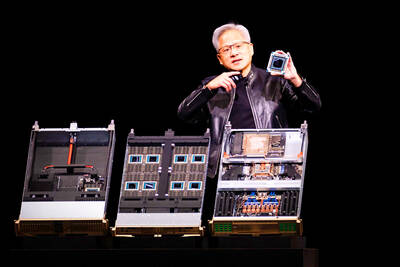
DOMESTIC COMPONENT: Huang identified several Taiwanese partners to be a key part of Nvidia’s Vera Rubin supply chain, including Asustek, Hon Hai and Wistron Nvidia Corp chief executive officer Jensen Huang (黃仁勳), addressing crowds at the company’s biggest annual event, unveiled a variety of new products while predicting that its flagship artificial intelligence (AI) processors would help generate US$1 trillion in sales through next year. During a two-and-a-half-hour keynote address, Huang announced plans to push deeper into central processing units (CPUs) — Intel Corp’s home turf — and introduced semiconductors made with technology acquired from start-up Groq Inc. The company even said it was developing chips for data centers in outer space. At the heart of Huang’s speech was the message that demand for computing power
OPTIMISTIC: Inflation still has a chance of remaining below the central bank’s 2 percent alert level, as Taiwan’s economy is resilient with healthy exports, the NDC minister said Taiwan’s inflation could exceed 2 percent this year if oil prices continue to surge amid escalating tensions in the Middle East, prompting the government to reassess its economic outlook, the Directorate-General of Budget, Accounting and Statistics (DGBAS) said yesterday. DGBAS Minister Chen Shu-tzu (陳淑姿) told lawmakers at a meeting of the legislature’s Finance Committee that the agency’s earlier growth forecast of 1.68 percent in the consumer price index (CPI) and 7.71 percent for GDP this year did not account for the ongoing Middle East conflict and would need revision, if tensions persist. The previous forecast assumed an average international crude price of

ELECTRIC DREAMS: Smart cities would use ‘virtual power plants,’ which integrate idle electricity use from households, businesses and factories, Asustek said Asustek Computer Inc (華碩) yesterday showcased key components of its artificial intelligence (AI)-driven smart city initiatives at a trade show in Taipei, eyeing new business opportunities as cities develop sovereign AI infrastructure. Advances in generative, multimodal and physical AI are driving cities toward a new phase of “sovereign AI,” Asustek cochief executive officer Samson Hu (胡書賓) told reporters on the sidelines of the Smart City Summit and Expo at Taipei Nangang Exhibition Center’s Hall 2. The company showcased its “AI City” framework, which comprises three layers — computing infrastructure centered on AI servers, AI models and a platform layer for data processing


 RSS
RSS