


In China’s factories, the robots are rising.
For decades, manufacturers employed waves of young migrant workers from China’s countryside to work at countless factories in coastal provinces, churning out cheap toys, clothing and electronics that helped power the country’s economic ascent.
Now, factories are rapidly replacing those workers with automation, a pivot that is encouraged by rising wages and new official directives aimed at helping the country move away from low-cost manufacturing as the supply of young, pliant workers shrinks.
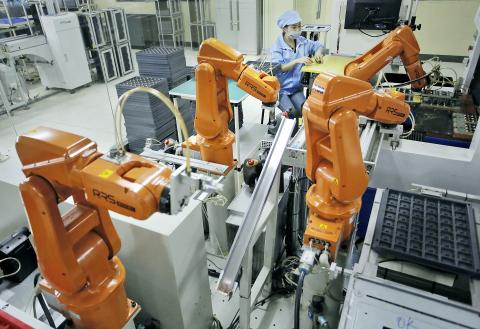
Photo: AP
With costs rising and profits shrinking, Chinese manufacturers “will all need to face the fact that only by successfully transitioning from the current labor-oriented mode to more automated manufacturing will they be able to survive in the next few years,” said Jan Zhang (張鍵), an automation expert at IHS Technology in Shanghai.
Shenzhen Rapoo Technology Co (深圳雷柏科技) is among the companies at ground zero of this transformation. At its factory, orange robot arms work alongside human operators assembling computer mice and keyboards.
“What we are doing here is a revolution” in Chinese manufacturing, said Pboll Deng (鄧邱偉), Rapoo’s deputy general manager.
The company began its push into automation five years ago. Rapoo installed 80 robots made by Sweden’s ABB Ltd to assemble mice, keyboards and their sub-components. The robots allowed the company to save US$1.6 million each year and trim its workforce to less than 1,000 from a peak of more than 3,000 in 2010.
Such upgrading underscores the grand plans China’s leaders have for industrial robotics. Chinese President Xi Jinping (習近平) called in a speech last year for a “robot revolution” in a nod to automation’s vital role in raising productivity.
Authorities have announced measures such as subsidies and tax incentives over the past three years to encourage industrial automation as well as development of a homegrown robotics industry.
Some provinces have set up their own “Man for Machine” programs aimed at replacing workers with robots.
Guangdong Province said in March it would invest 943 billion yuan (US$148 billion) to encourage nearly 2,000 large manufacturers to buy robots, the official Xinhua news agency reported. Guangzhou, the provincial capital, aims to have 80 percent of manufacturing automated by 2020.
A relentless surge in wages is adding impetus to the automation revolution. Deng said Rapoo’s wage bill rising 15 to 20 percent a year was one big factor driving its use of robots.
“Frontline workers, their turnover rate is really high. More and more people are unwilling to do repetitive jobs. So these two issues put the manufacturing industry in China under huge pressure,” he said.
China’s auto industry was the trailblazer for automation, but other industries are rapidly adopting the technology as robots become smaller, cheaper and easier to use. It now only takes on average 1.3 years for an industrial robot in China to pay back its investment, down from 11.8 years in 2008, according to Goldman Sachs.
Companies such as electronics maker TCL Corp are using robots to produce higher-value goods. At one factory in Shenzhen, TCL uses 978 machines to produce flat-screen TV panels. At another TCL plant in Hefei, near Shanghai, steel refrigerator frames are bent into shape before being plucked by a blue Yasakawa robot arm that stacks them in neat rows for further assembly.
Fridges and big washing machines have heavy internal components, so “if you use automated robots to make them, they also let you cut your labor intensity by a lot,” TCL chairman Tomson Li (李東生) said.
China held the title of world’s biggest market for industrial robots for the second straight year last year, with sales rising by more than half to 56,000, out of a total of 224,000 sold globally, according to the International Federation of Robotics.
There is plenty more room for explosive sales growth. China has about 30 robots for every 10,000 factory workers compared with 437 in South Korea and 152 in the US. The global average is 62. Beijing wants China’s number to rise to 100 by 2020.
The switch to robots has raised fears that it will contribute to slowing employment, though there are few signs that is happening yet.
Deng said Rapoo has not had to resort to layoffs. Rather, the company is just not replacing workers who quit.
“It’s not simply replacing the operation of workers by robot. We do more than that. We are making a robot platform” in which humans and machines work together to make production more flexible, he said.
On a tour of Rapoo’s factory, Deng pointed out the efficiencies.
As a conveyor belt carried circuit boards out of an industrial soldering machine, a robot arm removed them from metal jigs and placed them on another belt. Human workers typically do this job in other factories, Deng said, but turnover is high because of the heat and repetitiveness.
In a glass-walled room, robots assembled receivers for wireless mice, tasks that were previously done by 26 people, Deng said.
Now, one or two humans supervise as a laser automatically fuses shut metal USB plug housings.
Automation means “accuracy can still remain very high and there are seldom failures for the robots,” Deng said.
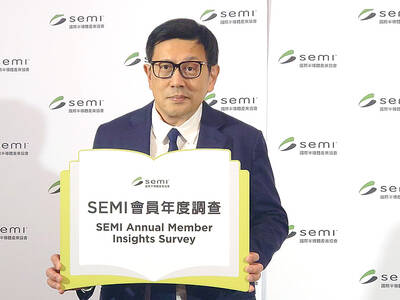
PRICE HIKES: The war in the Middle East would not significantly disrupt supply in the short term, but semiconductor companies are facing price surges for materials Taiwan’s semiconductor companies are not facing imminent supply disruptions of essential chemicals or raw materials due to the war in the Middle East, but surges in material costs loom large, industry association SEMI Taiwan said yesterday. The association’s comments came amid growing concerns that supplies of helium and other key raw materials used in semiconductor production could become a choke point after Qatar shut down its liquefied natural gas (LNG) production and helium output earlier this month due to the conflict. Qatar is the second-largest LNG supplier in the world and accounts for about 33 percent of global helium output. Helium is
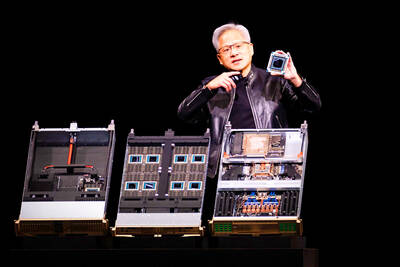
DOMESTIC COMPONENT: Huang identified several Taiwanese partners to be a key part of Nvidia’s Vera Rubin supply chain, including Asustek, Hon Hai and Wistron Nvidia Corp chief executive officer Jensen Huang (黃仁勳), addressing crowds at the company’s biggest annual event, unveiled a variety of new products while predicting that its flagship artificial intelligence (AI) processors would help generate US$1 trillion in sales through next year. During a two-and-a-half-hour keynote address, Huang announced plans to push deeper into central processing units (CPUs) — Intel Corp’s home turf — and introduced semiconductors made with technology acquired from start-up Groq Inc. The company even said it was developing chips for data centers in outer space. At the heart of Huang’s speech was the message that demand for computing power
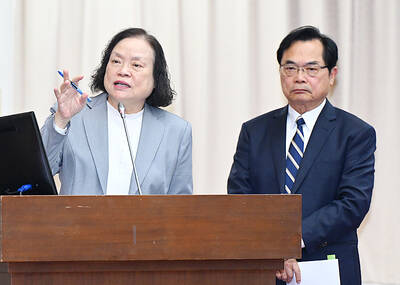
OPTIMISTIC: Inflation still has a chance of remaining below the central bank’s 2 percent alert level, as Taiwan’s economy is resilient with healthy exports, the NDC minister said Taiwan’s inflation could exceed 2 percent this year if oil prices continue to surge amid escalating tensions in the Middle East, prompting the government to reassess its economic outlook, the Directorate-General of Budget, Accounting and Statistics (DGBAS) said yesterday. DGBAS Minister Chen Shu-tzu (陳淑姿) told lawmakers at a meeting of the legislature’s Finance Committee that the agency’s earlier growth forecast of 1.68 percent in the consumer price index (CPI) and 7.71 percent for GDP this year did not account for the ongoing Middle East conflict and would need revision, if tensions persist. The previous forecast assumed an average international crude price of

ELECTRIC DREAMS: Smart cities would use ‘virtual power plants,’ which integrate idle electricity use from households, businesses and factories, Asustek said Asustek Computer Inc (華碩) yesterday showcased key components of its artificial intelligence (AI)-driven smart city initiatives at a trade show in Taipei, eyeing new business opportunities as cities develop sovereign AI infrastructure. Advances in generative, multimodal and physical AI are driving cities toward a new phase of “sovereign AI,” Asustek cochief executive officer Samson Hu (胡書賓) told reporters on the sidelines of the Smart City Summit and Expo at Taipei Nangang Exhibition Center’s Hall 2. The company showcased its “AI City” framework, which comprises three layers — computing infrastructure centered on AI servers, AI models and a platform layer for data processing


 RSS
RSS