


North Korea’s illicit and highly sophisticated efforts to circumvent UN sanctions might have sought to cushion their impact, but they offer no long-term solution to the fallout of tightened economic isolation, analysts said.
Sanctions relief was top of North Korean leader Kim Jong-un’s agenda for his Hanoi summit with US President Donald Trump last month, but the meeting broke up without a statement or even a lunch as the two sides disagreed over walking back Pyongyang’s nuclear weapons program in exchange for relaxation.
North Korea publishes virtually no economic statistics of its own, but according to figures from the Chinese General Administration of Customs, exports to its biggest trade partner have plummeted more than 90 percent.
Photo: AFP
Until 2016 — when the figures say North Korea sold China US$2.5 billion of goods — the UN Security Council sanctions largely targeted technology that could be used for weapons development.
Since then new measures have taken aim at a variety of broad economic sectors, including some of Pyongyang’s key foreign-currency earners, with exports of coal, iron ore, seafood and other commodities banned, trade in textiles blocked in both directions, and curbs on oil and fuel deliveries.
Exports to China were just US$213 million last year, Chinese statistics showed — although some observers question their reliability.
A report released last week by the UN’s independent Panel of Experts found that Pyongyang was employing increasingly sophisticated and varied ways to circumvent the rules, including the “physical disguise of tankers” and illegal name-changing, as well as ship-to-ship cargo transfers on the high seas.
Panel coordinator Hugh Griffiths likened Pyongyang’s efforts to high-net-worth tax avoiders and multinational corporations.
“They are exploiting international waters and the offshore economy,” he said.
North Korea uses ship-to-ship transfers for “most of its maritime-related coal trade,” the report said, adding that “such illegal deliveries became regularized and systemic in 2018.”
“No member state has supplied me with evidence to show that other member states in the region are allowing or aware of any systemic import of coal onto their territory,” Griffiths said. “It all has to be primarily in international waters through ship-to-ship transfers. It takes more time, more effort and more cost.”
North Korea was using “increasingly advanced evasion techniques” to circumvent a cap of 500,000 barrels of refined petroleum products imports a year, the panel said.
It described one example of vessel identity fraud as “the most sophisticated case” it had yet seen, which had “defeated the due diligence efforts of the region’s leading commodity trader,” US and Singaporean banks, and “a leading United Kingdom insurer.”
The world’s biggest container shipping line has also been caught up in the efforts, with the UN report saying it had continued to “unwittingly transport prohibited items.”
Copenhagen-based APM-Maersk said in a statement that its policy was “not to trade with North Korea” and that it had “guidelines and processes in place to ensure compliance with international sanctions and trade controls.”
However, while sanctions were being “successfully evaded on a case by case basis, they are working and that’s very evident from the Hanoi summit. What was the sole demand of the North Koreans? That sanctions be lifted,” Griffiths said.
Analysts say the five sanctions North Korea wanted withdrawn make up the bulk of the pressure that has helped bring Kim to the table, and without them the US would lose leverage.
The “dramatic” drop in its exports to China “underscores the effectiveness of Beijing’s enforcement,” said Jeong Hyung-gon of the Korea Institute for International Economic Policy.
Under-the-table trade would always fall far short of offsetting lost official revenue, Sejong Institute senior researcher Cheong Seong-chang said.
Those earnings were “not enough” for North Koreans, especially for those in the ruling class, he added.
“No matter how hard the regime tries to get around the sanctions,” without relief from the restrictions, Kim’s economic goals are “doomed to fail,” said Koh Yu-hwan, professor of North Korean studies at Dongguk University.

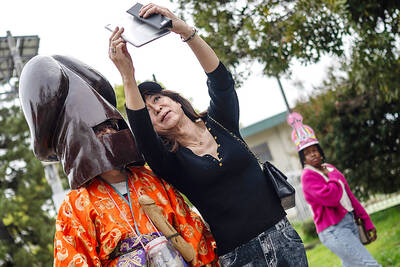
Showcasing phallus-shaped portable shrines and pink penis candies, Japan’s annual fertility festival yesterday teemed with tourists, couples and families elated by its open display of sex. The spring Kanamara Matsuri near Tokyo features colorfully dressed worshipers carrying a trio of giant phallic-shaped objects as they parade through the street with glee. The festival, as legend has it, honors a local blacksmith in the Edo Period (1603-1868) who forged an iron dildo to break the teeth of a sharp-toothed demon inhabiting a woman’s vagina that had been castrating young men on their wedding nights. A 1m black steel phallus sits in the courtyard of
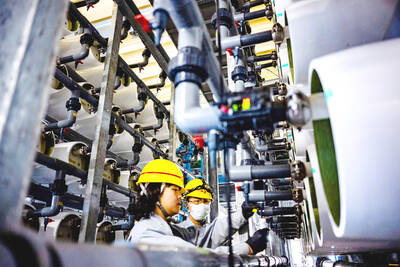
HIGH HOPES: The power source is expected to have a future, as it is not dependent on the weather or light, and could be useful for places with large desalination facilities A Japanese water plant is harnessing the natural process of osmosis to generate renewable energy that could one day become a common power source. The possibility of generating power from osmosis — when water molecules pass from a less salty solution to a more salty one — has long been known. However, actually generating energy from that has proved more complicated, in part due the difficulty of designing the membrane through which the molecules pass. Engineers in Fukuoka, Japan, and their private partners think they might have cracked it, and have opened what is only the world’s second osmotic power plant. It generates

JAN. 1 CLAUSE: As military service is voluntary, applications for permission to stay abroad for over three months for men up to age 45 must, in principle, be granted A little-noticed clause in sweeping changes to Germany’s military service policy has triggered an uproar after it emerged that the law requires men aged up to 45 to get permission from the armed forces before any significant stay abroad, even in peacetime. The legislation, which went into effect on Jan. 1 aims to bolster the military and demands all 18-year-old men fill out a questionnaire to gauge their suitability to serve in the armed forces, but stops short of conscription. If the “modernized” model fails to pull in enough recruits, parliament will be compelled to discuss the reintroduction of compulsory service, German

Hundreds of Filipinos and tourists flocked to a sun-bleached field north of Manila yesterday, on Good Friday, to witness one of the country’s most blood-soaked displays of religious fervor, undeterred by rising fuel prices. Scores of bare-chested flagellants with covered faces walked barefoot through the dusty streets of Pampanga Province’s San Fernando as they flogged their backs with bamboo whips in the scorching heat. Agence France-Presse (AFP) journalists said they saw devotees deliberately puncturing their skin with glass shards attached to a small wooden paddle to ensure their bleeding during the ritual, a way to atone for sins and seek miracles from


 RSS
RSS