


The Dalai Lama, the spiritual leader of Tibetan Buddhism, on Monday said it was possible that once he dies his incarnation could be found in India, where he has lived in exile for 60 years, and warned that any other successor named by China would not be respected.
Sitting in an office next to a temple ringed by green hills and snow-capped mountains, the 14th Dalai Lama spoke to Reuters a day after Tibetans in the northern Indian town of Dharamshala marked the anniversary of his escape from the Tibetan capital, Lhasa, disguised as a soldier.
He fled to India in early 1959 after a failed uprising against Chinese rule and has since worked to draw global support for linguistic and cultural autonomy in his remote and mountainous homeland.
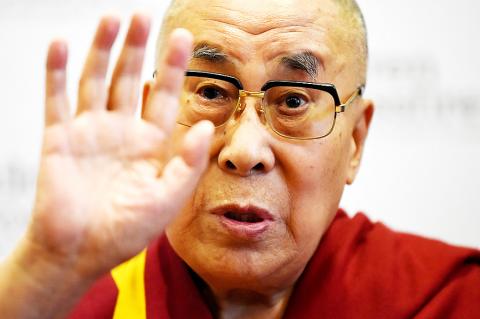
Photo: Reuters
China, which took control of Tibet in 1950, brands the 83-year-old Nobel peace laureate a dangerous separatist.
Pondering what might happen after his death, the Dalai Lama anticipated some attempt by Beijing to foist a successor on Tibetan Buddhists.
“China considers Dalai Lama’s reincarnation as something very important. They have more concern about the next Dalai Lama than me,” the Dalai Lama said.
“In future, in case you see two Dalai Lamas come, one from here, in free country, one chosen by Chinese, then nobody will trust, nobody will respect [the one chosen by China]. So that’s an additional problem for the Chinese. It’s possible, it can happen,” he added, laughing.
China has said its leaders have the right to approve the Dalai Lama’s successor, as a legacy inherited from China’s emperors.
However, many Tibetans — whose tradition holds that the soul of a senior Buddhist monk is reincarnated in the body of a child on his death — suspect any Chinese role as a ploy to exert influence on the community.
Born in 1935, the current Dalai Lama was identified as the reincarnation of his predecessor when he was two years old.
Speaking in Beijing at a daily news briefing yesterday, Chinese Ministry of Foreign Affairs spokesman Geng Shuang (耿爽) said the 14th Dalai Lama himself was chosen by following centuries-old religious rituals and history, which were “respected and protected” in rules and ordinances regulating religion.
“Therefore reincarnations, including that of the Dalai Lama, should observe the country’s laws and regulations and follow the rituals and history of religion,” Geng said.
Many of China’s more than 6 million Tibetans still venerate the Dalai Lama, despite government prohibitions on displays of his picture or any public display of devotion.
The Dalai Lama said that contact between Tibetans living in their homeland and in exile was increasing, but that no formal meetings have happened between Chinese and his officials since 2010.
Informally, however, some retired Chinese officials and businessman with connections to Beijing do visit him from time to time, he added.
He said the role of the Dalai Lama after his death, including whether to keep it, could be discussed during a meeting of Tibetan Buddhists in India later this year.
However, he added that although there was no reincarnation of Buddha, his teachings have remained.
“If the majority of [Tibetans] really want to keep this institution, then this institution will remain,” he said. “Then comes the question of the reincarnation of the 15th Dalai Lama.”
If there is one, he would still have “ no political responsibility,” said the Dalai Lama, who gave up his political duties in 2001, developing a democratic system for the up to 100,000 Tibetans living in India.
During the interview, the Dalai Lama spoke passionately about his love for cosmology, neurobiology, quantum physics and psychology.
If he was ever allowed to visit his homeland, he said he would like to speak about those subjects in a Chinese university.
However, he does not expect to go while China remained under communist rule.
“China — great nation, ancient nation — but its political system is totalitarian system, no freedom. So therefore I prefer to remain here, in this country,” he said.
The Dalai Lama was born to a family of farmers in Taktser, a village on the northeastern edge of the Tibetan plateau, in what is now China’s Qinghai Province.
During a recent Reuters visit to Taktser, police armed with automatic weapons blocked the road. Police and more than a dozen plain-clothed officials said the village was not open to non-locals.
“Our strength, our power is based on truth. Chinese power based on gun,” the Dalai Lama said. “So for short term, gun is much more decisive, but long-term truth is more powerful.”

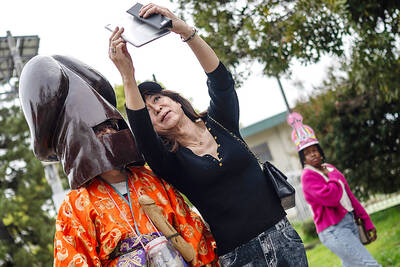
Showcasing phallus-shaped portable shrines and pink penis candies, Japan’s annual fertility festival yesterday teemed with tourists, couples and families elated by its open display of sex. The spring Kanamara Matsuri near Tokyo features colorfully dressed worshipers carrying a trio of giant phallic-shaped objects as they parade through the street with glee. The festival, as legend has it, honors a local blacksmith in the Edo Period (1603-1868) who forged an iron dildo to break the teeth of a sharp-toothed demon inhabiting a woman’s vagina that had been castrating young men on their wedding nights. A 1m black steel phallus sits in the courtyard of

HIGH HOPES: The power source is expected to have a future, as it is not dependent on the weather or light, and could be useful for places with large desalination facilities A Japanese water plant is harnessing the natural process of osmosis to generate renewable energy that could one day become a common power source. The possibility of generating power from osmosis — when water molecules pass from a less salty solution to a more salty one — has long been known. However, actually generating energy from that has proved more complicated, in part due the difficulty of designing the membrane through which the molecules pass. Engineers in Fukuoka, Japan, and their private partners think they might have cracked it, and have opened what is only the world’s second osmotic power plant. It generates

JAN. 1 CLAUSE: As military service is voluntary, applications for permission to stay abroad for over three months for men up to age 45 must, in principle, be granted A little-noticed clause in sweeping changes to Germany’s military service policy has triggered an uproar after it emerged that the law requires men aged up to 45 to get permission from the armed forces before any significant stay abroad, even in peacetime. The legislation, which went into effect on Jan. 1 aims to bolster the military and demands all 18-year-old men fill out a questionnaire to gauge their suitability to serve in the armed forces, but stops short of conscription. If the “modernized” model fails to pull in enough recruits, parliament will be compelled to discuss the reintroduction of compulsory service, German

Hundreds of Filipinos and tourists flocked to a sun-bleached field north of Manila yesterday, on Good Friday, to witness one of the country’s most blood-soaked displays of religious fervor, undeterred by rising fuel prices. Scores of bare-chested flagellants with covered faces walked barefoot through the dusty streets of Pampanga Province’s San Fernando as they flogged their backs with bamboo whips in the scorching heat. Agence France-Presse (AFP) journalists said they saw devotees deliberately puncturing their skin with glass shards attached to a small wooden paddle to ensure their bleeding during the ritual, a way to atone for sins and seek miracles from


 RSS
RSS