


Time magazine on Tuesday recognized journalists, including the slain Saudi Arabian columnist Jamal Khashoggi, as its Person of the Year in what it said was an effort to emphasize the importance of reporters’ work in an increasingly hostile world.
The designation was not intended as a specific message to the magazine’s runner-up, US President Donald Trump, who has denounced “fake news” and called some reporters enemies of the people, executive editor Ben Goldberger said.
Time cited four figures it called “the guardians.”
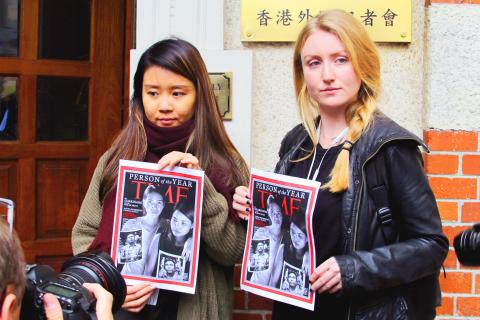
Photo: Reuters
Besides Khashoggi, they are the staff of the Capital Gazette in Annapolis, Maryland, where five people were shot to death in June; Philippine journalist Maria Ressa; and Reuters reporters Wa Lone and Kyaw Soe Oo, who have been jailed in Myanmar for a year.
It was the first time since the magazine began the end-of-year tradition in 1927 that Time featured a journalist or recognized someone posthumously.
Time said that this year has been marked by manipulation and abuse of information, along with efforts by governments to foment mistrust of the facts.
Goldberger said the magazine hopes the choice reminds people outside of journalism about the importance of the work.
Committee to Protect Journalists executive director Joel Simon said he sees this message already starting to get through — sadly, in part because of the attention paid to Khashoggi’s killing.
Khashoggi is one of at least 52 journalists murdered so far this year, the committee said.
“In some ways, I feel we’re at a turning point,” Simon said.
Khashoggi was killed two months ago when the Washington Post columnist, who was living in the US, visited the Saudi Arabian consulate in Turkey for paperwork so he could get married. He had been critical of the Saudi Arabian regime.
The Washington Post applauded Time for its message of support for journalists.
“We hope this recognition will prompt our nation’s leaders to stand up for America’s values and hold accountable those who attempt to silence journalists who cover our communities, or in Jamal’s case, an oppressive authoritarian government,” Washington Post publisher and chief executive Fred Ryan said.
Reesa cofounded online site the Rappler, which has aggressively covered the government of Philippine President Rodrigo Duterte. She was recently charged with tax fraud, with many in the Philippines seeing that as a reaction to the Rappler’s reporting.
Wa Lone and Kyaw Soe Oo were imprisoned after investigating a massacre of Rohingya Muslims.
Four journalists and a sales assistant were killed by a gunman at the Capital Gazette newspaper in spring.
Time is producing four different covers featuring “the guardians.”
Last year, Time recognized people who came forward to report on sexual misconduct. Trump, this year’s runner-up, was Person of the Year in 2016.
The third-place finisher this year was US Special Counsel Robert Mueller, who Time said could move up in next year’s rankings depending on the findings of his investigation into the Trump campaign’s contacts with Russia.
ROCKY RELATIONS: The figures on residents come as Chinese tourist numbers drop following Beijing’s warnings to avoid traveling to Japan The number of Chinese residents in Japan has continued to rise, even as ties between the two countries have become increasingly fractious, data released on Friday showed. As of the end of December last year, the number of Chinese residents had increased by 6.5 percent from the previous year to 930,428. Chinese people accounted for 22.6 percent of all foreign residents in Japan, making them by far the largest group, Japanese Ministry of Justice data showed. Beijing has criticized Tokyo in increasingly strident terms since Japanese Prime Minister Sanae Takaichi last year suggested that a military conflict around Taiwan could

A retired US colonel behind a privately financed rocket launch site in the Dominican Republic sees the project as a response to China’s dominance of the space race in Latin America. Florida-based Launch on Demand is slated to begin building a US$600 million facility in a remote region near the border with Haiti late this year. The project is designed to meet surging demand for the heavy-lift rockets needed to put clusters of satellites into orbit. It is also an answer to China’s growing presence in the region, said CEO Burton Catledge, a former commander of the US Air Force’s 45th Operations

Germany is considering Australia’s Ghost Bat robot fighter as it looks to select a combat drone to modernize its air force, German Minister of Defense Boris Pistorius said yesterday. Germany has said it wants to field hundreds of uncrewed fighter jets by 2029, and would make a decision soon as it considers a range of German, European and US projects developing so-called “collaborative combat aircraft.” Australia has said it will integrate the Ghost Bat, jointly developed by Boeing Australia and the Royal Australian Air Force, into its military after a successful weapons test last year. After inspecting the Ghost Bat in Queensland yesterday,
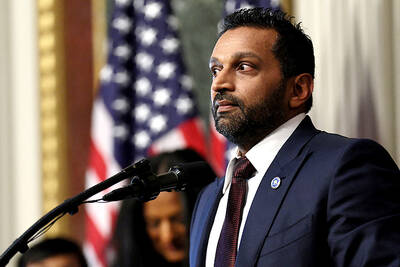
A pro-Iran hacking group claimed to breach FBI Director Kash Patel’s personal e-mail inbox and posted some of the contents online. The e-mails provided by the hacking group include travel details, correspondence with leasing agents in Washington and global entry, and loyalty account numbers. The e-mail address the hackers claim to have compromised has been previously tied to Patel’s personal details, and the leaked e-mails contain photos of Patel and others, in addition to correspondence with family members and colleagues. “The FBI is aware of malicious actors targeting Director Patel’s personal email information,” the agency said in a statement on


 RSS
RSS