


Police yesterday identified a headless female torso washed ashore in Copenhagen as that of Swedish journalist Kim Wall, who they believe was killed by a Danish inventor on board his home-made submarine.
Wall, who was researching a story on inventor Peter Madsen, went missing after he took her out to sea in his 17m submarine on Aug. 10. He denies killing her.
Announcing the results of tests on the torso, discovered by a passing cyclist on Monday, police spokesman Jens Moller said it had suffered damage suggesting “an attempt to make sure air and gas inside should leave the body so that it would not rise from the seabed.”

Photo: Tom Wall / AP
“There was also some metal attached to the body, allegedly also to make sure the body would sink to the bottom,” he added.
The arms, legs and head had been sawn from the body. Analysis showed a match with Wall’s DNA, which the police had gathered from a toothbrush and a hairbrush, and with blood found in the submarine, Moller said.
Police still do not know the cause of death and divers are searching for additional body parts.
Madsen, 46, was initially held on a charge of involuntary manslaughter, though a police statement in Danish on Monday referred to a “murder charge” against him.
Asked for clarification yesterday, police said by e-mail the charge was manslaughter.
The macabre case has riveted Swedish and Danish media, and made headlines around the world.
“It is with boundless sadness and dismay we received the message that the remains of our daughter and sister Kim Wall have been found,” Wall’s mother, Ingrid, said on Facebook.
“During the horrendous days that have passed since Kim disappeared, we have received countless evidence of how loved and appreciated she was, both as a person and friend and as a professional journalist. From all corners of the world comes proof of Kim as a person who made a difference,” she said.
Madsen’s lawyer, Betina Hald Engmark, was not immediately available for comment, but has told Danish media he is sticking to his explanation her death was caused by an accident.
Madsen has told a court that following the alleged accident, he “buried” Kim Wall at sea — changing his initial statement to police that he dropped her off alive in Copenhagen.
A day after taking Kim Wall out to sea, the inventor was rescued after his UC3 Nautilus vessel sank.
Police found nobody else on board. The submarine is one of three constructed by Madsen and one of the largest privately built ones in the world. It can carry eight people and weighs 40 tonnes when fully equipped.
Madsen was already well known in Denmark as an entrepreneur and aerospace engineer, as well as for his submarines. He founded the association Copenhagen Suborbitals, with the goal of sending a person into space in a home-built rocket, and wrote a blog under the nickname “Rocket Madsen.”
“He is not violent, he does not drink, does not do drugs,” Thomas Djursing, who wrote a book about him, told Danish tabloid B.T. earlier this month. “On the other hand, he quarrels with everyone and I have argued with him too, but that is how it often is with people who are deeply driven by a passion.”
Kim Wall, 30, was a freelance journalist whose work had appeared in Harper’s Magazine, the Guardian, the New York Times, Foreign Policy, the South China Morning Post, The Atlantic and Time.
Originally from Sweden, she held degrees from Columbia University and the London School of Economics, and was based between New York and Beijing. She had written about topics ranging from gender and social justice to pop culture and foreign policy, according to her LinkedIn profile.
She had also received training in hostile environments and emergency first-aid, she said on the profile.
Her mother said she had uncovered stories all over the world.
“She gave a voice to the weak, the vulnerable and marginalized people. That voice would have been needed for a long, long time. Now it won’t be so,” Ingrid Wall said.

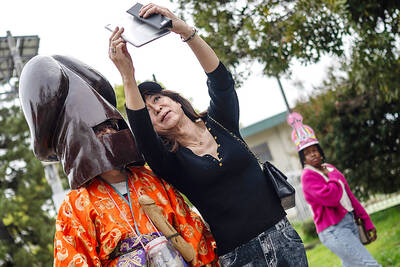
Showcasing phallus-shaped portable shrines and pink penis candies, Japan’s annual fertility festival yesterday teemed with tourists, couples and families elated by its open display of sex. The spring Kanamara Matsuri near Tokyo features colorfully dressed worshipers carrying a trio of giant phallic-shaped objects as they parade through the street with glee. The festival, as legend has it, honors a local blacksmith in the Edo Period (1603-1868) who forged an iron dildo to break the teeth of a sharp-toothed demon inhabiting a woman’s vagina that had been castrating young men on their wedding nights. A 1m black steel phallus sits in the courtyard of

HIGH HOPES: The power source is expected to have a future, as it is not dependent on the weather or light, and could be useful for places with large desalination facilities A Japanese water plant is harnessing the natural process of osmosis to generate renewable energy that could one day become a common power source. The possibility of generating power from osmosis — when water molecules pass from a less salty solution to a more salty one — has long been known. However, actually generating energy from that has proved more complicated, in part due the difficulty of designing the membrane through which the molecules pass. Engineers in Fukuoka, Japan, and their private partners think they might have cracked it, and have opened what is only the world’s second osmotic power plant. It generates

JAN. 1 CLAUSE: As military service is voluntary, applications for permission to stay abroad for over three months for men up to age 45 must, in principle, be granted A little-noticed clause in sweeping changes to Germany’s military service policy has triggered an uproar after it emerged that the law requires men aged up to 45 to get permission from the armed forces before any significant stay abroad, even in peacetime. The legislation, which went into effect on Jan. 1 aims to bolster the military and demands all 18-year-old men fill out a questionnaire to gauge their suitability to serve in the armed forces, but stops short of conscription. If the “modernized” model fails to pull in enough recruits, parliament will be compelled to discuss the reintroduction of compulsory service, German

Hundreds of Filipinos and tourists flocked to a sun-bleached field north of Manila yesterday, on Good Friday, to witness one of the country’s most blood-soaked displays of religious fervor, undeterred by rising fuel prices. Scores of bare-chested flagellants with covered faces walked barefoot through the dusty streets of Pampanga Province’s San Fernando as they flogged their backs with bamboo whips in the scorching heat. Agence France-Presse (AFP) journalists said they saw devotees deliberately puncturing their skin with glass shards attached to a small wooden paddle to ensure their bleeding during the ritual, a way to atone for sins and seek miracles from


 RSS
RSS