


The Australian government yesterday approved a controversial Indian-backed project to build one of the world’s biggest coal mines, despite conservationists’ fears that it threatens the Great Barrier Reef and vulnerable species while contributing to global climate change.
The Queensland project was approved subject to “36 of the strictest conditions in Australian history,” Australian Minister of the Environment Greg Hunt said.
It came two months after the Federal Court of Australia blocked the A$16.5 billion (US$12.1) Carmichael mine, largely in relation to its impact on two vulnerable reptiles — the lizard-like yakka skink and the ornamental snake.
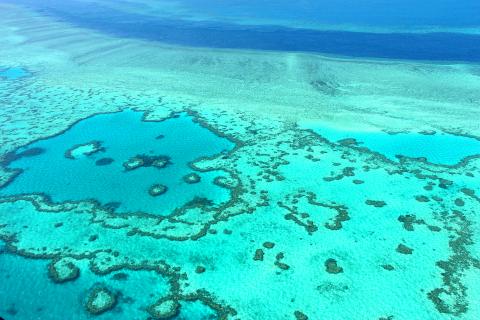
Photo: AFP
“The rigorous conditions will protect threatened species and provide long-term benefits for the environment through the development of an offset package,” Hunt said in a statement.
“These measures must be approved by myself before mining can start,” he said, adding that he had the power to suspend or revoke the approval and impose penalties if there was a breach of conditions.
Adani has faced numerous legal and approval hurdles for the huge open-cut and underground coal mine, plans for which are in the fifth year of development.
British bank Standard Chartered and the Commonwealth Bank of Australia have withdrawn as financial advisers, while major European and US banks have refused to fund the project due to environmental concerns.
Under the conditions, all advice from an independent scientific committee has to be implemented, 31,000 hectares of southern black-throated finch habitat will be protected and improved, and groundwater at a nearby wetland will be monitored.
About AU$1 million of funding over 10 years also has to be allocated to research programs that boost the conservation of threatened species in the Galilee Basin, about 1,200km northwest of Queensland’s capital, Brisbane.
The Indian conglomerate, which has hit out at activists and accused them of exploiting legal loopholes to stall the mine, welcomed Hunt’s decision and the “rigorous and painstaking conditions.”
“Today’s announcement of the final federal approval for the Carmichael Mine and North Galilee Basin Rail by Minister Hunt makes clear that these [conservation] concerns have been addressed, reflected in rigorous and painstaking conditions,” the company said in a statement, referring to a new rail line which will transport the coal to port.
Adani said that the mine would create 10,000 jobs and generate A$22 billion in taxes and royalties, although the figures have been disputed by critics, who say that plunging coal prices were making the development financially unviable.
Adani shares jumped more than 10 percent in early trading on the Bombay Stock Exchange following the announcement.
Despite the conditions, the Mackay Conservation Group — which brought the legal challenge to the federal court — said the approval “risks threatened species, precious groundwater, the global climate and taxpayers’ money.”
“Minister Hunt has again failed the people of Australia by ignoring new evidence on the devastating impacts of what would be Australia’s largest coal mine,” the group’s coordinator, Ellen Roberts, said.
Environmental campaign group Greenpeace said the mine would be a “complete disaster for the climate and the Great Barrier Reef.”
“The federal government and environment minister should be in the business of protecting the reef and the climate, not giving mining companies license to destroy them,” Greenpeace’s Shani Tager said in a statement. “This project means more dredging in the Great Barrier Reef, more ships through its waters and more carbon emissions.”
Local indigenous landowners, who are battling Adani in a separate case in the federal court, also slammed the approval and described the state and federal governments’ actions as “economically and environmentally irresponsible and morally bankrupt.”


Showcasing phallus-shaped portable shrines and pink penis candies, Japan’s annual fertility festival yesterday teemed with tourists, couples and families elated by its open display of sex. The spring Kanamara Matsuri near Tokyo features colorfully dressed worshipers carrying a trio of giant phallic-shaped objects as they parade through the street with glee. The festival, as legend has it, honors a local blacksmith in the Edo Period (1603-1868) who forged an iron dildo to break the teeth of a sharp-toothed demon inhabiting a woman’s vagina that had been castrating young men on their wedding nights. A 1m black steel phallus sits in the courtyard of
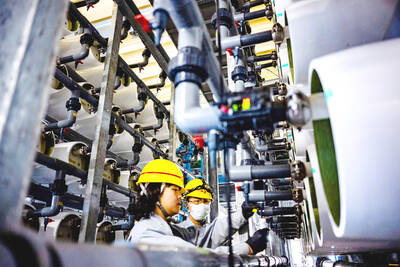
HIGH HOPES: The power source is expected to have a future, as it is not dependent on the weather or light, and could be useful for places with large desalination facilities A Japanese water plant is harnessing the natural process of osmosis to generate renewable energy that could one day become a common power source. The possibility of generating power from osmosis — when water molecules pass from a less salty solution to a more salty one — has long been known. However, actually generating energy from that has proved more complicated, in part due the difficulty of designing the membrane through which the molecules pass. Engineers in Fukuoka, Japan, and their private partners think they might have cracked it, and have opened what is only the world’s second osmotic power plant. It generates

JAN. 1 CLAUSE: As military service is voluntary, applications for permission to stay abroad for over three months for men up to age 45 must, in principle, be granted A little-noticed clause in sweeping changes to Germany’s military service policy has triggered an uproar after it emerged that the law requires men aged up to 45 to get permission from the armed forces before any significant stay abroad, even in peacetime. The legislation, which went into effect on Jan. 1 aims to bolster the military and demands all 18-year-old men fill out a questionnaire to gauge their suitability to serve in the armed forces, but stops short of conscription. If the “modernized” model fails to pull in enough recruits, parliament will be compelled to discuss the reintroduction of compulsory service, German

Hundreds of Filipinos and tourists flocked to a sun-bleached field north of Manila yesterday, on Good Friday, to witness one of the country’s most blood-soaked displays of religious fervor, undeterred by rising fuel prices. Scores of bare-chested flagellants with covered faces walked barefoot through the dusty streets of Pampanga Province’s San Fernando as they flogged their backs with bamboo whips in the scorching heat. Agence France-Presse (AFP) journalists said they saw devotees deliberately puncturing their skin with glass shards attached to a small wooden paddle to ensure their bleeding during the ritual, a way to atone for sins and seek miracles from


 RSS
RSS