


With next year’s election cycle heating up, US politicians last week harnessed worries over a rising China to power support for everything from patent law reform to debt reduction — and their own ambitions.
US President Barack Obama led the pack, warning on Thursday that crumbling US infrastructure threatened Washington’s standing as “an economic superpower” as he laid out a battle plan for assaulting 9.1 percent unemployment.
“And now we’re going to sit back and watch China build newer airports and faster railroads?” Obama said in a -campaign-style speech that was aimed at shoring up his embattled re-election prospects, which have been weighted down by the sluggish US economy.
Fighting much the same battle, Republican White House hopeful Mitt Romney on Tuesday made confronting China over its alleged currency manipulation and rampant theft of US intellectual property a cornerstone of his economic plan.
“I have no interest in starting a trade war with China, but I cannot accept our current trade surrender,” said the former Massachusetts governor, who trails Texas Governor Rick Perry in the fight for the party’s presidential nomination.
US Representative Jeb Hensarling, the top Republican on a new “Super-committee” ordered to shave more than US$1 trillion from US debt over 10 years, said Beijing was Washington’s largest overseas creditor.
“In interest payments alone, we are enabling China to buy two jet fighters a week,” he said as the panel formally took up its mission on Thursday.
“Is it not our public duty to respond to this kind of warning with the same alarm and resolve that would be summoned to defeat any other threat to our nation?” he asked.
US House of Representatives Armed Services Committee Chairman Buck McKeon, launching a fight to beat back defense cuts he warns will lead to the “hollowing out” of the US military, said he would lead fellow lawmakers to China, Taiwan and South Korea later this month amid worries about Beijing’s growing arsenal.
“It’ll give some members of the committee a little better understanding of what we’re facing over there,” McKeon told reporters of the visit.
And China’s economic rise also featured as US lawmakers sent Obama legislation to drag US patent law into the Internet age and spur high-tech innovation.
A statement from US House Judiciary Committee Chairman Lamar Smith, a key author of the measure, warned that it was needed because “this year, for the first time, China is expected to become the world’s No. 1 patent publisher, surpassing the US and Japan in the total and basic number of patents.”
Amid the chorus of warnings, US Vice President Joe Biden took to the New York Times opinion page to argue for a “clear-eyed” approach to Beijing’s growing clout while saying reports of US economic demise were greatly exaggerated.
“Some may warn of America’s demise, but I’m not among them,” Biden, who stopped in China on an Asia trip last month, said in the column on Thursday. “And let me reassure you: Based on my time in China, neither are the Chinese.”
Biden said that Americans worry about what China’s rise might mean for the US and the world, but he rejected the view that it portends a “cold-war-style rivalry or great power confrontation.”
“I remain convinced that a successful China can make our country more prosperous, not less,” he wrote.
And at a Republican presidential candidate debate on Wednesday, former US envoy to Beijing Jon Huntsman chided Romney over his plan, saying: “I’d have to say, Mitt, now is not the time, in a recession, to enter a trade war.”
The phenomenon is not a new one — politicians, especially in election season, have talked tough about China, or Japan, or even, in the wake of the Sept. 11, 2001, attacks, Saudi Arabia.
“A big part of it is politics,” said Republican US Senator Bob Corker, who sits on the Senate Foreign Relations Committee, emphasizing that Washington and Beijing have a largely “symbiotic” economic relationship.
However, Corker said, the US has to tread carefully to avoid embracing policies “having the effect of giving China an even greater competitive advantage than they have” on the economic front.

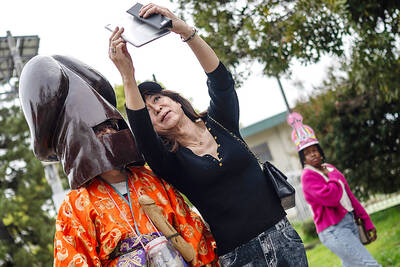
Showcasing phallus-shaped portable shrines and pink penis candies, Japan’s annual fertility festival yesterday teemed with tourists, couples and families elated by its open display of sex. The spring Kanamara Matsuri near Tokyo features colorfully dressed worshipers carrying a trio of giant phallic-shaped objects as they parade through the street with glee. The festival, as legend has it, honors a local blacksmith in the Edo Period (1603-1868) who forged an iron dildo to break the teeth of a sharp-toothed demon inhabiting a woman’s vagina that had been castrating young men on their wedding nights. A 1m black steel phallus sits in the courtyard of
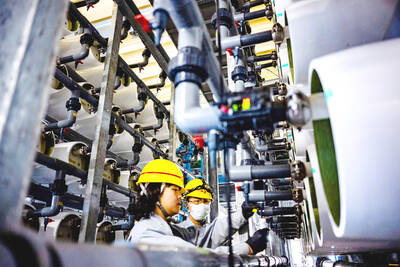
HIGH HOPES: The power source is expected to have a future, as it is not dependent on the weather or light, and could be useful for places with large desalination facilities A Japanese water plant is harnessing the natural process of osmosis to generate renewable energy that could one day become a common power source. The possibility of generating power from osmosis — when water molecules pass from a less salty solution to a more salty one — has long been known. However, actually generating energy from that has proved more complicated, in part due the difficulty of designing the membrane through which the molecules pass. Engineers in Fukuoka, Japan, and their private partners think they might have cracked it, and have opened what is only the world’s second osmotic power plant. It generates

JAN. 1 CLAUSE: As military service is voluntary, applications for permission to stay abroad for over three months for men up to age 45 must, in principle, be granted A little-noticed clause in sweeping changes to Germany’s military service policy has triggered an uproar after it emerged that the law requires men aged up to 45 to get permission from the armed forces before any significant stay abroad, even in peacetime. The legislation, which went into effect on Jan. 1 aims to bolster the military and demands all 18-year-old men fill out a questionnaire to gauge their suitability to serve in the armed forces, but stops short of conscription. If the “modernized” model fails to pull in enough recruits, parliament will be compelled to discuss the reintroduction of compulsory service, German

Hundreds of Filipinos and tourists flocked to a sun-bleached field north of Manila yesterday, on Good Friday, to witness one of the country’s most blood-soaked displays of religious fervor, undeterred by rising fuel prices. Scores of bare-chested flagellants with covered faces walked barefoot through the dusty streets of Pampanga Province’s San Fernando as they flogged their backs with bamboo whips in the scorching heat. Agence France-Presse (AFP) journalists said they saw devotees deliberately puncturing their skin with glass shards attached to a small wooden paddle to ensure their bleeding during the ritual, a way to atone for sins and seek miracles from


 RSS
RSS