


China has its eye on becoming the top science nation in the world, overtaking the US and European nations, researchers at a US science conference said on Friday.
After being the world’s main source of cheap manufactured goods, China is investing heavily in science and technology.
“China hopes to become one of the leading sources of intellectual property in coming years,” said Denis Simon, a professor at Penn State University, who is also the science and technology adviser to the mayor of the Chinese city of Dalian.
At a time when the US and Europe are hamstrung by shrinking budgets, China has increased spending on science and technology “significantly,” Simon said at the annual meeting of the American Association for the Advancement of Science (AAAS).
“The Chinese have indicated that by 2020 they hope to spend around 2.5 percent of GDP on research and development,” Simon said.
In the US, meanwhile, Republican lawmakers are talking about trimming US$1 billion from the National Institutes of Health, the world’s largest public research institute, and slashing funds for other science and research agencies, in a bid to narrow a trillion-dollar US deficit.
That is at odds with the billion-dollar boost US President Barack Obama proposed for science and health research in his 2012 budget.
The Republicans also want to slash funds for education by US$5 billion, even though US Secretary of Education Arne Duncan has warned that the US must better educate its kids, especially in science and math, or risk becoming uncompetitive in the global economy.
A report last year showed the US has slipped from second place to 13th out of 34 countries in the number of students enrolled in university and that it was stagnating in science teaching — in 17th place — and doing poorly in math, in 25th place.
Shanghai, which was considered a country for the education report, made its debut in the rankings in first place.
More Chinese are enrolling in universities, which means there will “be more researchers in China than there are in the US,” which will drive up Chinese scientific output and the quality of the reports, Penn State professor Caroline Wagner said at the AAAS meeting.
In another sign that China is serious about moving into the top slot for science, the number of quality scientific papers coming out of the country — measured by how often they are cited in other studies — is growing exponentially.
How often a peer-reviewed scientific report is cited by another scientist is considered a key measure of quality, Wagner said.
The number of Chinese papers being cited is up, while the number of citations of US or European reports is declining.
In sheer volume of work, China already produces more research papers in the fields of natural science and engineering than the US, which is overall the biggest producer of scientific reports in the world, Wagner said.
“Based on current trends, China will publish more papers in all fields by 2015,” Wagner said.
However, there are obstacles standing in the way of China becoming the world’s leading science nation.
Among them, China has to overcome a massive brain drain, which sees nearly three-quarters of Chinese who travel abroad to study staying overseas, and a culture of fabrication and plagiarism among Chinese researchers, that Simon said could be driven by intense pressure and competition.


Showcasing phallus-shaped portable shrines and pink penis candies, Japan’s annual fertility festival yesterday teemed with tourists, couples and families elated by its open display of sex. The spring Kanamara Matsuri near Tokyo features colorfully dressed worshipers carrying a trio of giant phallic-shaped objects as they parade through the street with glee. The festival, as legend has it, honors a local blacksmith in the Edo Period (1603-1868) who forged an iron dildo to break the teeth of a sharp-toothed demon inhabiting a woman’s vagina that had been castrating young men on their wedding nights. A 1m black steel phallus sits in the courtyard of
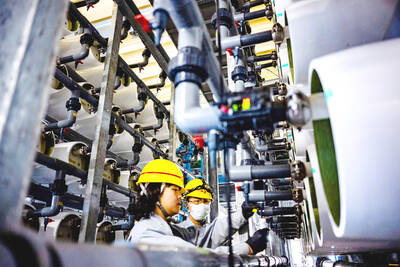
HIGH HOPES: The power source is expected to have a future, as it is not dependent on the weather or light, and could be useful for places with large desalination facilities A Japanese water plant is harnessing the natural process of osmosis to generate renewable energy that could one day become a common power source. The possibility of generating power from osmosis — when water molecules pass from a less salty solution to a more salty one — has long been known. However, actually generating energy from that has proved more complicated, in part due the difficulty of designing the membrane through which the molecules pass. Engineers in Fukuoka, Japan, and their private partners think they might have cracked it, and have opened what is only the world’s second osmotic power plant. It generates

JAN. 1 CLAUSE: As military service is voluntary, applications for permission to stay abroad for over three months for men up to age 45 must, in principle, be granted A little-noticed clause in sweeping changes to Germany’s military service policy has triggered an uproar after it emerged that the law requires men aged up to 45 to get permission from the armed forces before any significant stay abroad, even in peacetime. The legislation, which went into effect on Jan. 1 aims to bolster the military and demands all 18-year-old men fill out a questionnaire to gauge their suitability to serve in the armed forces, but stops short of conscription. If the “modernized” model fails to pull in enough recruits, parliament will be compelled to discuss the reintroduction of compulsory service, German

Hundreds of Filipinos and tourists flocked to a sun-bleached field north of Manila yesterday, on Good Friday, to witness one of the country’s most blood-soaked displays of religious fervor, undeterred by rising fuel prices. Scores of bare-chested flagellants with covered faces walked barefoot through the dusty streets of Pampanga Province’s San Fernando as they flogged their backs with bamboo whips in the scorching heat. Agence France-Presse (AFP) journalists said they saw devotees deliberately puncturing their skin with glass shards attached to a small wooden paddle to ensure their bleeding during the ritual, a way to atone for sins and seek miracles from


 RSS
RSS