


Tensions between Chad and Sudan rose further on Saturday following a rebel attack that observers say could yet lead to the fall of Chadian President Idriss Deby Itno and plunge the country into chaos.
In the Chadian capital N'Djamena Deby accused his Sudanese counterpart Omar al-Beshir of "genocide" in the west Sudanese region of Darfur and branded him a "traitor," a day after severing diplomatic ties with Khartoum.
The UN voiced concern about threats by Chad to expel Sudanese refugees amid the escalating crisis between the two countries, warning that such action would violate international humanitarian law.
UN Secretary General Kofi Annan's special representative to Sudan Jan Pronk issued the warning after N'djamena threatened to expel some 200,000 Sudanese refugees in eastern Chad in retaliation for Khartoum's alleged support of a Chadian rebel offensive.
"I have asked all the big powers, the African Union, the United Nations, the European Union, all nations who love peace and justice to intervene militarily to save the people of Darfur who are victims of the most terrible genocide carried out by President Beshir," Deby told supporters.
Deby urged the international community to make Darfur,wracked by ethnic conflict since 2003, a UN protectorate.
"The international community must face up to all its responsibilities to resolve the crisis in Darfur and place Darfur under UN protection," he said.
Deby told a crowd of several thousand supporters: "You have shown the international community and the traitors to the national cause that you are not ready to allow your country to be occupied by mercenaries sent by that traitor Beshir."
The Chadian leader, who is fighting for his political life after almost 16 years in power, also referred to al-Bashir in Arabic as "a donkey."
Sudan said Chad had ordered its top diplomat in N'Djamena to leave the country, after breaking off diplomatic ties on Friday.
Chadian Prime Minister Pascal Yoadimnadji on Saturday told representatives of the UN in N'Djamena that refugees from Sudan would have to leave within the next two and half months.
"The Chadian government has given the international community until the end of June 2006 to find another host country," he said.
Though calm was holding in N'Djamena on Saturday, observers warned that the rebellion had not been broken and that, just three weeks before Chad's presidential election, Deby's hold on power was shaky.
A French military source said the rebels, who sent some 600 men into the capital on Thursday, could be regrouping and planning fresh attacks.
Opposition parties accuse Deby of using revenue from Chad's new-found oil riches to bolster the military and boosting his chances of re-election on May 3, in violation of a deal with the World Bank to channel oil money into alleviating poverty.
Chad's internal strife is closely linked to the three-year civil war in Darfur and could yet destabilize other neighboring countries such as Cameroon and the Central African Republic (CAR), which on Friday closed its border with Chad.
Former colonial power France came to Deby's aid several times this week -- airlifting a small number of armed Chadian troops, firing into the air to disperse rebels in N'Djamena and providing military intelligence. But Paris has insisted it will not join the fighting to save his political future.
A French diplomat warned on Saturday that if the rebels toppled Deby, it could create a power vacuum that would destabilize the country.
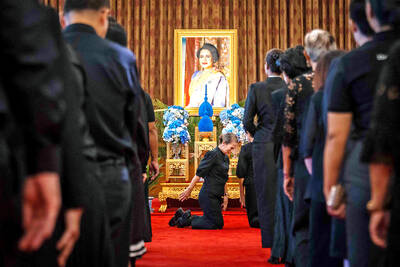
‘MOTHER’ OF THAILAND: In her glamorous heyday in the 1960s, former Thai queen Sirikit mingled with US presidents and superstars such as Elvis Presley The year-long funeral ceremony of former Thai queen Sirikit started yesterday, with grieving royalists set to salute the procession bringing her body to lie in state at Bangkok’s Grand Palace. Members of the royal family are venerated in Thailand, treated by many as semi-divine figures, and lavished with glowing media coverage and gold-adorned portraits hanging in public spaces and private homes nationwide. Sirikit, the mother of Thai King Vajiralongkorn and widow of the nation’s longest-reigning monarch, died late on Friday at the age of 93. Black-and-white tributes to the royal matriarch are being beamed onto towering digital advertizing billboards, on

DOUBLE-MURDER CASE: The officer told the dispatcher he would check the locations of the callers, but instead headed to a pizzeria, remaining there for about an hour A New Jersey officer has been charged with misconduct after prosecutors said he did not quickly respond to and properly investigate reports of a shooting that turned out to be a double murder, instead allegedly stopping at an ATM and pizzeria. Franklin Township Police Sergeant Kevin Bollaro was the on-duty officer on the evening of Aug. 1, when police received 911 calls reporting gunshots and screaming in Pittstown, about 96km from Manhattan in central New Jersey, Hunterdon County Prosecutor Renee Robeson’s office said. However, rather than responding immediately, prosecutors said GPS data and surveillance video showed Bollaro drove about 3km

POWER ABUSE WORRY: Some people warned that the broad language of the treaty could lead to overreach by authorities and enable the repression of government critics Countries signed their first UN treaty targeting cybercrime in Hanoi yesterday, despite opposition from an unlikely band of tech companies and rights groups warning of expanded state surveillance. The new global legal framework aims to bolster international cooperation to fight digital crimes, from child pornography to transnational cyberscams and money laundering. More than 60 countries signed the declaration, which means it would go into force once ratified by those states. UN Secretary-General Antonio Guterres described the signing as an “important milestone,” and that it was “only the beginning.” “Every day, sophisticated scams destroy families, steal migrants and drain billions of dollars from our economy...

Indonesia was to sign an agreement to repatriate two British nationals, including a grandmother languishing on death row for drug-related crimes, an Indonesian government source said yesterday. “The practical arrangement will be signed today. The transfer will be done immediately after the technical side of the transfer is agreed,” the source said, identifying Lindsay Sandiford and 35-year-old Shahab Shahabadi as the people being transferred. Sandiford, a grandmother, was sentenced to death on the island of Bali in 2013 after she was convicted of trafficking drugs. Customs officers found cocaine worth an estimated US$2.14 million hidden in a false bottom in Sandiford’s suitcase when


 RSS
RSS