


Chinese police ransacked the headquarters and arrested four employees of a company owned by Rebiya Kadeer, a Muslim businesswoman who was released from prison two months ago and is now in the US, her daughter said.
Kadeer's son, who runs two of the company's nine restaurants, fled and remains in hiding, said the daughter, Akida Rouzi.
"We have heard he is going to be safe for the time being," Rouzi said Friday by telephone from her home in Virginia, where her mother is living.
Kadeer was arrested in 1999 on her way to a meeting with staff members of the US Congressional Research Service. She was never told why. However, she told reporters after her release in March that it probably was because she was carrying papers about alleged human rights and other abuses of her Uighur people by the Chinese.
The 8 million Uighurs are Muslims from the Xinjiang autonomous region of northwestern China. They are ethnically related to Central Asians, not to the Chinese.
Kadeer, 58, spent 5 years of an 8-year prison sentence before being released in March, ostensibly on medical grounds. Her release was announced minutes after the State Department had said it would not introduce a resolution at the Human Rights Commission in Geneva that would denounce China's rights record.
There has been no word from the Chinese government about the latest reported incident.
A State Department official, who refused to speak for attribution, said: "We are aware of such reports and have raised our concerns with the Chinese both here in Washington and in Beijing."
Rouzi, Kadeer's daughter, said the family doesn't know why police ransacked the offices of Kadeer's company, Akida, and arrested the workers. The conglomerate, based in Urumqi, includes real estate firms, stocks brokerages, import-export companies and restaurants.
"They haven't given us any official papers," she said. "Even when they searched the company headquarters, there was no warrant and so no word on why."
She said police at first arrested five people, including Ahmatchan Matilai, the best friend of her 32-year-old brother, Ablikim Abudureyim. Matilai was released after a couple of hours, again without explanation, she said.
The human rights group Amnesty International USA has been deeply involved with Kadeer's case. The organization said Kadeer was told three days before her release in March that she must avoid contact with Uighurs abroad and keep quiet about conditions in Xinjiang.
T. Kumar, who handles affairs of the organization's Asia-Pacific region, said her businesses were threatened if she did not follow those ground rules.
Kadeer's husband, who lives in the US, is an activist for the Uighurs. For years, Kadeer was presented as a model for China's poor Muslim women and even was named a delegate to the UN 1995 Women's Conference in Beijing.
She said in the March interview that she assumed her growing prominence among the Uighurs made the Chinese authorities uneasy about her activities, which included a charity to help Muslim women start businesses.

An American scientist convicted of lying to US authorities about payments from China while he was at Harvard University has rebuilt his research lab in Shenzhen, China, to pursue technology the Chinese government has identified as a national priority: embedding electronics into the human brain. Charles Lieber, 67, is among the world’s leading researchers in brain-computer interfaces. The technology has shown promise in treating conditions such as amyotrophic lateral sclerosis and restoring movement in paralyzed people. It also has potential military applications: Scientists at the Chinese People’s Liberation Army have investigated brain interfaces as a way to engineer super soldiers by boosting
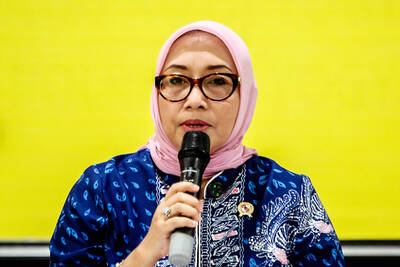
Indonesian police have arrested 13 people after shocking images of alleged abuse against small children at a daycare center went viral, sparking outrage across the nation, officials said on Monday. Police on Friday last week raided Little Aresha, a daycare center in Yogyakarta on Java island, following a report from a former employee. CCTV footage circulating on social media showed children, most younger than two, lying on the floor wearing only diapers, their hands and feet bound with rags. The police have confirmed that the footage is authentic. Police said they also found 20 children crammed into a room just 3m by 3m. “So
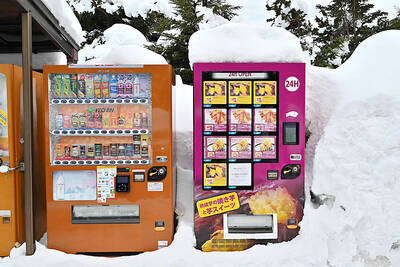
From post offices and parks to stations and even the summit of Mount Fuji, Japan’s vending machines are ubiquitous, but with the rapid pace of inflation cooling demand for their drinks, operators are being forced to rethink the business. Last month beverage giant DyDo Group Holdings announced it would remove about 20,000 vending machines — about 7 percent of their stock nationwide — by January next year, to “reconstruct a profitable network.” Pokka Sapporo Food & Beverage, based in Nagoya, also said last month it would sell its 40,000-machine operation to Osaka-based Lifedrink Co. “The strength of the vending machine

A highway bomb attack in a restive region of southwestern Colombia on Saturday killed 14 people and injured at least 38, the latest spate of violence ahead of next month’s presidential election. Authorities blamed the attack in the Cauca department — a conflict-ridden, coca-growing region — on dissidents of the now-disbanded FARC guerrilla army, who have been sowing violence across the country. “Those who carried out this attack ... are terrorists, fascists and drug traffickers,” Colombian President Gustavo Petro said on social media. “I want our very best soldiers to confront them,” he added. The leftist leader blamed the bombing


 RSS
RSS