


Gunfire and explosions rocked the provincial capital of Ambon yesterday, leaving one dead, 13 wounded and a church in ruins as Christians and Muslims clashed for a fourth day in Indonesia's Maluku islands.
In Jakarta, national police spokesman Colonel Zainuri Lubis said the death toll from the violence had risen to 36 since Sunday. A total of 159 people were injured in that period, he said.
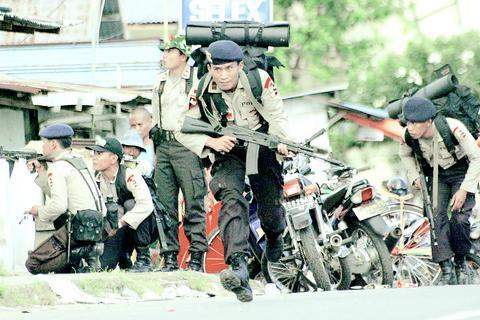
PHOTO: EPA
Shortly after dawn, unidentified assailants launched attacks in several districts of Ambon, with the heaviest fighting in areas that straddle the avenues between the Muslim and Christian communities.
Plumes of smoke could be seen rising from at least two places, and gunfire from snipers positioned atop buildings rang out across the divided city for several hours.
Police and the military were patrolling the streets, and most shops and banks were shut.
Ambon police chief Brigadier General Bambang Sutrisno insisted security was improving in the province, where Muslim-Christian violence three years ago killed 9,000 people.
"We believe things are getting better," he said.
A 22-year-old man was shot dead yesterday. Nine others were taken to a hospital in the Muslim part of town with gunshot wounds or blast injuries, medical orderlies said.
The Nazaret Protestant Church and seven nearby houses in a Christian neighborhood were torched by unidentified assailants just after dawn.
Witnesses said at least four people were injured.
Witnesses also claimed the military stood by as the church and nearby homes were burned down.
"We wanted to get our things from the house but the soldiers shouted `you cannot' and pointed their guns at us," said Jan Lukukay, a 53-year-old school teacher. "Why aren't they protecting us?"
The latest round of violence erupted on Sunday after several members of the region's small, largely Christian, separatist movement rallied in the city center. Muslims, who view such public displays as a provocation, assaulted the demonstrators, touching off the sectarian clashes.
The earlier conflict here galvanized militant Muslims across Indonesia -- and attracted Islamic fighters from around Southeast Asia and from the Middle East.
Many members of Jemaah Islamiyah, an al-Qaeda-linked extremist group blamed for a series of deadly bombings in Indonesia, have told authorities that they fought in the conflict.
Unlike most of mainly Muslim Indonesia, the province's 2 million people are evenly divided between Muslims and Christians.
Christians complain that Muslim settlers from other parts of Indonesia have come to dominate government work and the retail sector, siphoning off jobs and business from Christians.
In a related development, police in Indonesia's Central Sulawesi said in the past three months they have seized 168 homemade bombs and about 100 firearms in searches of areas that were also the scene of sectarian fighting in recent years.

South Korea’s air force yesterday apologized for a 2021 midair collision involving two fighter jets, a day after auditors said the pilots were taking selfies and filming during the flight and held them responsible for the accident. “We sincerely apologize to the public for the concern caused by the accident that occurred in 2021,” an air force spokesman told a news conference, adding that one of the pilots involved had been suspended from flying duties, received severe disciplinary action and has since left the military. The apology followed a report released on Wednesday by the South Korean Board of Audit and Inspection,

Indonesian police have arrested 13 people after shocking images of alleged abuse against small children at a daycare center went viral, sparking outrage across the nation, officials said on Monday. Police on Friday last week raided Little Aresha, a daycare center in Yogyakarta on Java island, following a report from a former employee. CCTV footage circulating on social media showed children, most younger than two, lying on the floor wearing only diapers, their hands and feet bound with rags. The police have confirmed that the footage is authentic. Police said they also found 20 children crammed into a room just 3m by 3m. “So

About 240 Indians claiming descent from a Biblical tribe landed at Tel Aviv airport on Thursday as part of a government operation to relocate them to Israel. The newcomers passed under a balloon arch in blue and white, the colors of the Israeli flag, as dozens of well-wishers welcomed them with a traditional Jewish song. They were the first “bnei Menashe” (“sons of Manasseh”) to arrive in Israel since the government in November last year announced funding for the immigration of about 6,000 members of the community from the states of Manipur and Mizoram in northeast India. The community claims to descend from

‘TROUBLING’: The firing of Phelan, who was an adviser to a nonprofit that supported the defense of Taiwan, was another example of ‘dysfunction’ under Trump, a US senator said US Secretary of the Navy John Phelan has been fired, a US official and a person familiar with the matter said on Wednesday, in another wartime shakeup at the Pentagon coming just weeks after US Secretary of Defense Pete Hegseth ousted the Army’s top general. The Pentagon announced his departure in a brief statement, saying he was leaving the administration “effective immediately,” but it did not provide a reason or say whether it was his decision to go. The sources, who spoke on condition of anonymity, said Phelan was dismissed in part because he was moving too slowly to implement reforms to


 RSS
RSS