


Swiss detectives are hunting a man who stabbed to death an air traffic controller at his home in Zurich on Tuesday in what they believe may have been an act of revenge for a plane disaster.
Police confirmed they were looking into whether the murder was linked to the mid-air collision in July 2002 between a Russian charter aircraft and a cargo plane over southern Germany.
Seventy-one people -- most of them Russian schoolchildren -- were killed in the accident. The controller was the only person on duty at the time and was later blamed for the crash by investigators.
On Wednesday, Swiss investigators said they were looking for an unshaven, heavily built man, aged between 50 and 55, who spoke broken German and possibly came from eastern Europe.
On Tuesday evening, the man knocked on the door of the controller's family home in a suburb near Zurich airport. After a brief conversation, he stabbed the 36-year-old Danish controller to death in front of his wife.
The couple's three children are believed to have been at home at the time. The attacker fled on foot.
Detectives were trying to establish the killer's motives. The murdered air controller had not received any threats, they said.
"[Revenge] cannot be ruled out. We are looking into whether there is a link between the collision and the killing," said Pascal Gossner, the investigating public prosecutor.
Asked whether the murder might have been carried out by a hitman hired by a group of Russian relatives determined to get revenge, he replied: "It is possible. It could be a reason. You have to say he spoke broken German. But you cannot say he was from Russia. This is really speculation."
Gossner confirmed, however, that the murder suspect had recently arrived in Switzerland.
After the collision near the German town of Uberlingen, accident investigators discovered that the controller had told the Bashkirian Airlines plane to descend -- even though its onboard warning equipment warned it to climb.
The pilot followed the controller's instructions and ploughed into a DHL cargo plane that was descending in accordance with its own collision-avoiding equipment.
The air traffic controller, who worked for the firm Skyguide, has never been publicly named. He had lived in Switzerland for five years when the crash took place, detectives said. Last night relatives of the crash victims said they were shocked by the news of the controller's murder.
Yulia Fedotova, who lost her daughter Sofia, 15, said: "We had hoped that he would stand before a court and [if they decided as much] he would be punished. "We are shocked by the news of course, and among the relatives of the victims I have spoken to, we feel sorrow for his wife and children who now have to live without a husband and father."
Most of the collision victims came from affluent families in Bashkiria, an oil-rich, mainly Muslim region.
Alan Rossier, head of the Swiss company Skyguide for which the controller worked, described the killing as "appalling" and said that the firm's employees were in shock.

‘CROSSING THE LINE’: China’s embassy in Seoul criticized US Forces Korea Commander General Xavier Brunson, asking if his ‘hostile’ remarks were authorized by Washington South Korea and the US are in talks over recent public remarks by the commander of US Forces Korea, Seoul’s presidential office said yesterday, after the comments drew sharp criticism from China. In a recent podcast interview, US Forces Korea Commander General Xavier Brunson described South Korea as “the dagger in the heart of Asia” from China’s east coast, prompting the Chinese embassy in Seoul to say that he had “truly crossed the line.” The interview came amid growing speculation that Washington might seek to expand the role of US Forces Korea in countering the growing regional influence of China, a key

Through the noise of rushing papers and whirring belts at a print factory in Kyoto, two creators watch their photo essay come to life in broadsheet form — part of an effort to win new audiences in the age of artificial intelligence (AI). Despite the decline of the publishing industry, self-publication and handmade “zine” magazines are growing in popularity in Japan, reflecting the nation’s enduring love of paper in the digital era. While speaking to Agence France-Presse at the plant, his hands black with ink, one of the creators, Kazuma Obara, said: “I think [paper] is a medium that engages all five

Australian researchers have trained lab-grown brain cells on a silicon computer chip to play the 1990s shooter game Doom and said they are just scratching the surface of what the neurons could be capable of doing. It is the science-fiction work of biotech boffins at Cortical Labs, who researched and developed the technology that harnesses the workings of the brain’s networking system. Each so-called “biological computer” contains about 200,000 living human brain cells, grown from stem cells that were harvested from blood donations. Having mastered the simple computer game Pong, where a paddle is moved up and down to send a ball
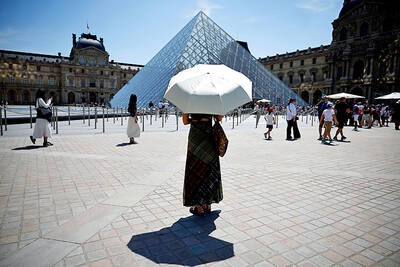
France experienced its hottest spring on record, the French weather service said on Tuesday, after an exceptional early heat wave that also broke highs for the season in England and Wales. Meteo-France said the average nationwide temperature over March to May was 13.8°C — about 1.7°C above the norm, and surpassing records set in 2011 and 2020. “The warmest spring since records began in 1900,” it said in a bulletin. All three months were warmer than average, but the onset of an “unprecedented heatwave” late last month pushed the mercury to highs typically seen at the height of the summer. “Our country had never


 RSS
RSS