


Vice President Dick Cheney, on a five-day trip through Switzerland and Italy, is stepping out of his self-imposed seclusion and into what administration officials and political analysts say is a calculated election-year makeover to temper his hard-line image at home and abroad.
Cheney, who usually shuns the media, has given a spate of radio and newspaper interviews in the last month. This European trip is only his second overseas in the last three years, the first being a visit to the Persian Gulf in early 2002 to build support for toppling Saddam Hussein. He invited eight journalists to join him aboard Air Force Two, a military version of a 757 jetliner.
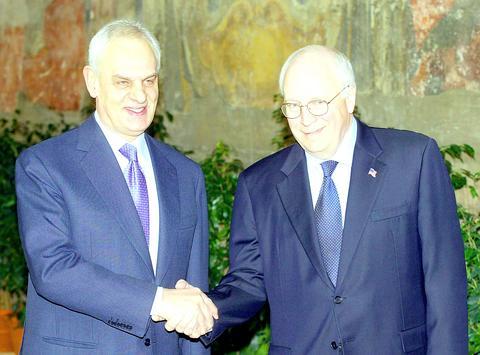
PHOTO: EPA
On Monday, he addressed a gathering of 200 Italian troops, political leaders, entrepreneurs and university students in Rome. He thanked top Italian officials, including Prime Minister Silvio Berlusconi, for their nation's contributions and sacrifices in Iraq and Afghanistan. And he paid homage at the American military cemetery here to the soldiers killed during the Allied landing in World War II at nearby Anzio 60 years ago this week. Yesterday, he was due to meet with Pope John Paul II at the Vatican.
Cheney's advisers say that raising the vice president's public visibility and opening a public-relations offensive is aimed at mending fences with foreign critics of the Iraq war and countering Democrats' efforts at home to demonize Cheney as a symbol of the George W. Bush administration's close corporate connections and overreliance on dubious intelligence about Iraq's illicit weapons programs.
"This year's going to be a long slog, and it's imperative that we recount the accomplishments of the administration," said Mary Matalin, a longtime Cheney adviser. "This is something he can do quite well. He's particularly adept at putting events in a historical context."
Cheney has long been a favorite of conservatives, and in the 2000 campaign he also offered a reassuring presence on the ticket to many independents wary of Bush's inexperience. But with Bush having to rely less on Cheney's stature after the Sept. 11, 2001, terrorist attacks, there are signs the vice president is becoming a more divisive figure.
A New York Times poll this month found that Cheney's favorable ratings had declined to 20 percent of the voters surveyed compared with 39 percent in a similar poll in January 2002. His unfavorable ratings increased to 24 percent, from 11 percent, in the same period. Many voters in both surveys said they were undecided or did not know enough to have an opinion.
"He's clearly at a point in his vice presidency to do more harm than good, except among the most intense Republican partisans who look to him for reassurance," said Paul Light, a vice-presidential academic at New York University's Wagner Graduate School of Public Service. "Handling Dick Cheney is like handling nuclear material. It can be quite powerful, but it can be quite dangerous and has to be handled carefully."
Cheney was a major architect of the administration's march to war with Iraq, and critics now say he oversold the intelligence about Baghdad's illicit arms.
Democrats who have been critical of the contracting process for rebuilding Iraq have singled out the Halliburton in particular, in part because Cheney was chairman of the Texas-based energy company until 2000. Halliburton last week agreed to repay the government $6.3 million for apparent overcharges.
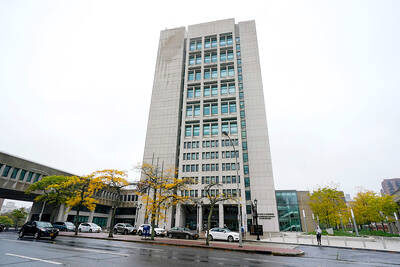
A coalition of civil rights groups on Tuesday asked a New York State judge to order one of its largest suburban counties to stop its deployment of nearly 600 license plate readers, calling it a warrantless and “indiscriminate surveillance system” that violates the state constitution. The class action lawsuit also alleged that Westchester County never got proper authorization to launch the program, which has amassed a database of 1.6 billion plate scans that has been shared with more than 50 outside law enforcement agencies. The complaint said the network “records the long-term travel patterns, daily habits, and intimate information of millions of
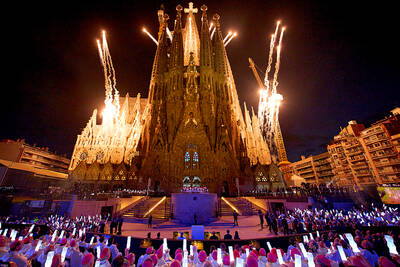
Pope Leo XIV on Wednesday blessed a giant new tower at Barcelona’s famed Sagrada Familia Basilica after celebrating mass inside what is now the world’s tallest church. A fireworks and light show illuminated the exterior of the temple at the end of the ceremony, bathing the unfinished basilica in shifting colours that highlighted its towering spires. A choir of 600 singers performed at the service which lasted around 90 minutes and was attended by Spanish Prime Minister Pedro Sanchez as well as King Felipe VI and Queen Letizia. The stained-glass windows in various colours shone brightly in between the tree-like
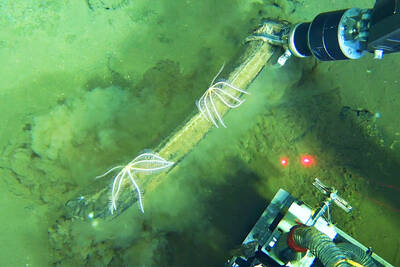
Scientists have discovered communities of marine life — including jellyfish, tubeworms and brittle stars — thriving on a whale graveyard. The graveyards form when whale carcasses fall to the sea floor, becoming a sustaining snack for nearby critters. This one, which is up to 7km below the surface of the southeastern Indian Ocean, spans the largest area, and is so far the deepest found. A whale’s sheer size and the unique chemistry of its bones are the keys to forming these unique underwater neighborhoods, said Song Xikun (宋希坤), a biologist with the Chinese Academy of Sciences’ Institute of Deep-sea Science and Engineering

Voters in Switzerland yesterday cast their ballots on an initiative championed by the top right-wing party to cap the Alpine country’s population at 10 million. As of press time last night, early results showed that Swiss voters were leaning against it. The populist Swiss People’s Party, which has the most seats in parliament, has stirred up and fostered anti-migration sentiment over the years, notably about an influx of workers from the neighboring EU. Critics called the bid a self-inflicted wound, saying the boom in migration over the past generation has brought foreign labor and skills to sectors such as healthcare, finance, pharmaceuticals


 RSS
RSS