


Last time the Year of the Rat rolled around, many people listened to the advice of fortune tellers and bought a rodent to attract wealth. With three days left until the Lunar New Year, Rodents Care Association (中華民國愛鼠協會) president Chang Sheng-man (張勝鬘) hasn’t heard anything of the sort yet — although she is fairly certain that the animals will see a bump in popularity.
“In these cases, people aren’t buying them out of love for animals,” she says. “We are worried that we will soon be overloaded,” adding that overbreeding due to improper care is one of the main reasons people abandon these furry creatures.
Rodents — especially hamsters — continue to grow in popularity, as they’re relatively easy to care for and require little space. But Chang says pet shops often fail to warn customers of how fast they can reproduce, and the owners simply dump them when it becomes too much to handle. Rodents Care has taken in over 2,000 animals since its founding in 2016, and the rescue rate continues to grow.
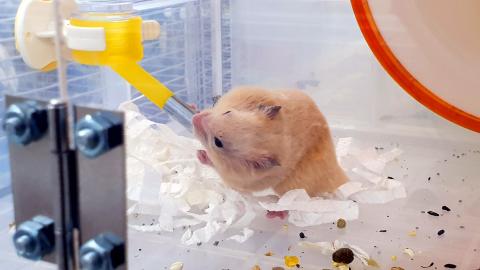
Photo: Han Cheung, Taipei Times
The most important solution, Chang stresses, is to house one rodent in one cage. In addition to curbing overbreeding, rodents are usually territorial and cage-mates often end up seriously harming each other. In July of last year, the Liberty Times (Taipei Times’ sister newspaper) addressed the issue:
“People often buy several hamsters at once because they believe that it’s therapeutic to watch the cute scene of them cuddling together,” the report states. “This is totally wrong. Your imagined scenario will not happen, and the animals will end up either hurt or dead!”
FILLING THE VOID
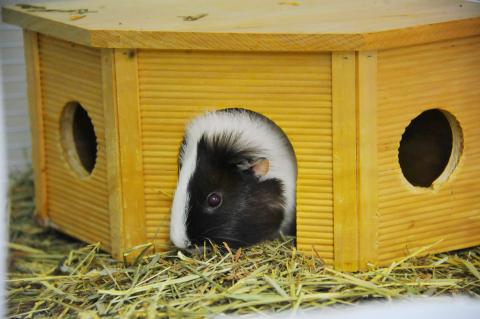
Photo: Han Cheung, Taipei Times
Chang got her first pet hamster in college because she thought “they were cute.” Soon, she started paying attention to the issue of rodent abandonment, and decided to help out, only to find that there was no formal rescue organization. By contrast, there have been dog and cat rescues for decades and even one for rabbits, founded in 2009.
Chang says Rodents Care first started as a Facebook group around 2015. Group membership quickly swelled, and the volunteer rescuers combined their resources and started an organization and shelter.
“There were people posting information on the Facebook group about abandoned rodents every day,” Chang says. “That’s when I realized how serious the problem was, and also how many people cared and were willing to contribute.”
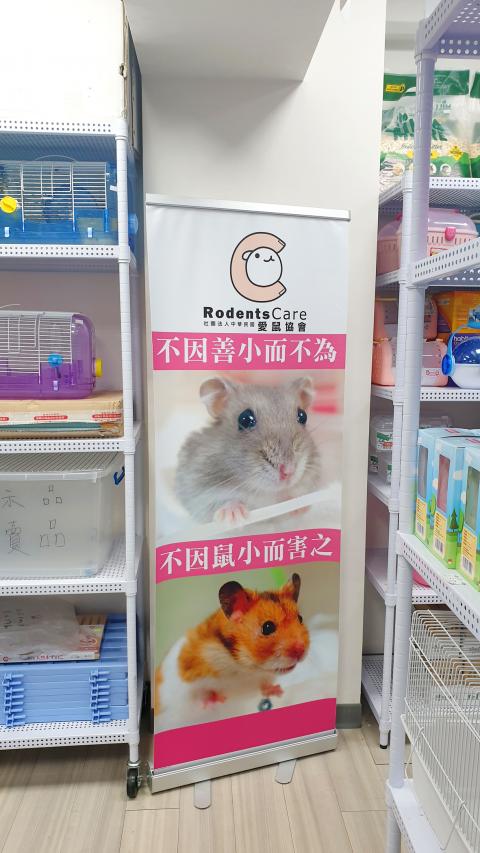
Photo: Han Cheung, Taipei Times
At first, there were quite a few misunderstandings as people thought the association was rescuing street rats (since the Chinese word for rodents and common rats are the same), that are considered pests. Someone even came into the shelter to scream at them, Chang recalls.
“We had to stress to the public that we are caring for pet rodents,” Chang says. “We don’t focus much on feral rats, only that people should use more humane methods to get them out of their houses.”
However, they have taken in lab rats as well as baby street rats. Adult wild rats aren’t suited to human conditions and can survive easily on the street, while a hamster cannot, Chang says. However, wild rats can make for good pets if raised from a young age.

Photo: Han Cheung, Taipei Times
YouTuber Vito (維特), for example, took in a litter of babies he found in his house last year and has been making videos with them.
“Most people in Taiwan still can’t accept it, though,” Chang says, and indeed Vito has received some negative attention for bringing them onto a television show.
ABUSE AND ABANDONMENT
Chang has seen all sorts of abandonment methods in her career. Once, someone found a box containing a winter white dwarf hamster in a bathroom stall at Taipei Main Station, with a note asking whomever found it to specifically bring the animal to Rodents Care.
The next day, the person who brought in the box inquired about adopting the hamster.
“Apparently he had never had a pet before, and spent all night reading up on hamster care. He believed that it was fate to meet the hamster, and passed the adoption review with high marks,” Chang says.
Aside from the various issues caused by overpopulation, hamsters are often nocturnal, and some people cannot stand their nightly noises, such as cage chewing or running on the wheel. Chang says another major issue is parents forcing their children to abandon the pets.
“Unlike dogs and cats, it’s easy to secretly get a pet rat,” Chang says. “Children often house the rats in their pockets and drawers. But parents think that they are dirty and smelly and spread diseases.”
It’s hard to detect animal abuse in rodents, as they are small animals and the cruelty often happens in the home. Chang says they are alerted to most cases when the perpetrator posts photos or videos of the abuse online, otherwise there’s not much available evidence to go by.
The animals are quite sensitive to heat as well. One owner brought the hamster with them to buy breakfast on a hot day, and it died on the way. Keeping cage temperature cool is crucial, Chang says.
Recently, she has been concerned about the growing popularity of the African dormouse, which are very fertile yet much harder to care for compared to hamsters. So far, they’ve only received one case — of 28 dormice — but she expects to see more.
Chang says that people often pay more attention to cats and dogs, but rats and mice also have a long history of close interaction with human beings and have been an integral part of technological advancement.
“Are they less important because they are small and their lifespans are short?” Chang asks. “If you count them in sheer numbers, they are actually quite significant. Humans should accept the responsibility of caring for them. They don’t require many resources, after all.”

The Lee (李) family migrated to Taiwan in trickles many decades ago. Born in Myanmar, they are ethnically Chinese and their first language is Yunnanese, from China’s Yunnan Province. Today, they run a cozy little restaurant in Taipei’s student stomping ground, near National Taiwan University (NTU), serving up a daily pre-selected menu that pays homage to their blended Yunnan-Burmese heritage, where lemongrass and curry leaves sit beside century egg and pickled woodear mushrooms. Wu Yun (巫雲) is more akin to a family home that has set up tables and chairs and welcomed strangers to cozy up and share a meal

Dec. 8 to Dec. 14 Chang-Lee Te-ho (張李德和) had her father’s words etched into stone as her personal motto: “Even as a woman, you should master at least one art.” She went on to excel in seven — classical poetry, lyrical poetry, calligraphy, painting, music, chess and embroidery — and was also a respected educator, charity organizer and provincial assemblywoman. Among her many monikers was “Poetry Mother” (詩媽). While her father Lee Chao-yuan’s (李昭元) phrasing reflected the social norms of the 1890s, it was relatively progressive for the time. He personally taught Chang-Lee the Chinese classics until she entered public

Last week writer Wei Lingling (魏玲靈) unloaded a remarkably conventional pro-China column in the Wall Street Journal (“From Bush’s Rebuke to Trump’s Whisper: Navigating a Geopolitical Flashpoint,” Dec 2, 2025). Wei alleged that in a phone call, US President Donald Trump advised Japanese Prime Minister Sanae Takaichi not to provoke the People’s Republic of China (PRC) over Taiwan. Wei’s claim was categorically denied by Japanese government sources. Trump’s call to Takaichi, Wei said, was just like the moment in 2003 when former US president George Bush stood next to former Chinese premier Wen Jia-bao (溫家寶) and criticized former president Chen

President William Lai (賴清德) has proposed a NT$1.25 trillion (US$40 billion) special eight-year budget that intends to bolster Taiwan’s national defense, with a “T-Dome” plan to create “an unassailable Taiwan, safeguarded by innovation and technology” as its centerpiece. This is an interesting test for the Chinese Nationalist Party (KMT), and how they handle it will likely provide some answers as to where the party currently stands. Naturally, the Lai administration and his Democratic Progressive Party (DPP) are for it, as are the Americans. The Chinese Communist Party (CCP) is not. The interests and agendas of those three are clear, but


 RSS
RSS