


Just as her career as a vocalist began taking off in 2013, singer Lucy Dhegrae found herself silenced, physically unable to produce the notes she once delivered with ease.
Diagnosed with paresis of the vocal folds, a form of paralysis, the artist traced the condition threatening her future as a performer to a traumatic night a decade earlier, when she says she was drugged and raped as a first-year student at the University of Michigan.
“The moment of discovering that I couldn’t sing — it felt like a death,” Dhegrae said in an interview at her apartment in Manhattan’s Greenwich Village neighborhood.
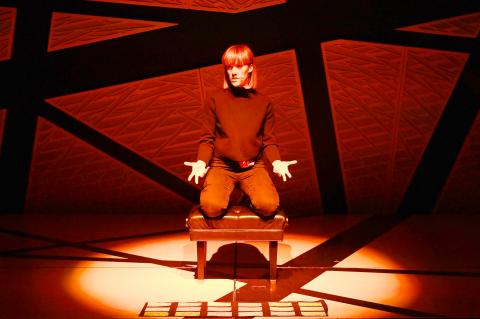
photo: AFP
“It was just like my body saying, ‘Okay, now you really have to deal with this. We’re going to take away the one thing that you need, and that you use to make money, that you use to survive,’” she said. “It forced me to look at [the trauma], and honestly, I’m not sure I would have.”
Dhegrae, who had kept her assault private, poured herself into research of her mysterious condition that doctors were unable to explain.
She found articles that referred to sexual assault survivors who eventually lost their voices altogether after keeping silent for a period of time.
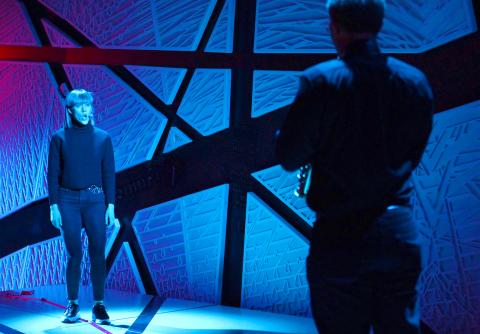
photo: AFP
She became an active volunteer with the US anti-sexual violence organization RAINN (Rape, Abuse & Incest National Network) and, through her research, learned survivors regained their ability to speak by starting to discuss their trauma. “I knew at that time, because I had lost my singing voice and not my speaking voice, that I would need to sing about it,” she said.
GOING BEYOND UNDERSTANDING
She employed a range of healing techniques including meditation, breath work, massage, self-defense training and holistic alternative therapies.
Dhegrae also developed The Processing Series”of experimental voice concerts — already under way at Brooklyn’s National Sawdust arts institution — that explore music’s ability to help the body and mind deal with the impact of trauma.
“To heal trauma, we have to go beyond understanding it. It’s beyond logic,” she said. “Your brain can’t make sense that all of a sudden, something horrible can happen to you at any time.”
“You have to find a way to unravel that and to make your body whole, because your brain learns ... to section off that memory.”
Advisors instructed Dhegrae to keep her vocal condition under wraps, saying it could “blacklist” her from getting hired, she said.
“Discovering that I had paresis really echoed the experience of being assaulted,” the 35-year-old said, saying she plunged into depression. “I wasn’t supposed to tell anyone.”
“That’s a lot like rape... you don’t know who to talk to about this deep shame.”
After years of therapy, Dhegrae hoped performing in her The Processing Series concerts based on her own healing journey could help other survivors feel less alone.
“I had these really powerful experiences of physical recovery, of physical cohesiveness — feeling like you’re separate and coming together again — that was something I wanted to share,” she said.
“I wanted to create a show that I would have wanted to see, that would have helped me in that moment, because in 2013 when I found out that I had paresis, I had no one to talk to,” she continued. “If I had had one person to talk to... that would have made that period of my life just infinitely easier.”
“I wanted to be that for other people.”
RAW, ANIMAL SELF
Dhegrae began working on Processing years before the #MeToo movement that has ended the careers of a range of powerful men, including the disgraced Hollywood mogul Harvey Weinstein, whose Manhattan trial has begun.
But the national conversation on sexual violence has fostered a larger community of people interested in art based on the theme, she said.
Dhegrae commissioned several composers to contribute pieces for her four-installment series of shows — experimental works written for voice that also feature instrumentals including saxophone, piano and violin as well as visual projections.
At one point, the tall, lithe Dhegrae sings with square shoulders and a bold voice opposite a male vocalist, appearing to confront her trauma head-on.
One emotional piece entitled She Gets to Decide draws on the 1938 Balthus painting Therese Dreaming,” which shows a girl sitting with her leg up on a chair, causing her skirt to slide above her thighs, revealing her underwear.
In the work premiered in January, the artist sings a reference to the trial of Larry Nassar, a former doctor for the United States gymnastic team convicted of sexually assaulting minors. “Leave your pain here,” the judge had told one woman giving testimony, “and go out and do your magnificent things.”
In performing the pieces, Dhegrae says she taps into her “raw, animal self” to elicit a range of complex emotions.
“I don’t just sing beautifully. I scream. I grunt. I whisper. I cry,” she said. “Singing — it’s just connected to this deeper part of you.”
“That’s also been something that I’ve owned rather than trying to, say, only give the public this beautiful side of my voice. I want to give them the entire experience.”

The Lee (李) family migrated to Taiwan in trickles many decades ago. Born in Myanmar, they are ethnically Chinese and their first language is Yunnanese, from China’s Yunnan Province. Today, they run a cozy little restaurant in Taipei’s student stomping ground, near National Taiwan University (NTU), serving up a daily pre-selected menu that pays homage to their blended Yunnan-Burmese heritage, where lemongrass and curry leaves sit beside century egg and pickled woodear mushrooms. Wu Yun (巫雲) is more akin to a family home that has set up tables and chairs and welcomed strangers to cozy up and share a meal
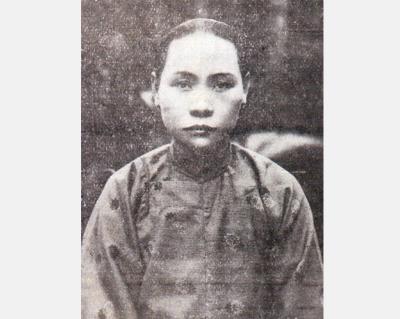
Dec. 8 to Dec. 14 Chang-Lee Te-ho (張李德和) had her father’s words etched into stone as her personal motto: “Even as a woman, you should master at least one art.” She went on to excel in seven — classical poetry, lyrical poetry, calligraphy, painting, music, chess and embroidery — and was also a respected educator, charity organizer and provincial assemblywoman. Among her many monikers was “Poetry Mother” (詩媽). While her father Lee Chao-yuan’s (李昭元) phrasing reflected the social norms of the 1890s, it was relatively progressive for the time. He personally taught Chang-Lee the Chinese classics until she entered public

Last week writer Wei Lingling (魏玲靈) unloaded a remarkably conventional pro-China column in the Wall Street Journal (“From Bush’s Rebuke to Trump’s Whisper: Navigating a Geopolitical Flashpoint,” Dec 2, 2025). Wei alleged that in a phone call, US President Donald Trump advised Japanese Prime Minister Sanae Takaichi not to provoke the People’s Republic of China (PRC) over Taiwan. Wei’s claim was categorically denied by Japanese government sources. Trump’s call to Takaichi, Wei said, was just like the moment in 2003 when former US president George Bush stood next to former Chinese premier Wen Jia-bao (溫家寶) and criticized former president Chen

President William Lai (賴清德) has proposed a NT$1.25 trillion (US$40 billion) special eight-year budget that intends to bolster Taiwan’s national defense, with a “T-Dome” plan to create “an unassailable Taiwan, safeguarded by innovation and technology” as its centerpiece. This is an interesting test for the Chinese Nationalist Party (KMT), and how they handle it will likely provide some answers as to where the party currently stands. Naturally, the Lai administration and his Democratic Progressive Party (DPP) are for it, as are the Americans. The Chinese Communist Party (CCP) is not. The interests and agendas of those three are clear, but


 RSS
RSS