


Two weeks ago, I ate a duck’s foot for the first time at Ya Ge (雅閣), the Michelin-starred fine-dining Cantonese restaurant located in the Mandarin Oriental. The appendage in question was thinly veiled by a cloak of slippery tofu skin that suffused its fragrance into everything it touched — the stuffing of shrimp, pork, taro and celery, crowned with a webbed duck’s foot, glazed in abalone sauce.
Lifting the foot to my mouth, I discovered that this delicacy — much like the sea cucumbers and birds’ nests of my youth — was more a matter of mouthfeel than taste. The gelatinous folds had little in the way of their own flavor, instead absorbing the milkiness of the tofu skin and umami of the sauce. As the bird’s delicate bones clattered to my plate, I realized that despite never having eaten a duck’s foot before, there was something familiar and comforting about the way it tasted after all.
In the plush dining rooms of the Mandarin Oriental, such nostalgic textures and flavor combinations are seeing a revival under the leadership of Ya Ge’s chef de cuisine Tse Man (謝文). Chef Tse, who previously cooked at the legendary Fook Lam Moon in Hong Kong, applies his expert knowledge of Cantonese fare and exacting selection of ingredients to the restaurant’s new seasonal dim sum menu, which stretches the imagination back in time.
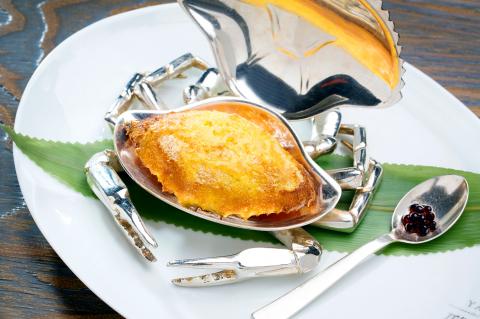
Photo courtesy of Mandarin Oriental Taipei
The steamed duck’s feet (NT$300) are just one of many retro dishes developed anew. Deep-fried mashed taro filled with foie gras and mushrooms (NT$300) evokes old-world glamor with its feathery, crispy golden skirt. Taro remains the star of that dish, given the restrained use of goose liver. And the evergreen barbecued pork bun (NT$300) is reliable, with fluffy bread wrapped around a substantial filling.
But the innovations do not disappoint either. A steamed dumpling stuffed with crab meat, shrimp, egg white and black truffle (NT$360) is an easy standout. Black truffle has become a lazy shorthand for luxury, indiscriminately deployed in marked-up versions of basic dishes — black truffle French fries or scrambled eggs, to name a few. In these dumplings, however, the fungus is used with intention, and melds well with the springy seafood and silky egg whites.
Like its understated interior, Ya Ge knows how to produce a showstopper in the most unassuming places. Moreish vegetarian dumplings (NT$270) filled with matsutake mushrooms are folded and painted like ornamental carp napping in a bamboo basket. The molten interiors of salted egg custard buns (NT$270), a perennial favorite, are encased in black charcoal dough with a bold brush of gold dust, lending dramatic flair to each bite.
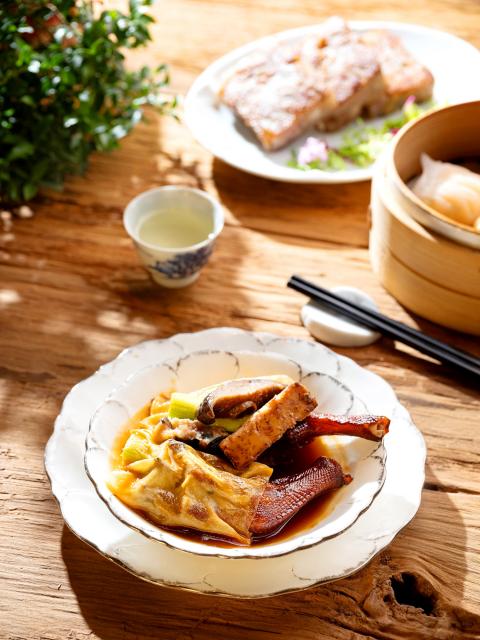
Photo courtesy of Mandarin Oriental Taipei
But the most intricate of all is the oven-baked crab (NT$750), served in its own custom-made crab-shaped holder. A silver carapace, complete with crab legs and pincers, mimics the shells of the flower crab and Japanese blue crab, whose insides have been meticulously hand-picked, de-boned and shaped into a crisp cutlet minimally seasoned with onions. The clean flavors and exquisite presentation signal the kitchen’s confidence in their ingredients and techniques, with no resorting to cover-ups.
While my appetite that day centered on the new dim sum menu, a la carte options, like the crab, also deserve attention. Crispy roasted chicken (NT$750 for a half, NT$1,480 for a whole) lives up to its name, achieving a seemingly impossible combination of crisp, bronzed skin lining juicy and tender meat. The chicken is flavorsome on its own, but is also given a leg up by an unusual dip of lemon juice and fish sauce.
Honey-glazed barbecued pork (NT$980), using meat from three-month-old local Berkshire piglets, is served atop a bed of hot stones that amplify the smells and sounds of sizzling lard. The fatty meat is not the melt-in-your-mouth texture that I prefer, but carries a bit of chew. For a well-rounded meal, seasonal vegetables — on this occasion, sweet asparagus — braised in supreme broth (NT$400) will do a lot to offset the richness of the other dishes.
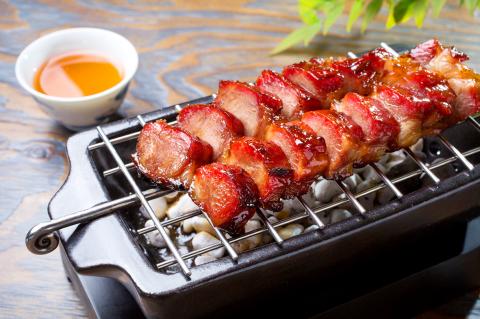
Photo courtesy of Mandarin Oriental Taipei
The rose-tinted glasses of yesteryear also extend to the desserts. Humble red bean soup (NT$320), with a velvety texture from partially mashed beans, benefits from the lightly perfumed note of 10-year-aged dried tangerine peel. It’s a rare find — red bean soup cooked with tangerine peel is now seldom available outside the home and the most traditional of dessert shops. But if sweet soup is not your cup of tea, the organic beancurd with mashed taro (NT$320) is a heavenly pairing in a bowl and a loving nod to Taiwan’s local produce.
Davina Tham ate at Ya Ge courtesy of Mandarin Oriental Taipei.
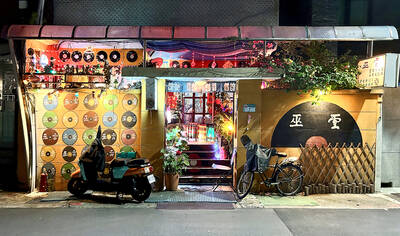
The Lee (李) family migrated to Taiwan in trickles many decades ago. Born in Myanmar, they are ethnically Chinese and their first language is Yunnanese, from China’s Yunnan Province. Today, they run a cozy little restaurant in Taipei’s student stomping ground, near National Taiwan University (NTU), serving up a daily pre-selected menu that pays homage to their blended Yunnan-Burmese heritage, where lemongrass and curry leaves sit beside century egg and pickled woodear mushrooms. Wu Yun (巫雲) is more akin to a family home that has set up tables and chairs and welcomed strangers to cozy up and share a meal
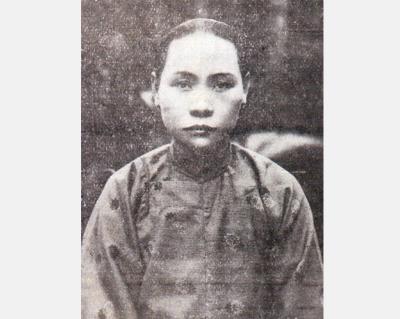
Dec. 8 to Dec. 14 Chang-Lee Te-ho (張李德和) had her father’s words etched into stone as her personal motto: “Even as a woman, you should master at least one art.” She went on to excel in seven — classical poetry, lyrical poetry, calligraphy, painting, music, chess and embroidery — and was also a respected educator, charity organizer and provincial assemblywoman. Among her many monikers was “Poetry Mother” (詩媽). While her father Lee Chao-yuan’s (李昭元) phrasing reflected the social norms of the 1890s, it was relatively progressive for the time. He personally taught Chang-Lee the Chinese classics until she entered public

Last week writer Wei Lingling (魏玲靈) unloaded a remarkably conventional pro-China column in the Wall Street Journal (“From Bush’s Rebuke to Trump’s Whisper: Navigating a Geopolitical Flashpoint,” Dec 2, 2025). Wei alleged that in a phone call, US President Donald Trump advised Japanese Prime Minister Sanae Takaichi not to provoke the People’s Republic of China (PRC) over Taiwan. Wei’s claim was categorically denied by Japanese government sources. Trump’s call to Takaichi, Wei said, was just like the moment in 2003 when former US president George Bush stood next to former Chinese premier Wen Jia-bao (溫家寶) and criticized former president Chen

President William Lai (賴清德) has proposed a NT$1.25 trillion (US$40 billion) special eight-year budget that intends to bolster Taiwan’s national defense, with a “T-Dome” plan to create “an unassailable Taiwan, safeguarded by innovation and technology” as its centerpiece. This is an interesting test for the Chinese Nationalist Party (KMT), and how they handle it will likely provide some answers as to where the party currently stands. Naturally, the Lai administration and his Democratic Progressive Party (DPP) are for it, as are the Americans. The Chinese Communist Party (CCP) is not. The interests and agendas of those three are clear, but


 RSS
RSS