


When Tokyo’s Tsukiji Fish Market, the world’s oldest, largest and arguably most famous, closed last year, laments echoed throughout the globe. Two-starred Michelin chef Lionel Beccat had called it “a world unto itself.”
Photographer Shen Chao-Liang (沈昭良) has been visiting the iconic market since the early 1990s, documenting not only the people who spend much of their life there, but also the area where it was located, a history that can be traced back to 1657 when authorities reclaimed land along Tokyo Bay and christened it “Tsukiji” or “constructed land.”
Several of Shen’s large black-and-white prints will be on display at his solo exhibition, Tsukiji Fish Market, at Taipei’s AKI Gallery beginning tomorrow.
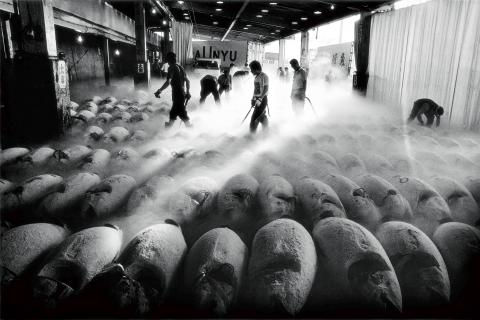
Photo courtesy of the artist and AKI Gallery
The opening will feature talks in Mandarin by Shen, with another series of talks on Jan. 4 by Lan Tsu-wei (藍祖蔚), film critic and deputy editor at the Liberty Times (the Taipei Times’ sister newspaper) and independent curator Hiroshi Suganuma. The talks begin at 3pm.
Shen repeatedly visited the area starting from 1993 to capture the rise of Tsukiji and the people and tourists that made it come alive before it was relocated. The photos that will be on display serve both as beginning and coda, a career that reflect his own transition from photo-journalist to fine-art photographer.
Whenever in Tokyo, Shen would find himself mingling among the market’s morning crowds.
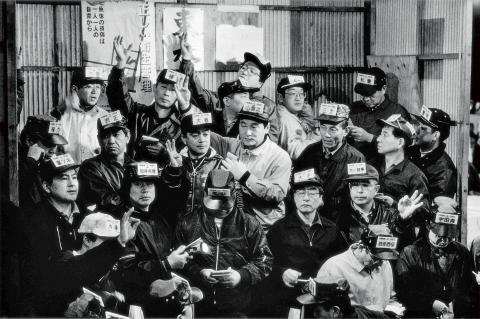
Photo courtesy of the artist and AKI Gallery
Some of the photographs border on the abstract, while others are grainy shots of workers shuffling among hundreds of frozen fish, the morning light illuminating the rising vapor, and fish mongers hawking their catches. Shen manages to capture both the mystique of why the market was attractive to tourists, but also the banality of its daily grind.
Tsukiji Fish Market records an objective perspective to the market’s development up until it closed last year. According to a blurb in the catalogue to the series, the presentation of images shows the interrelationship between people and the photographer and the narrative of this environment. It also provides possibilities to interpret what has been recorded.
■ Aki Gallery (也趣藝廊), 141 Minzu W Rd, Taipei City (台北市民族西路141號), tel: (02) 2599-1171. Open Tuesdays to Sundays from noon to 6:30pm
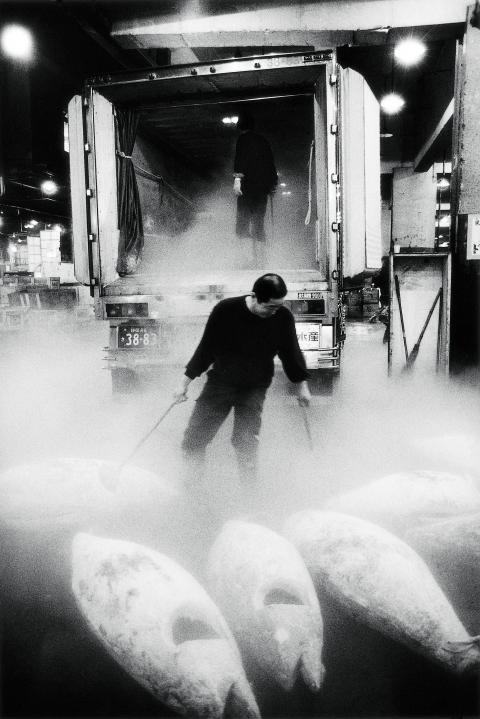
Photo courtesy of the artist and AKI Gallery
■ Opens tomorrow. Until Jan. 19
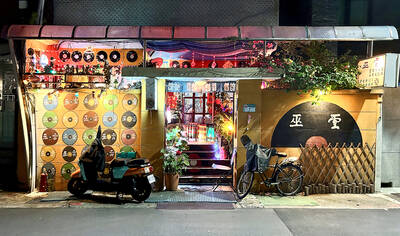
The Lee (李) family migrated to Taiwan in trickles many decades ago. Born in Myanmar, they are ethnically Chinese and their first language is Yunnanese, from China’s Yunnan Province. Today, they run a cozy little restaurant in Taipei’s student stomping ground, near National Taiwan University (NTU), serving up a daily pre-selected menu that pays homage to their blended Yunnan-Burmese heritage, where lemongrass and curry leaves sit beside century egg and pickled woodear mushrooms. Wu Yun (巫雲) is more akin to a family home that has set up tables and chairs and welcomed strangers to cozy up and share a meal
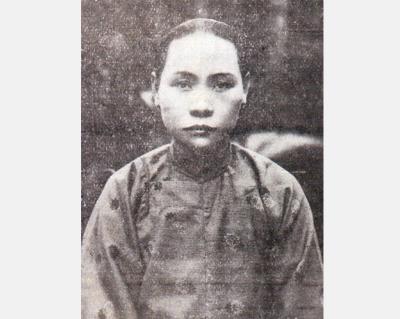
Dec. 8 to Dec. 14 Chang-Lee Te-ho (張李德和) had her father’s words etched into stone as her personal motto: “Even as a woman, you should master at least one art.” She went on to excel in seven — classical poetry, lyrical poetry, calligraphy, painting, music, chess and embroidery — and was also a respected educator, charity organizer and provincial assemblywoman. Among her many monikers was “Poetry Mother” (詩媽). While her father Lee Chao-yuan’s (李昭元) phrasing reflected the social norms of the 1890s, it was relatively progressive for the time. He personally taught Chang-Lee the Chinese classics until she entered public

Last week writer Wei Lingling (魏玲靈) unloaded a remarkably conventional pro-China column in the Wall Street Journal (“From Bush’s Rebuke to Trump’s Whisper: Navigating a Geopolitical Flashpoint,” Dec 2, 2025). Wei alleged that in a phone call, US President Donald Trump advised Japanese Prime Minister Sanae Takaichi not to provoke the People’s Republic of China (PRC) over Taiwan. Wei’s claim was categorically denied by Japanese government sources. Trump’s call to Takaichi, Wei said, was just like the moment in 2003 when former US president George Bush stood next to former Chinese premier Wen Jia-bao (溫家寶) and criticized former president Chen

President William Lai (賴清德) has proposed a NT$1.25 trillion (US$40 billion) special eight-year budget that intends to bolster Taiwan’s national defense, with a “T-Dome” plan to create “an unassailable Taiwan, safeguarded by innovation and technology” as its centerpiece. This is an interesting test for the Chinese Nationalist Party (KMT), and how they handle it will likely provide some answers as to where the party currently stands. Naturally, the Lai administration and his Democratic Progressive Party (DPP) are for it, as are the Americans. The Chinese Communist Party (CCP) is not. The interests and agendas of those three are clear, but


 RSS
RSS