


Nantou (南投), Taiwan’s only landlocked county, is where I first fell in love with the nation, a few months after arriving here in 1993, when I got a job in an English cram school in a rural part of the county. It’s also one of the richest and most spectacular parts of the country for hikers, river tracers and other nature lovers.
For most tourists, the attractions of Nantou County start and end with Sun Moon Lake (日月潭), a lovely place that has become one of Taiwan’s top tourist draws. Some also get to the Forest Recreation Area at Sitou (溪頭), and since opening in 2005, the Heavenly Steps (天梯) suspension bridge at Jhusan (竹山) has been a huge draw among locals.
It’s worth mentioning, though, that what we can see along the Heavenly Steps trail today is a pale shadow of the true wonders of the (presently inaccessible) main part of Taiji Canyon (太極峽谷), a kilometer or two downstream. When (or rather if) that awe-inspiring place ever reopens to hikers, it will be a major cause for celebration.
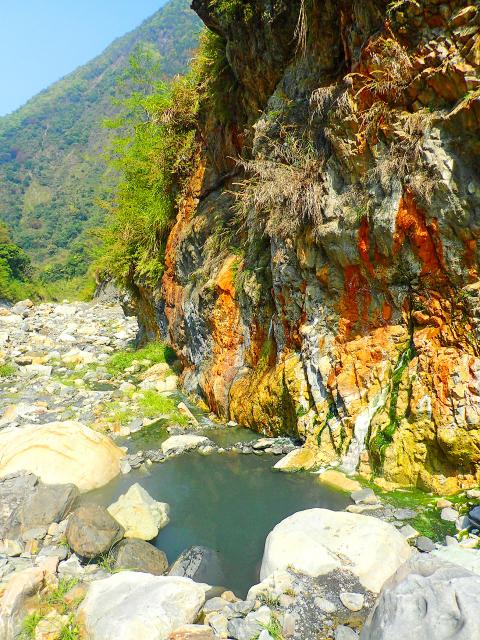
Photo: Richard Saunders
NANTOU’S HOT SPRINGS
Among its other tourist draws, Nantou County has more than its fair share of hot springs, although they’ve taken a bit of a battering in recent years.
The springs at Auwanda (奧萬大) near Wushe (霧社) in the north of the county are now all but gone, and most of the crowds visiting the Forest Recreation Area are there either for the cool mountain air, or for the spectacular display of autumn colors (arguably Taiwan’s finest), put on every winter by the forests of maple trees.
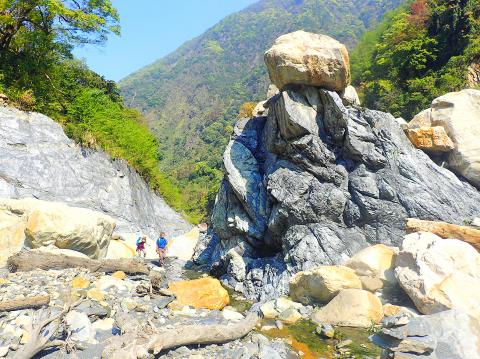
Photo: Richard Saunders
Lushan Hot Spring (盧山溫泉; the favorite spa of Chiang Kai-shek, 蔣介石) survives, despite damage caused by a series of typhoons in recent years, and several other hot springs sources in this part of Nantou have been tapped to supply smaller-scale resorts and bath houses.
For such a rugged part of the island, it’s quite surprising that so many of Nantou’s hot spring sources have been developed. Happily, a couple do survive in all their splendidly untouched, natural beauty.
Just below Lushan (the Aboriginal village area, not the hot spring resort downstream), Chingying Hot Spring (精英溫泉), although never formally developed, can be reached by a bumpy one-track road, and is besieged on weekends.
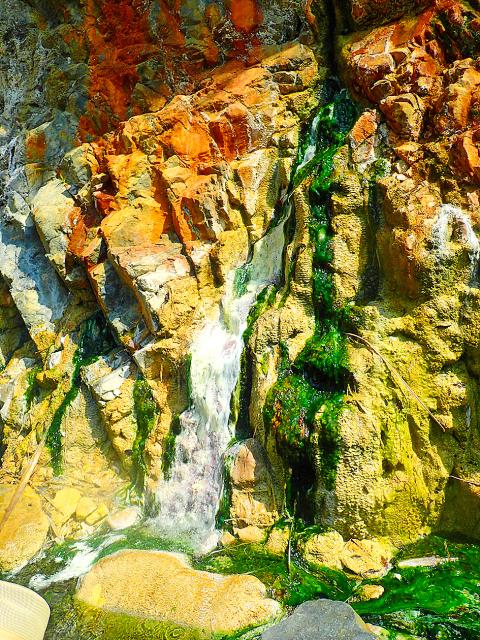
Photo: Richard Saunders
A short clamber upstream, and a couple of small sources have, however, escaped attention and remain attractively untouched. A further kilometer or two upstream, the beautiful Yunhai Hot Spring (雲海溫泉) is unknown to all but keen hikers, as getting up there involves scaling a couple of vertical dam walls on fixed ropes.
LELEGU HOT SPRING
Easier to reach, yet still strenuous and awkward enough to keep all but fit hikers out, Lelegu Hot Spring (樂樂谷溫泉) lies in the deep gorge below Nantou’s second hot spring resort, Dongpu Hot Springs (東埔溫泉). The slightly odd name (which means “happy happy valley”) is in fact a transliteration of the original Bunan Aboriginal name for the hot spring, Laku Laku, which represents the sound of the pressurized, boiling-hot water as it bubbles out of rock faces in the gorge, just above the river.
Before planning a trip to Lelegu Hot Springs, note that the place is one of many around the nation that are officially off-limits to general visitors, yet remain very popular with hikers, so if you go, you do so at your own risk.
The hot springs are accessible year-round, but the best time is December to late April, not only because of the cooler weather, but also because the river level will be lower, making the hike more straightforward. Definitely don’t attempt to visit for several weeks after a typhoon.
Start the journey along Dongpu Rd (東埔路), the main drag of which is lined with hot spring hotels. Walk straight past these and onto Kaigao Lane (開高巷), which contours the hillside, through a tunnel and on to a residential area beyond, where fruit and veg are farmed on the flat alluvial plain at the foot of the gorge.
On the left is the modern trailhead of Batongguan Historic Trail (八通關古道), and for the first hour of the hike, follow it, first zigzagging steeply upwards, then round the sheer, severely eroded bluffs of Father and Son Cliff (父不知子斷崖). About 20 minutes after the cliff, there’s a fork. Turn right, along the trail that descends into the gorge. At first, it’s clear and wide, but soon narrows, and although easy enough to follow, it’s steep in parts, and the thick layer of loose leaf mold makes for slippery footing, so take care.
The trail zigzags down the precipitous face of the gorge, with one or two relatively easy scrambles. At the bottom the trail veers left and levels out, finally reaching the river bank just upstream from a rocky defile through which the water seethes, even during the dry season.
Now simply follow the boulder-strewn left bank of the river. Cairns mark the best route through the maze of huge boulders, rock faces and thickets of tall grass. Keep high and well to the left as the river falls over a small waterfall and rages through a small gorge, and the first hot spring sources are in the rock face on the left just a little further upstream.
The water emerges from the cliff at a perfect temperature for a bath, and there’s usually a pool or two, made from rocks, left by earlier hikers.
About 100 meters upstream is a second area of hot spring sources, spluttering furiously out of the cliff, emitting large clouds of steam, and far too hot to dip even a toe into. Be careful where you tread in this area, as the water is close to boiling point in many places.
Continue another five minutes upstream (this last bit is impossible during the wet season), and more hot spring sources sputter out of the rock into a series of pools. You almost certainly won’t be alone here if you come on a weekend, but it’s a beautiful spot, and you’ll definitely feel happy happy.
Richard Saunders is a classical pianist and writer who has lived in Taiwan since 1993. He’s the founder of a local hiking group, Taipei Hikers, and is the author of six books about Taiwan, including Taiwan 101 and Taipei Escapes. Visit his Web site at www.taiwanoffthebeatentrack.com.


The US war on Iran has illuminated the deep interdependence of Asia on flows of oil and related items as raw materials that become the basis of modern human civilization. Australians and New Zealanders had a wake up call. The crisis also emphasizes how the Philippines is a swatch of islands linked by jet fuel. These revelations have deep implications for an invasion of Taiwan. Much of the commentary on the Taiwan scenario has looked at the disruptions to world trade, which will be in the trillions. However, the Iran war offers additional specific lessons for a Taiwan scenario. An insightful
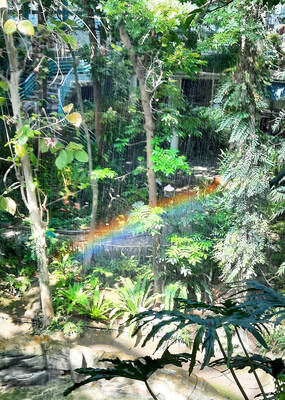
It’s only half the size of its more famous counterpart in Taipei, but the Botanical Garden of the National Museum of Nature Science (NMNS, 國立自然科學博物館植物園) is surely one of urban Taiwan’s most inviting green spaces. Covering 4.5 hectares immediately northeast of the government-run museum in Taichung’s North District (北區), the garden features more than 700 plant species, many of which are labeled in Chinese but not in English. Since its establishment in 1999, the site’s managers have done their best to replicate a number of native ecosystems, dividing the site into eight areas. The name of the Coral Atoll Zone might

Polling data often confirms what we expect, but sometimes it throws up surprises. When examined over time, some patterns appear that speak to something bigger going on. In this column, whenever possible, Formosa’s polls are used. Despite the sometimes cringeworthy antics of Formosa’s Chairman, Wu Tzu-Chia (吳子嘉), the data produced includes detailed breakdowns crucial for analysis. It has also been conducted monthly 11-12 times a year for many years with many of the same questions, allowing for analysis over time. When big shifts do occur between one month and the next it is usually in response to some event in

April 6 to April 13 Few expected a Japanese manga adaptation featuring four tall, long-haired heartthrobs and a plucky heroine to transform Taiwan’s television industry. But Meteor Garden (流星花園) took the nation by storm after premiering on April 12, 2001, single-handedly creating the “idol drama” (偶像劇) craze that captivated young viewers across Asia. The show was so successful that Japan produced its own remake in 2005, followed by South Korea, China and Thailand. Other channels quickly followed suit, with more than 50 such shows appearing over the following two years. Departing from the melodramatic


 RSS
RSS