


For a city that has gained fame its 24-hour lifestyle, Taipei’s first venture last year into the international nighttime festivals that are the annual Nuit Blanche arts extravaganzas was a bit a mess.
The idea behind Nuite Blanche, the first of which was held in Paris in October 2002, is to turn a city into a massive art gallery for a night, exposing contemporary art to a wider audience and encouraging people to explore areas of a city where they might not often go.
Scores of cities around the world now host their own Nuite Blanche on the first Saturday in October.
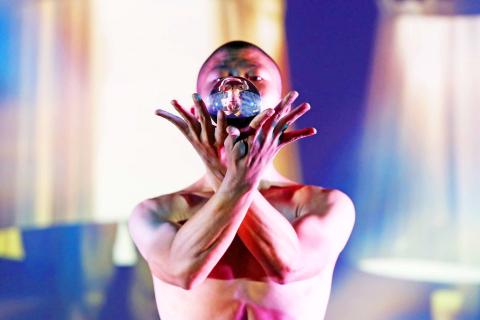
Photo: CNA
Last year’s Nuit Blanche Taipei (臺北白晝之夜) was in the old part of the city, centering around the North Gate (北門) and stretching down to the 228 Peace Memorial Park (228和平公園).
However, a lack of adequate controls and signage meant that large crowds of people roamed somewhat aimlessly, clustering in certain spots, creating traffic hazards as they spilled off the sidewalks and blocked roadways. Many found it difficult to follow the supposed paths from one exhibition or performance to another.
Another complaint was that while the event was to run from 6pm on Saturday until 6am on Sunday, most of the live performances ended well before midnight.
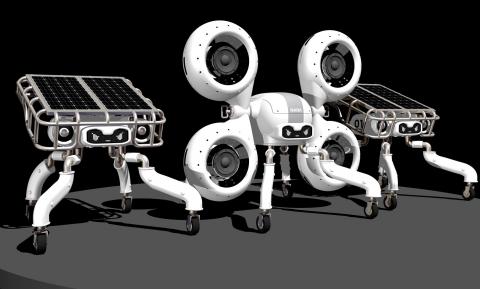
Photo: Liberty Times
Organizers, who include the Taipei Department of Cultural Affairs and several curators, appear to have tried to apply the lessons of last year to this year’s schedule as they moved the whole event from the west side over toward the Gongguan area (公館) and centered it around National Taiwan University, the Taipower Building on Roosevelt Road and the Taipei City Hakka Cultural Park (客家文化主題公園).
However, once again the live shows will end by midnight, although the DJ parties and art installations will go on until 6am.
Organizers are billing Gongguan as “the intersection of independent spirits and multiculturalism,” and say this year’s program is grouped under three major themes: “Electronic Treasure on the Royal Palm Boulevard,” “Independent Treasure on the Streets of Wen-Luo-Ting, and “Cross-cultural Treasure of the Dreamers.”
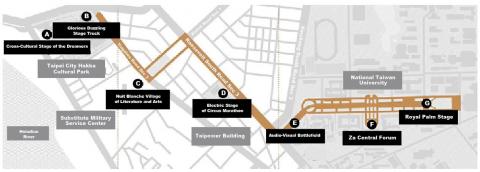
Graphic: TT and Nuit Blanche Taipei
There are seven main performance areas this year, up from last year’s five, with 2km route that runs from what is being called the Royal Palm Stage, Za Central Forum to the Audio-Visual Battlefield, Electric Stage of Circus Marathon, Nuite Blanche Village of Literature and Arts, Glorious Dazzling Stage Truck and ending at the Cross-Cultural Stage of Dreamers.
There will be art installations, including more of Akibo Lee’s (李明道) robots, performances by foreign and Taiwanese artists such as former Cirque du Soleil performer Chen Hsing-ho (陳星合), musicians ranging from the Taipei Chinese Orchestra (臺北市立國樂團) to the Muddy Basin Ramblers to Aboriginal performers to the solar-powered robot band SIAMSIAM to a “Battle Jam,” far too much to cover in this limited space.
However, the organizers have created a great Web site (nuitblanche.taipei) in Chinese and English, with maps, list of programs and schedule, a transportation guide and an app.
However, it is not just the Gongguan area that will be hopping on Saturday night. More than 30 museums and cultural facilities will open till midnight, including the National Palace Museum, the Presidential Office Building, the Taipei Fine Arts Museum and the Museum of Contemporary Arts, Taipei.


The US war on Iran has illuminated the deep interdependence of Asia on flows of oil and related items as raw materials that become the basis of modern human civilization. Australians and New Zealanders had a wake up call. The crisis also emphasizes how the Philippines is a swatch of islands linked by jet fuel. These revelations have deep implications for an invasion of Taiwan. Much of the commentary on the Taiwan scenario has looked at the disruptions to world trade, which will be in the trillions. However, the Iran war offers additional specific lessons for a Taiwan scenario. An insightful
It’s only half the size of its more famous counterpart in Taipei, but the Botanical Garden of the National Museum of Nature Science (NMNS, 國立自然科學博物館植物園) is surely one of urban Taiwan’s most inviting green spaces. Covering 4.5 hectares immediately northeast of the government-run museum in Taichung’s North District (北區), the garden features more than 700 plant species, many of which are labeled in Chinese but not in English. Since its establishment in 1999, the site’s managers have done their best to replicate a number of native ecosystems, dividing the site into eight areas. The name of the Coral Atoll Zone might

On Monday morning, in quick succession, the Chinese Communist Party (CCP) and the Chinese Nationalist Party (KMT) released statements announcing “that the Central Committee of the Communist Party of China and General Secretary Xi Jinping (習近平) have invited KMT Chairwoman Cheng Li-wun (鄭麗文) to lead a delegation on a visit to the mainland” as the KMT’s press release worded it. The KMT’s press release added “Chairwoman Cheng expressed her gratitude for the invitation and has gladly accepted it.” Beijing’s official Xinhua news release described Song Tao (宋濤), head of the Taiwan Work Office of the CCP Central Committee, as
Polling data often confirms what we expect, but sometimes it throws up surprises. When examined over time, some patterns appear that speak to something bigger going on. In this column, whenever possible, Formosa’s polls are used. Despite the sometimes cringeworthy antics of Formosa’s Chairman, Wu Tzu-Chia (吳子嘉), the data produced includes detailed breakdowns crucial for analysis. It has also been conducted monthly 11-12 times a year for many years with many of the same questions, allowing for analysis over time. When big shifts do occur between one month and the next it is usually in response to some event in


 RSS
RSS