


Discovered in Ingmar Bergman’s archive, a previously unknown manuscript about sexual and social revolution in the 1960s is to be turned into a movie, nearly a decade after the Swedish director’s death. Sixty-four minutes with Rebecka, written by the legendary filmmaker when he was aged 51, was found in 2002 when Bergman donated his work to an institute in his name, shelved among thousands of letters, completed screenplays and photographs.
“Finding an unknown but finished Ingmar Bergman screenplay would be the equivalent of finding a manuscript by Hemingway or if not Shakespeare,” Jan Holmberg, head of the Ingmar Berman Foundation, told AFP.
Known for broaching issues of death, loneliness and religious self-doubt, Bergman portrays the main character Rebecka as an emotionally alienated teacher of deaf mutes, seeking sexual and political liberation during the tumultuous 1960s.
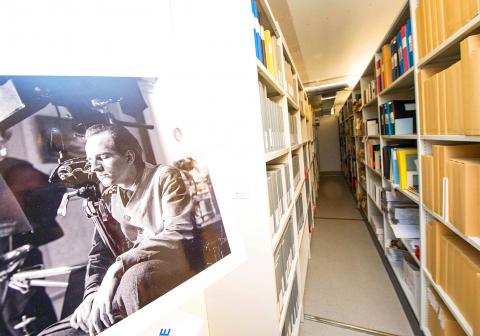
Photo: AFP/Jonathan Nackstrand
“This is the mature artist at his very best, making one of his masterpieces,” Holmberg said. The married Rebecka visits a sex club while she is pregnant and decides to leave her forgiving husband in the hand-written script, which touches on gay relationships, desire, guilt and mental suffering.
Bergman, who was an introverted and conservative filmmaker, portrays the era’s frenetic sexual and social revolution in the script, which was originally meant to be a movie collaboration between Bergman, Federico Fellini and Akira Kurosawa, a trio of directing giants.
HOLLYWOOD BLOW
Fellini had contacted Bergman in 1962 to ask if the Swedish director would be interested in filming a joint movie series with Kurosawa, who years later dropped out for unknown reasons, according to Holmberg. In 1968, Bergman and Fellini signed a Hollywood contract to turn the script into a joint motion picture, but when the Italian screenwriter did not keep his part of the agreement, Bergman was offered to direct the film by himself.
Suffering a major blow to profits because of the emergence and dominance of television in the 1960s, the US film industry began to diversify, drawing inspiration from European cinema. Holmberg said several letters sent back and forth between Bergman and movie executives indicated “an increasingly irritated atmosphere, where the movie companies suddenly wanted the film to be longer than what had been thought earlier” to turn it into a TV series.
He noted that the script has “many daring sex scenes, homosexuality and violent sexuality... which would never have been shown on American TV in the 60s.”
‘TURN IN HIS GRAVE’
Adapted into a radio play which premiered in Sweden on Nov. 6, the script was directed by 72-year-old Suzanne Osten, a renowned Swedish filmmaker who had a conflicted relationship with Bergman throughout her career.
“We had a few confrontations and he was generally known as controlling, but no one has ever questioned his quality as a filmmaker and artist,” Osten told AFP. “I would never have made it if he lived today. He was a conservative old man and became even more conservative. But he was also a very sensitive artist,” said Osten, who is set to direct the movie adaptation of 64 minutes with Rebecka in 2018.
Holmberg said Bergman would probably have “turned in his grave” if he knew Osten was directing the script, but later “calm down and realize that this is a pretty fantastic way to continue his legacy.
“He and Susanne were often enemies and stood on opposite sides in the political and cultural rebellion at the end of the 60s,” he added.
“She is younger than Bergman was and stands for something different... This will be a feminist reinterpretation of Bergman,” Holmberg said. The son of a Lutheran minister and a nurse, Bergman was born in 1918 in the Swedish town of Uppsala, north of Stockholm, and had a strict religious upbringing, noticeable in many of his films. Bergman, who married five times and had nine children, also directed the psychological drama Persona (1966), The Seventh Seal (1957) and Fanny and Alexander (1982), which won four Academy Awards in 1984. He died in 2007 at the age of 89 in Faro, a Swedish island in the Baltic Sea where he filmed several of his movies.


The US war on Iran has illuminated the deep interdependence of Asia on flows of oil and related items as raw materials that become the basis of modern human civilization. Australians and New Zealanders had a wake up call. The crisis also emphasizes how the Philippines is a swatch of islands linked by jet fuel. These revelations have deep implications for an invasion of Taiwan. Much of the commentary on the Taiwan scenario has looked at the disruptions to world trade, which will be in the trillions. However, the Iran war offers additional specific lessons for a Taiwan scenario. An insightful

The problem with Marx’s famous remark that history repeats itself, first as tragedy, the second time as farce, is that the first time is usually farce as well. This week Chinese Nationalist Party (KMT) Chair Cheng Li-wun (鄭麗文) made a pilgrimage to the People’s Republic of China (PRC) “to confer, converse and otherwise hob-nob” with Chinese Communist Party (CCP) officials. The visit was an instant international media hit, with major media reporting almost entirely shorn of context. “Taiwan’s main opposition leader landed in China Tuesday for a rare visit aimed at cross-strait ‘peace’”, crowed Agence-France Presse (AFP) from Shanghai. Rare!

April 6 to April 13 Few expected a Japanese manga adaptation featuring four tall, long-haired heartthrobs and a plucky heroine to transform Taiwan’s television industry. But Meteor Garden (流星花園) took the nation by storm after premiering on April 12, 2001, single-handedly creating the “idol drama” (偶像劇) craze that captivated young viewers across Asia. The show was so successful that Japan produced its own remake in 2005, followed by South Korea, China and Thailand. Other channels quickly followed suit, with more than 50 such shows appearing over the following two years. Departing from the melodramatic

Sunflower movement superstar Lin Fei-fan (林飛帆) once quipped that the Democratic Progressive Party (DPP) could nominate a watermelon to run for Tainan mayor and win. Conversely, the DPP could run a living saint for mayor in Taipei and still lose. In 2022, the DPP ran with the closest thing to a living saint they could find: former Minister of Health and Welfare Chen Shih-chung (陳時中). During the pandemic, his polling was astronomically high, with the approval of his performance reaching as high as 91 percent in one TVBS poll. He was such a phenomenon that people printed out pop-up cartoon


 RSS
RSS