


Cubanos, or Cuban sandwiches, have become somewhat of a thing in Taiwan ever since Jon Favreau served them from a food truck in the 2014 winter movie Chef.
Few places seem to get it right, though, usually going too heavy or sweet with the sauces (it’s said that a true cubano should only contain mustard) or using the wrong type of bread. But really, authenticity should not be something to dwell on as even US restaurants often suggest their own take on the prototypical version that Cuban workers in Florida ate. The point is, that I have yet to sample a cubano in Taiwan that is up to par.
This quest brought my friend and me to Borracho & Wok, a small gastropub tucked into an alley behind Zhongxiao E Rd, which is rumored to have excellent Cuban sandwiches. The restaurant also exercises its creativity, as its offerings include a spicy peanut butter and bacon version (NT$180) and a raw beef and truffle (NT$250) invention.
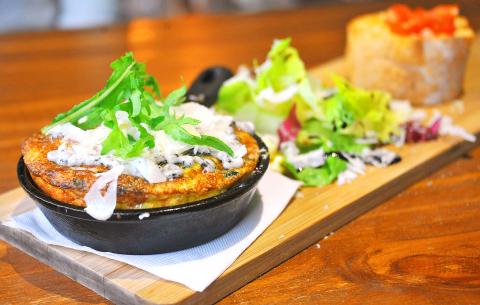
Photo: Han Cheung, Taipei Times
I later find out that it’s actually owned by celebrity chef Chen Wei-kang (陳偉剛), but that’s really irrelevant for people who don’t watch local television shows. As borracho means “drunk” in Spanish, the place has a pretty extensive alcohol menu (Alpenkaiser Weizenbier or red wine for brunch, anyone?), and the wok part refers to the many dishes that are served in cast iron skillets. To get the full experience, we order the raw beef cubano and a spinach frittata with truffle and chorizo (NT$260) in a skillet. You can add NT$90 for a salad, chips and a drink to go with the sandwich.
For appetizers, we chose the deep fried squid ink and risotto balls (NT$230), which were filled with melted cheese, squid bits and lots of garlic. They are perfectly fried with just the right amount of crispiness and the rice is sticky yet firm, creating layers of textures when paired with the runny cheese and squid. The garlic is the main flavor here, with a touch of saltiness. The distribution of squid is a bit uneven, however, as one of the balls only contained one tiny piece.
The frittata was fluffy in the inside, balanced with the bits of chorizo and spinach. It’s topped with the slightly sharp padano cheese, which pleasantly melts into the egg. The dish leans toward the sweet side again as the top is coated with truffle mayonnaise — fortunately the chef shows restraint and keeps it light.
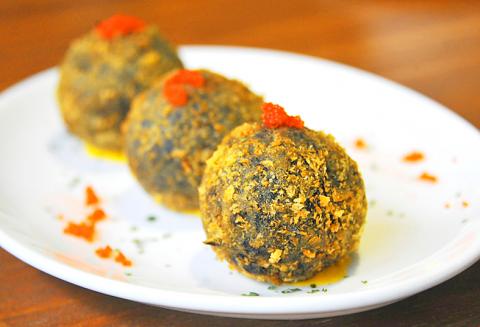
Photo: Han Cheung, Taipei Times
The cubano was expectedly not authentic, but it did not disappoint. As most Taiwanese versions of foreign food go, it featured a sweeter palate with the truffle relish. There’s lots of cheese, which contains both the stringy and liquidy type — personally I would have just preferred stringy as there is already the relish that softens the bread, which was developed by the Japanese executive chef while he was training in South America. It does resemble Cuban bread (which is similar to French bread) despite being slightly crunchier, and pairs well with the rest of the ingredients. Even though the beef did not come exactly raw, it didn’t matter as it was tender and flavorful. And it does contain ham — which is the staple of a cubano and cannot be omitted.
The side salad was refreshing — many local establishments tend to overdo the dressing and toppings, but this one treaded lightly, featuring only with raw mozzarella bits, thin slices of padano and dashes of olive oil and vinaigrette.
Overall, it was not exactly the cubano I was looking for, but I did leave Borracho and Wok satisfied as the food was intricate and not too heavy. Maybe this is good enough, and if I want a real Cuban sandwich I should head to Miami.
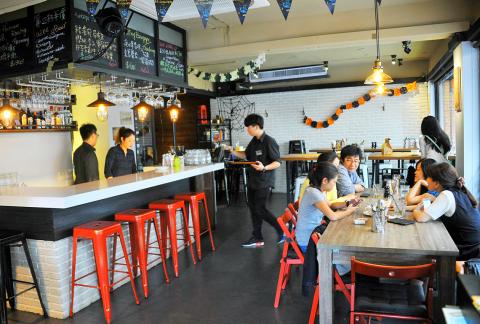
Photo: Han Cheung, Taipei Times

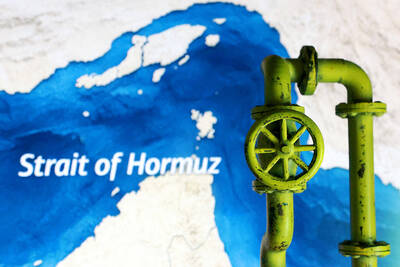
The US war on Iran has illuminated the deep interdependence of Asia on flows of oil and related items as raw materials that become the basis of modern human civilization. Australians and New Zealanders had a wake up call. The crisis also emphasizes how the Philippines is a swatch of islands linked by jet fuel. These revelations have deep implications for an invasion of Taiwan. Much of the commentary on the Taiwan scenario has looked at the disruptions to world trade, which will be in the trillions. However, the Iran war offers additional specific lessons for a Taiwan scenario. An insightful
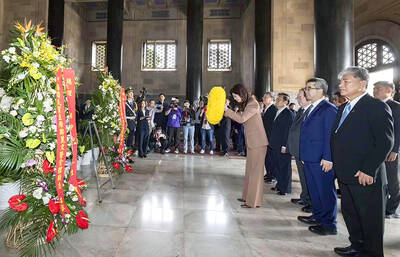
The problem with Marx’s famous remark that history repeats itself, first as tragedy, the second time as farce, is that the first time is usually farce as well. This week Chinese Nationalist Party (KMT) Chair Cheng Li-wun (鄭麗文) made a pilgrimage to the People’s Republic of China (PRC) “to confer, converse and otherwise hob-nob” with Chinese Communist Party (CCP) officials. The visit was an instant international media hit, with major media reporting almost entirely shorn of context. “Taiwan’s main opposition leader landed in China Tuesday for a rare visit aimed at cross-strait ‘peace’”, crowed Agence-France Presse (AFP) from Shanghai. Rare!
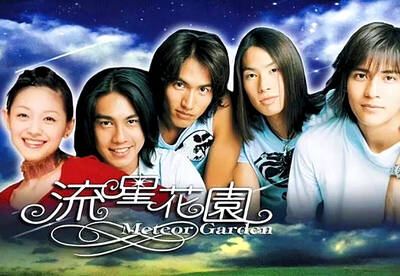
April 6 to April 13 Few expected a Japanese manga adaptation featuring four tall, long-haired heartthrobs and a plucky heroine to transform Taiwan’s television industry. But Meteor Garden (流星花園) took the nation by storm after premiering on April 12, 2001, single-handedly creating the “idol drama” (偶像劇) craze that captivated young viewers across Asia. The show was so successful that Japan produced its own remake in 2005, followed by South Korea, China and Thailand. Other channels quickly followed suit, with more than 50 such shows appearing over the following two years. Departing from the melodramatic

Sunflower movement superstar Lin Fei-fan (林飛帆) once quipped that the Democratic Progressive Party (DPP) could nominate a watermelon to run for Tainan mayor and win. Conversely, the DPP could run a living saint for mayor in Taipei and still lose. In 2022, the DPP ran with the closest thing to a living saint they could find: former Minister of Health and Welfare Chen Shih-chung (陳時中). During the pandemic, his polling was astronomically high, with the approval of his performance reaching as high as 91 percent in one TVBS poll. He was such a phenomenon that people printed out pop-up cartoon


 RSS
RSS