


Two scholars said Tuesday that they believe that an old sketchbook containing 65 drawings is an authentic work by Vincent van Gogh, and was created by that Post-Impressionist in Arles, France, where he made many of his famous and beloved paintings.
The scholars, Bogomila Welsh-Ovcharov, a University of Toronto professor emeritus of art history, and Ronald Pickvance, who has written two books on the artist, spoke as Welsh-Ovcharov announced the release of her book about the drawings, Vincent van Gogh: The Lost Arles Sketchbook.
But experts at the Van Gogh Museum in Amsterdam, which owns the largest collection of van Gogh artworks, immediately said that they disagreed with the scholars and that they view the drawings as most likely imitations by another artist.
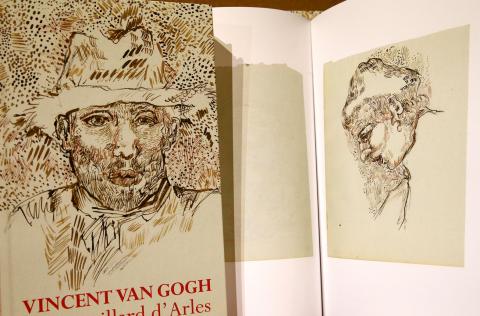
Photo: REUTERS
“In our opinion, it’s not authentic,” said Louis van Tilborgh, a senior researcher at the Van Gogh Museum. “Owners of the sketchbook have asked our opinion in 2007 and 2012 again, and we studied the iconography, style and technique, and studied the provenance, and we came to the conclusion that it’s not by him. We have not changed our opinion.”
Van Tilborgh said, for example, that the drawings were made with brown ink, while van Gogh always worked with black or purple ink.
The announcement drew attention because Pickvance and Welsh-Orcharov are highly respected van Gogh scholars. Welsh-Ovcharov, 77, has curated exhibitions on van Gogh at the Musee d’Orsay in Paris and other museums. Pickvance organized two van Gogh exhibitions at the Metropolitan Museum of Art.
Pickvance said in a phone interview that there was no chance the book or the 65 drawings are forgeries. “These are absolutely OK, from one to 65,” he said. “End of song, end of story.”
Welsh-Ovcharov said that she first encountered the sketchbook in 2013, and spent three years tracking its history. She said that she believed the sketchbook had been given to the proprietors of the Cafe de Gare, a cafe and inn where van Gogh lived in Arles from May to early September 1888, by Felix Rey, a doctor who treated van Gogh. Not a typical artist’s sketchbook, it was a commercial ledger that Welsh-Ovcharov said had probably been given to van Gogh by the cafe’s owners, Joseph and Marie Ginoux, and was later returned by the doctor, filled with van Gogh’s creations, after the artist had been admitted to an asylum.
Welsh-Ovcharov said that this version of events was supported by a cafe’s employee datebook that she had reviewed and that has information on the cafe and the Ginoux family.
In an entry for May 20, 1890, the datebook says “Monsieur Doctor Rey left for M. and Mme. Ginoux from the painter Van Goghe [sic] some empty olive boxes and a bundle of checked towels as well as a large book of drawings and apologizes for the delay.”
The documents were later passed down to a Ginoux niece, Marguerite Crevoulin, according to Welsh-Ovcharov’s account.
Van Tilborgh said that he viewed the datebook as an “unreliable source.”
“The suggestion,” the museum said in a statement, “is that Rey had visited van Gogh in the asylum in Saint-Remy, but there is no evidence that this physician remained in contact with van Gogh at all after the latter’s admission to the asylum.”
Welsh-Ovcharov said the sketchbook remained with the Ginoux family until 1944. The sketchbook and the datebook were recovered from a Ginoux family home by a neighbor who did not know what they were, Welsh-Ovcharov said. The neighbor later gave the sketchbook to her daughter, the current owner, as a birthday present in the 1960s.
The current owner was not aware of what she had until someone suggested she take them to an expert, Welsh-Ovcharov said.
“These are very simple people and it was just by quirk of fate that they showed it to someone in the region who knew a local art specialist,” she said. “They took 30 of them and ripped them out of the book.”
The specialist, Franck Baille, an art historian and author from Aix-en-Provence who is director of a Monte Carlo auction house, then shared them with Welsh-Ovcharov, who has spent summers in Provence for the past 20 years.
“My first feeling was an incredible overwhelming feeling that I know what I have in my hands,” she said. “But then, of course, I knew I needed to do the scholarship.”
The sketchbook contains a portrait of van Gogh; sketches of Paul Gauguin; and sketches of the Yellow House, where van Gogh once lived; Langlois Bridge; seascapes at Saintes-Maries-de-la-Mer; and other major landmarks from paintings now among the artist’s most beloved artworks.
“Vincent van Gogh: The Lost Arles Sketchbook” is published in French by Editions de Seuil in Paris, and will be released simultaneously in English, German and Dutch, with other languages to follow. The English version is published by Abrams in Britain and the US.

The US war on Iran has illuminated the deep interdependence of Asia on flows of oil and related items as raw materials that become the basis of modern human civilization. Australians and New Zealanders had a wake up call. The crisis also emphasizes how the Philippines is a swatch of islands linked by jet fuel. These revelations have deep implications for an invasion of Taiwan. Much of the commentary on the Taiwan scenario has looked at the disruptions to world trade, which will be in the trillions. However, the Iran war offers additional specific lessons for a Taiwan scenario. An insightful
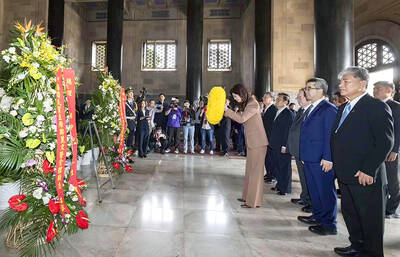
The problem with Marx’s famous remark that history repeats itself, first as tragedy, the second time as farce, is that the first time is usually farce as well. This week Chinese Nationalist Party (KMT) Chair Cheng Li-wun (鄭麗文) made a pilgrimage to the People’s Republic of China (PRC) “to confer, converse and otherwise hob-nob” with Chinese Communist Party (CCP) officials. The visit was an instant international media hit, with major media reporting almost entirely shorn of context. “Taiwan’s main opposition leader landed in China Tuesday for a rare visit aimed at cross-strait ‘peace’”, crowed Agence-France Presse (AFP) from Shanghai. Rare!
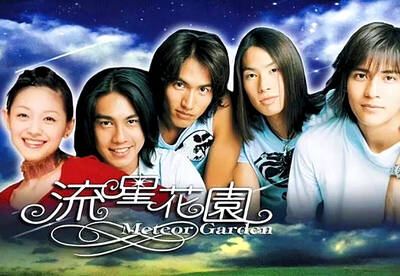
April 6 to April 13 Few expected a Japanese manga adaptation featuring four tall, long-haired heartthrobs and a plucky heroine to transform Taiwan’s television industry. But Meteor Garden (流星花園) took the nation by storm after premiering on April 12, 2001, single-handedly creating the “idol drama” (偶像劇) craze that captivated young viewers across Asia. The show was so successful that Japan produced its own remake in 2005, followed by South Korea, China and Thailand. Other channels quickly followed suit, with more than 50 such shows appearing over the following two years. Departing from the melodramatic

Sunflower movement superstar Lin Fei-fan (林飛帆) once quipped that the Democratic Progressive Party (DPP) could nominate a watermelon to run for Tainan mayor and win. Conversely, the DPP could run a living saint for mayor in Taipei and still lose. In 2022, the DPP ran with the closest thing to a living saint they could find: former Minister of Health and Welfare Chen Shih-chung (陳時中). During the pandemic, his polling was astronomically high, with the approval of his performance reaching as high as 91 percent in one TVBS poll. He was such a phenomenon that people printed out pop-up cartoon


 RSS
RSS