


Ernest Clayton, who served in the UK’s 125th anti-tank regiment royal artillery during World War II, was not fond of curry rice. The dish was one of his son Mike’s favorites, who often wondered about his father’s aversion to it.
It wasn’t until after Ernest passed away in 2001 that Mike read his war diary and found out that meager portions of rice and stew was almost all his father had to eat during almost three years as a prisoner of war (POW) in Taiwan under the Japanese. Being forced to perform hard labor and often beaten, Mike says that in the diary, his father seemed very happy whenever there was different food, such as when pork innards were added to the stew on Christmas Day, 1942.
Arriving in Taiwan on Saturday, Mike saw his father’s name on the Taiwan POW memorial near the Kinkaseki camp in New Taipei City’s Jinguashi (金瓜石) for the first time on Sunday.
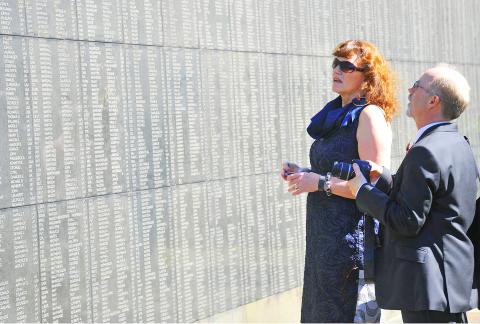
Photo: Han Cheung, Taipei Times
“You’re not quite sure what you’re going to think. And then you see his name, it brings tears to your eyes,” he tells the Taipei Times.
Mike and two other children of former Taiwan POWs visited Taiwan for the first time last week to participate in the Taiwan POW Memorial Society’s Remembrance Day service at the Kinkaseki memorial. They also toured several of the 14 POW camps that stretch from the north coast to Kaohsiung, which combined held approximately 4,350 Allied prisoners captured from various battlegrounds. More than 10 percent died in captivity due to harsh conditions.
NEVER TALK ABOUT IT

Photo: Han Cheung, Taipei Times
Most of these World War II soldiers are no longer alive, but their descendants, looking for answers to a past their fathers seldom discussed, continue to visit Taiwan — mostly after stumbling across the society’s Web site.
Caroline Little says her father, Andrew Hiddleston of the 155th Field Regiment Royal Artillery, would encourage her to visit Malaya (today’s continental Malaysia and Singapore), telling her of all the beautiful things to see. He was captured by the Japanese during the fall of Singapore.
“He would have never advised me to come to Taiwan, because his memory here was not [positive],” Little says.
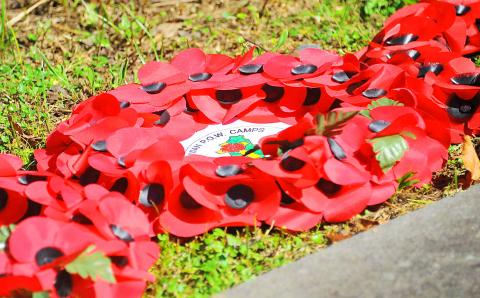
Photo: Han Cheung, Taipei Times
In November 1942, Hiddleston was transferred to Kinkaseki to work at the Japanese Empire’s largest copper mine. The only time he would open up about this period was on Remembrance Day, when he would attend the local memorial service and reminisce with other veterans. But he mostly talked about the interesting things he saw, such as underground rainbow-colored pools (from petrol) and the stalagmites and stalactites in the mines.
“Once I got older, I realized he didn’t want to talk about it and I stopped asking about it,” she says. “We knew that he didn’t have enough food, and that was it.”
Robert Forrester of the Indian Army Corps of Clerks also toiled in Kinkaseki. As the threat of an Allied invasion grew, the prisoners were moved inland to Kukutsu, located south of Sindian District (新店). Taiwan POW Society founder Michael Hurst writes on its Web site that this was basically an extermination camp, with conditions even worse than that of Kinkaseki.
Unlike Hiddleston, Forrester told his daughter Joy Sheldon about his suffering.
“From the few things he said … [I knew] obviously how cruel the [Japanese and Taiwanese] guards were,” she says. “How they had very little rest … the guards would come through and wake them up and beat them on any excuse.”
“If he were alive today he would have said, ‘Don’t come back. There’s no need to come back,’” she adds. “But he’s not alive and I wanted to come.”
FILLING THE GAPS
Ernest Clayton’s diary was a mostly factual detailing of what they ate and the work they did. But a few bits hinted of the hardship. He writes how he felt that Singapore’s River Valley Road Camp was a “holiday” compared to that of Taiwan. In another part he describes a prisoner escape, where the escapees were captured and killed.
Standing under a hot November sun on a hill overlooking Kinkaseki, Mike could only imagine what it was like to toil here during the summer months.
Ernest never stayed at Kinkaseki, but Little and Sheldon took a ride up the rugged mountain path that their fathers traversed to the mines every day, which Hurst writes was a “huge effort considering the poor physical condition of the men.”
They also visited the mines, where the POWs worked in “places so hot and dangerous that Taiwanese and Japanese miners refused to go,” as well as the tunnel where the prisoners were to be exterminated in the event of an Allied invasion.
Little also learned that she had many facts wrong. Her father would tell a story of how he was rescued by US airmen who gave the prisoners food against orders after seeing how emaciated they were. Since they were rescued by airmen, Little believed that they were flown out — but in fact they left on an aircraft carrier.
“It’s nice to be able to piece things together,” she says.
And until the end, Little says that her father didn’t show bitterness.
“He tried to convey that the Japanese simply lived by a different philosophy from us,” she says.
“That loss of face was the most terrible humiliation for them, and behaving honorably was imperative. It was simply that their idea of honorable was somewhat different from us.”

The US war on Iran has illuminated the deep interdependence of Asia on flows of oil and related items as raw materials that become the basis of modern human civilization. Australians and New Zealanders had a wake up call. The crisis also emphasizes how the Philippines is a swatch of islands linked by jet fuel. These revelations have deep implications for an invasion of Taiwan. Much of the commentary on the Taiwan scenario has looked at the disruptions to world trade, which will be in the trillions. However, the Iran war offers additional specific lessons for a Taiwan scenario. An insightful
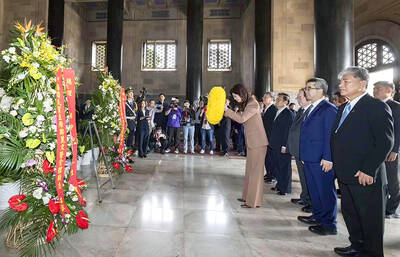
The problem with Marx’s famous remark that history repeats itself, first as tragedy, the second time as farce, is that the first time is usually farce as well. This week Chinese Nationalist Party (KMT) Chair Cheng Li-wun (鄭麗文) made a pilgrimage to the People’s Republic of China (PRC) “to confer, converse and otherwise hob-nob” with Chinese Communist Party (CCP) officials. The visit was an instant international media hit, with major media reporting almost entirely shorn of context. “Taiwan’s main opposition leader landed in China Tuesday for a rare visit aimed at cross-strait ‘peace’”, crowed Agence-France Presse (AFP) from Shanghai. Rare!
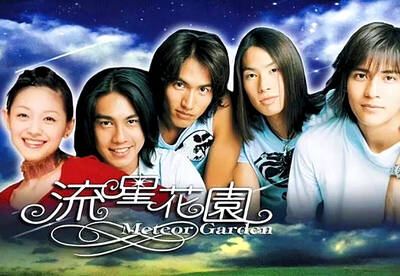
April 6 to April 13 Few expected a Japanese manga adaptation featuring four tall, long-haired heartthrobs and a plucky heroine to transform Taiwan’s television industry. But Meteor Garden (流星花園) took the nation by storm after premiering on April 12, 2001, single-handedly creating the “idol drama” (偶像劇) craze that captivated young viewers across Asia. The show was so successful that Japan produced its own remake in 2005, followed by South Korea, China and Thailand. Other channels quickly followed suit, with more than 50 such shows appearing over the following two years. Departing from the melodramatic
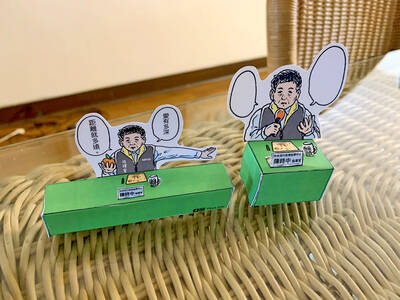
Sunflower movement superstar Lin Fei-fan (林飛帆) once quipped that the Democratic Progressive Party (DPP) could nominate a watermelon to run for Tainan mayor and win. Conversely, the DPP could run a living saint for mayor in Taipei and still lose. In 2022, the DPP ran with the closest thing to a living saint they could find: former Minister of Health and Welfare Chen Shih-chung (陳時中). During the pandemic, his polling was astronomically high, with the approval of his performance reaching as high as 91 percent in one TVBS poll. He was such a phenomenon that people printed out pop-up cartoon


 RSS
RSS